

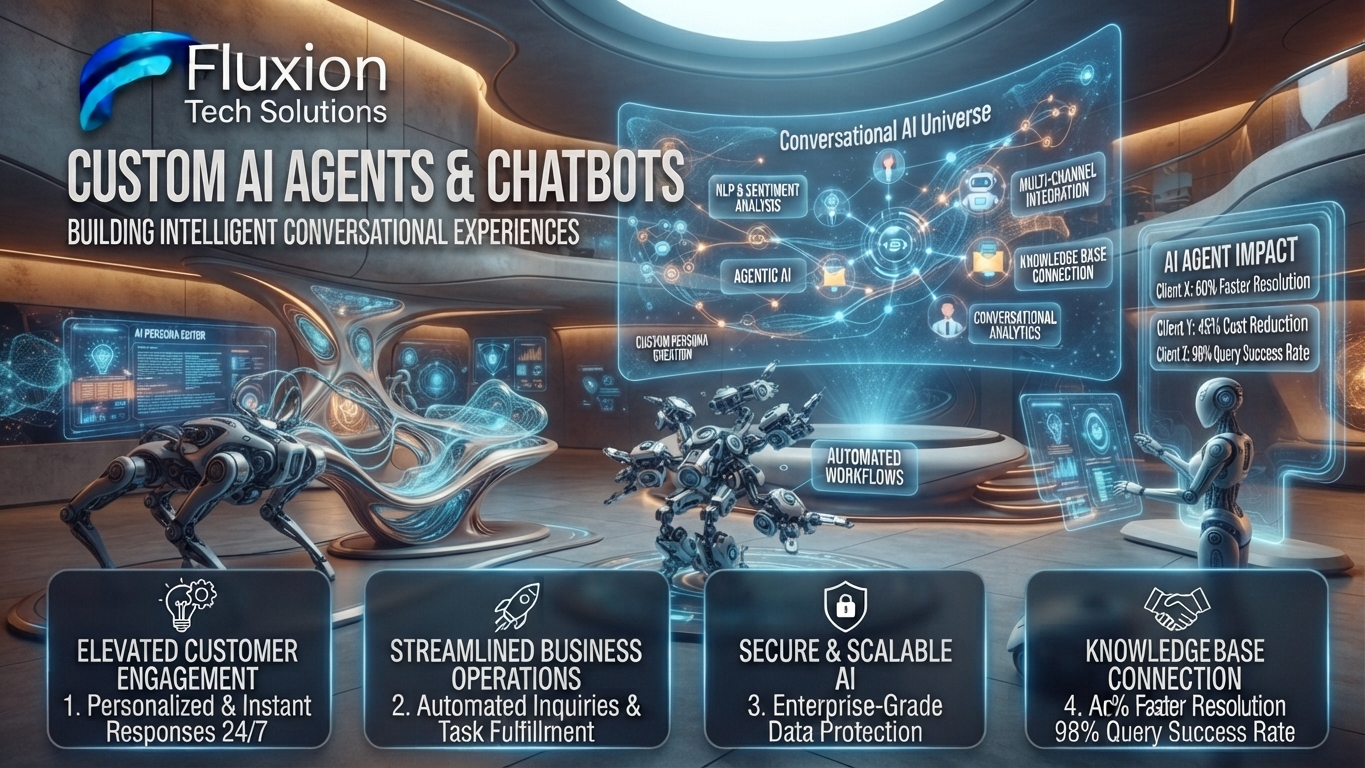
Custom AI Agents & Chatbots: Transforming Business Communication
Artificial intelligence is changing how businesses communicate with customers and manage their daily operations. Companies are looking for smarter ways to answer questions, provide support, handle repetitive tasks, and improve productivity. AI-powered tools are becoming valuable because they can assist users quickly and help organizations manage different activities more efficiently.
Custom AI Agents & Chatbots provide businesses with flexible solutions designed around their specific requirements. They can answer customer questions, guide visitors, support employees, retrieve information, and automate selected business processes.
Unlike basic automated systems, modern AI solutions can use natural language processing and other artificial intelligence technologies to understand requests and generate relevant responses. Fluxion Tech Solutions ↗ recognizes the importance of modern AI technologies in helping businesses improve digital experiences and operational efficiency.
What Are Custom AI Agents & Chatbots?Custom AI agents and chatbots are software solutions developed to perform specific tasks through conversations, instructions, or automated workflows.
A chatbot is generally designed to communicate with users through text or voice. It can answer common questions, provide information, guide customers, and direct users toward suitable services.
An AI agent can perform a wider range of tasks. Depending on its design and permissions, it may retrieve information, use connected tools, follow instructions, and complete specific actions.
Custom solutions are designed according to a company's industry, services, workflows, and customer needs. This makes them more suitable for particular business requirements than generic conversational tools.
Difference Between AI Chatbots and AI AgentsAlthough these terms are sometimes used together, they have different roles.
AI Chatbots: Chatbots mainly focus on conversations. They answer questions, provide information, and guide users through predefined or AI-generated interactions.
AI Agents: AI agents can work toward specific goals by completing multiple steps. They may use connected systems, retrieve information, and perform approved tasks.
For example, a customer support chatbot may explain a company's return policy. An AI agent could potentially check an order through an authorized system and help initiate a return request.
The right choice depends on the complexity of the task and the level of automation a business requires.
Benefits of Custom AI Agents & Chatbots1. Faster Customer SupportCustomers often need quick answers about products, services, payments, or business policies. AI chatbots can respond to common questions without requiring customers to wait for a human representative.
For more complicated issues, they can direct users to the appropriate support team.
2. Business Process AutomationAI agents can help automate repetitive activities such as collecting information, organizing requests, retrieving records, and supporting routine workflows.
This can reduce manual effort and allow employees to focus on tasks that require human judgment.
3. Improved Customer ExperienceA well-designed chatbot can provide consistent information and guide customers through different steps. Personalized responses based on available customer information can also make interactions more relevant.
4. Continuous AvailabilityAI chatbots can provide automated assistance outside normal business hours. This allows customers to access basic information even when human support representatives are unavailable.
However, complex issues may still require assistance from a person.
5. Better Operational EfficiencyBusinesses can use AI tools to support internal teams, organize information, and reduce repetitive communication. This can improve workflows and help employees manage their responsibilities.
Common Uses of AI Agents and ChatbotsDifferent industries can use AI-powered systems in several ways.
E-commerce: Chatbots can answer product questions, explain delivery information, and guide customers through shopping processes.
Healthcare: AI assistants can provide general service information, explain appointment procedures, and help users find relevant resources. Sensitive medical decisions should remain under qualified professional supervision.
Education: Educational chatbots can answer common questions, provide learning resources, and guide students through administrative processes.
Real Estate: AI assistants can collect property requirements, share available listing information, and help arrange inquiries.
Finance: Businesses can use AI tools to answer general service questions and guide customers through basic processes while applying appropriate privacy and security controls.
Customer Service: AI-powered assistants can manage frequently asked questions, collect support requests, and route complicated problems to human representatives.
Important Features of Custom AI ChatbotsA successful chatbot should provide useful features that match the business's needs.
Natural Language UnderstandingNatural language processing helps chatbots interpret user messages and understand the meaning behind common questions.
Personalized ResponsesCustom chatbots can use relevant business information and approved customer context to provide more useful responses.
Website IntegrationBusinesses can integrate chatbots into their websites so visitors can ask questions without leaving the page.
Multilingual SupportDepending on the selected AI model and implementation, chatbots can communicate in multiple languages to support different audiences.
Knowledge Base IntegrationA chatbot can use approved business documents, product details, service information, and frequently asked questions to provide relevant answers.
Human Support HandoverWhen a chatbot cannot resolve an issue, it should provide a clear way for the customer to contact a human support representative.
How AI Agents WorkAI agents typically combine several technologies to complete tasks.
First, they receive an instruction or user request. The AI model then interprets the request and determines an appropriate response or action.
If the system has access to approved tools, it may retrieve information from a database, check records, or interact with connected software.
The agent processes the available information and returns a response or completes the permitted task.
For example, a business may develop an AI agent that receives a customer inquiry, checks product availability through an authorized system, and provides the relevant information.
Businesses should define clear permissions and approval requirements, especially when an agent can access important records or perform actions that affect customers.
Steps to Develop Custom AI Agents & ChatbotsCreating a useful AI solution requires planning and a structured development process.
1. Identify Business RequirementsStart by understanding the problems the AI system should solve. Identify the target users, common questions, repetitive tasks, and expected results.
2. Choose the Right AI TechnologySelect suitable AI models, frameworks, and tools according to the project's requirements. The technology should support the intended tasks and integration needs.
3. Prepare Business DataOrganize relevant company information, such as service descriptions, policies, product details, and frequently asked questions. Accurate information helps improve response quality.
4. Design the Conversation FlowPlan how users will interact with the system. Clear instructions, useful responses, and appropriate error handling help create a better experience.
5. Integrate Business SystemsWhere required, connect the AI solution with approved platforms such as websites, customer management systems, databases, or internal software.
6. Test and ImproveTest the system using realistic questions and business scenarios. Review incorrect responses, security risks, and workflow problems before making it available to users.
7. Launch and MonitorAfter deployment, monitor performance and collect feedback. Regular updates help maintain accuracy and improve the system as business requirements change.
Security and Privacy ConsiderationsAI systems may interact with customer information, company documents, and internal business platforms. Protecting this information should be a priority.
Businesses should apply appropriate access controls, secure data connections, and clear data-handling policies. Sensitive information should only be accessible to authorized users and systems.
AI agents should also have limited permissions. Important actions, such as approving payments or changing customer records, may require human confirmation.
Regular testing and monitoring can help identify security weaknesses and reduce the risk of incorrect or unauthorized actions.
Challenges of Implementing AI SolutionsAlthough AI agents and chatbots offer useful opportunities, businesses may face some challenges.
One challenge is response accuracy. AI systems can sometimes generate incorrect or incomplete information, so businesses should test responses and provide reliable knowledge sources.
Another challenge is integration. Connecting an AI solution with existing business software may require additional technical work.
Data privacy, development costs, ongoing maintenance, and employee training also need attention.
A clear implementation plan helps organizations select appropriate features and manage these challenges effectively.
Future of Custom AI Agents & ChatbotsArtificial intelligence continues to develop, creating new opportunities for business automation and digital communication.
Future AI solutions are expected to support more advanced workflows, better integration with business systems, and more personalized interactions.
Voice-based assistants, intelligent search, automated reporting, and AI-powered customer service are examples of areas where businesses may find additional value.
Organizations that carefully adopt AI technologies can improve selected processes while maintaining human oversight for important decisions.
Why Choose Fluxion Tech Solutions?Choosing the right development approach is important when creating custom AI systems. Businesses should consider their goals, existing software, data requirements, security needs, and expected user experience.
Fluxion Tech Solutions focuses on modern technology and software development solutions that support business needs. Custom AI development should prioritize practical functionality, reliable integration, clear workflows, and ongoing improvements.
By selecting suitable AI technologies and defining clear objectives, businesses can explore automation opportunities that support their operations and customer relationships.
ConclusionCustom AI Agents & Chatbots ↗ help businesses improve communication, support customers, and automate selected tasks. From answering common questions to assisting with connected business workflows, these technologies offer flexible opportunities for organizations across different industries.
Successful implementation requires accurate information, suitable AI technology, secure integrations, regular testing, and human oversight where necessary.
With thoughtful planning and support from Fluxion Tech Solutions, businesses can explore custom AI solutions that improve efficiency, strengthen digital experiences, and support long-term growth.
Frequently Asked Questions1. What are Custom AI Agents & Chatbots?
They are AI-powered software solutions designed to communicate with users, answer questions, retrieve information, and perform selected business tasks.
2. What is the difference between an AI agent and a chatbot?
A chatbot mainly focuses on conversations, while an AI agent can also complete multi-step tasks using approved tools and connected systems.
3. Can AI chatbots provide customer support 24/7?
Yes. They can provide automated responses at any time, although complex problems may require human assistance.
4. Can custom AI chatbots be integrated into websites?
Yes. Businesses can integrate chatbots into websites to answer questions, provide information, and guide visitors.
5. Are AI agents secure for business use?
They can be designed with security controls, limited permissions, and appropriate data protection practices. Regular testing and monitoring are also important.
6. Can AI agents automate business tasks?
Yes. Depending on their design and permissions, AI agents can support tasks such as information retrieval, request handling, and workflow automation.
7. Why should businesses choose custom AI solutions?
Custom solutions can be designed around specific business requirements, workflows, customer needs, and existing software systems.