

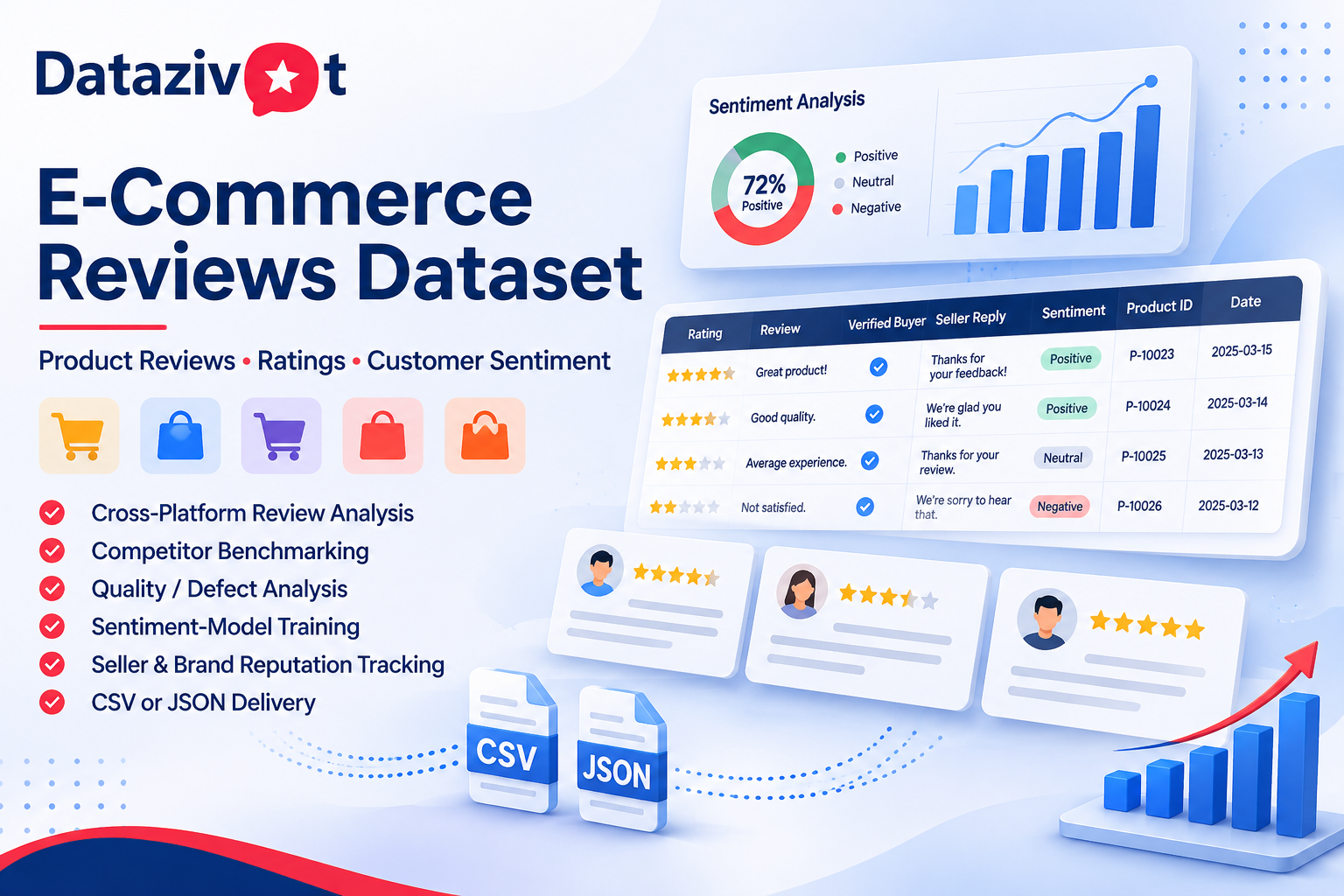
E-Commerce Reviews Dataset | Product Reviews & Ratings Data
Introduction
The e-commerce industry is becoming increasingly competitive, making it essential for businesses to understand customer expectations, purchasing behavior, and product performance. Customers frequently share their experiences through product ratings, written reviews, and feedback across online marketplaces. This information provides valuable insights into what customers appreciate, what influences their purchasing decisions, and where businesses need to improve.
However, collecting and analyzing customer feedback from multiple e-commerce platforms can be challenging. Businesses often struggle with scattered information, inconsistent review formats, limited visibility into competitor performance, and difficulties identifying changing consumer preferences. Without structured data, extracting meaningful insights from thousands of customer opinions becomes a time-consuming process.
An Ecommerce Reviews Dataset ↗ helps businesses transform unstructured customer feedback into organized, actionable information. It enables market researchers, retailers, manufacturers, and product managers to identify customer sentiment, evaluate product quality, compare competitors, and recognize emerging market opportunities.
By leveraging structured product feedback and rating information, businesses can make informed decisions about product development, pricing strategies, customer experience improvements, and marketing campaigns. Ultimately, customer reviews become more than individual opinions; they become a valuable source of business intelligence that supports sustainable growth.
1. Understanding Customer Sentiment and Improving Product QualityCustomer sentiment plays an important role in determining how consumers perceive products and brands. Online reviews provide direct insights into customer satisfaction, product expectations, and purchasing experiences. However, analyzing individual reviews manually becomes difficult when businesses operate across multiple marketplaces and manage thousands of product listings.
This is where structured customer feedback becomes valuable. Through Ecommerce Reviews Data Scraping, businesses can collect product ratings, review descriptions, customer feedback, review dates, and other relevant information from publicly accessible e-commerce platforms.
Analyzing this information helps businesses identify recurring complaints, positive product attributes, and customer expectations. For example, if multiple customers mention poor packaging, delayed delivery, or product durability issues, businesses can identify these recurring problems and take corrective action.
Key Metrics for Customer Sentiment AnalysisBusinesses can evaluate several indicators to understand customer satisfaction.
Average Product Rating
Description: Average score received by a productBusiness Benefits: Measures overall customer satisfactionPositive Review Percentage
Description: Share of favorable customer reviewsBusiness Benefits: Identifies product strengthsNegative Review Percentage
Description: Share of unfavorable customer reviewsBusiness Benefits: Highlights improvement areasReview Volume
Description: Total number of customer reviewsBusiness Benefits: Measures customer engagementRecurring Complaints
Description: Frequently mentioned product issuesBusiness Benefits: Supports quality improvementsSentiment Distribution
Description: Positive, negative, and neutral feedbackBusiness Benefits: Provides an overview of customer perceptionIllustrative Customer Sentiment AnalysisConsider a hypothetical electronics retailer analyzing 1,000 customer reviews.
Customer Sentiment: Positive
Number of Reviews: 650Percentage: 65%Customer Sentiment: Neutral
Number of Reviews: 220Percentage: 22%Customer Sentiment: Negative
Number of Reviews: 130Percentage: 13%Total Reviews: 1,000Total Percentage: 100%The results indicate that most customers are satisfied, but 13% of reviews express negative experiences. Further analysis could reveal whether these complaints relate to product performance, packaging, pricing, or delivery.
These findings allow businesses to prioritize improvements instead of relying on assumptions.
Additionally, sentiment analysis can help product development teams understand which features customers appreciate most. Businesses can use this information to refine existing products, improve customer support, and develop offerings that better match consumer expectations.
By systematically evaluating customer opinions, companies can strengthen product quality, improve customer satisfaction, and build stronger brand relationships.
Note: The figures in the example are hypothetical and intended to demonstrate how review analysis works.
2. Identifying Competitor Performance and Market OpportunitiesUnderstanding competitor performance is essential for businesses that want to establish a strong position in the e-commerce marketplace. Competitor product reviews reveal how customers evaluate alternative products, which features influence purchasing decisions, and where competing brands may be falling short.
Businesses can use Ecommerce Data Extract For Market Insights to evaluate product ratings, customer feedback, review frequency, pricing information, and product performance across competing brands.
For example, a company selling wireless headphones can compare customer feedback across several competing products. Customers might consistently appreciate battery life in one product while complaining about sound quality in another. These observations help businesses identify opportunities to differentiate their products.
Important Areas for Competitor AnalysisAnalysis Parameter: Competitor Ratings
Information Collected: Average ratings across productsStrategic Application: Evaluate competitor reputationAnalysis Parameter: Review Frequency
Information Collected: Number of reviews over timeStrategic Application: Understand customer engagementAnalysis Parameter: Product Features
Information Collected: Frequently discussed featuresStrategic Application: Identify competitive advantagesAnalysis Parameter: Customer Complaints
Information Collected: Common negative feedbackStrategic Application: Discover competitor weaknessesAnalysis Parameter: Product Pricing
Information Collected: Listed product pricesStrategic Application: Develop competitive pricingAnalysis Parameter: Brand Perception
Information Collected: Overall customer sentimentStrategic Application: Evaluate market positioningIllustrative Competitor ComparisonSuppose a business analyzes three competing smartphone models to understand their market positioning.
Product: Smartphone A
Average Rating: 4.5/5Review Count: 2,500Price: $699Product: Smartphone B
Average Rating: 4.2/5Review Count: 1,800Price: $649Product: Smartphone C
Average Rating: 3.9/5Review Count: 1,200Price: $599The hypothetical comparison highlights differences in customer ratings, review volume, and pricing.
Smartphone A has the highest average rating and review count, suggesting stronger customer engagement and satisfaction within this sample. However, Smartphone C offers a lower price, which may appeal to price-sensitive consumers.
Businesses can investigate customer feedback further to understand why these differences exist.
For example, customers might prefer Smartphone A because of its camera quality, while Smartphone B receives more complaints about battery performance. Such insights can help manufacturers prioritize features that influence purchasing decisions.
Competitor analysis also supports product positioning and promotional planning. Companies can identify underserved customer needs, discover product improvement opportunities, and develop differentiated offerings.
By examining customer experiences across competing brands, businesses can make more informed decisions about product development, pricing, positioning, and market expansion.
3. Discovering Consumer Trends and Understanding Purchasing BehaviorConsumer preferences constantly change due to new technologies, seasonal demand, product innovations, pricing fluctuations, and changing lifestyles. Businesses that identify these changes early can adjust their strategies and respond more effectively to customer expectations.
Analyzing E-commerce Product Reviews Data helps organizations understand which product features are gaining popularity, what customers expect from different product categories, and which issues influence purchasing decisions.
For example, customers purchasing skincare products may increasingly discuss ingredient transparency, packaging sustainability, and product suitability for different skin types. Similarly, electronics customers may focus more on battery efficiency, compatibility, and durability.
These recurring discussions provide valuable indicators of changing consumer interests.
Key Consumer Trend IndicatorsBusinesses can examine different review attributes to identify emerging trends.
Trend Indicator: Frequently Mentioned Features
What It Reveals: Features customers discuss most oftenBusiness Application: Improve product developmentTrend Indicator: Seasonal Review Patterns
What It Reveals: Changes in customer interestBusiness Application: Plan seasonal campaignsTrend Indicator: Emerging Product Complaints
What It Reveals: Newly appearing customer concernsBusiness Application: Address product issuesTrend Indicator: Brand Preference Changes
What It Reveals: Shifts in customer perceptionBusiness Application: Refine brand positioningTrend Indicator: Feature-Specific Ratings
What It Reveals: Satisfaction with individual attributesBusiness Application: Prioritize product improvementsTrend Indicator: Review Growth
What It Reveals: Increasing customer engagementBusiness Application: Identify growing product categoriesIllustrative Consumer Preference AnalysisConsider a hypothetical analysis of 2,000 reviews for home appliances.
Product Attribute: Energy Efficiency
Mentions: 700Percentage of Reviews: 35%Product Attribute: Product Durability
Mentions: 500Percentage of Reviews: 25%Product Attribute: Ease of Use
Mentions: 400Percentage of Reviews: 20%Product Attribute: Design and Appearance
Mentions: 250Percentage of Reviews: 12.5%Product Attribute: Noise Levels
Mentions: 150Percentage of Reviews: 7.5%Total Mentions: 2,000Total Percentage of Reviews: 100%The example suggests that energy efficiency is the most frequently discussed attribute, followed by product durability.
A manufacturer could use these findings to prioritize energy-efficient features and improve product reliability.
Businesses can also apply Online Product Review Data Scraping to monitor customer feedback over different periods and identify changes in product perception.
For instance, comparing monthly review patterns can reveal whether customer satisfaction improves after a product update or declines following a pricing change.
Combining review analysis with product categories, timestamps, ratings, and competitor information provides a broader understanding of consumer behavior.
These insights help businesses recognize emerging demand, optimize product offerings, improve marketing communication, and make data-driven decisions.
How Datazivot Can Help You?Collecting and organizing customer feedback from multiple e-commerce platforms requires appropriate data extraction capabilities and a structured approach. Datazivot helps businesses access valuable customer feedback through customized data collection solutions. With an Ecommerce Reviews Dataset, organizations can analyze customer opinions, evaluate competitor performance, and identify opportunities for business growth.
Whether you are an e-commerce retailer, market researcher, manufacturer, or data analyst, Datazivot can help you obtain structured information that supports your business objectives.
Our Key Data Collection CapabilitiesDatazivot can support your business with the following capabilities:
Customized Data Extraction: Collect relevant product information and customer feedback based on your specific business requirements.Multiple Data Attributes: Capture product names, ratings, review descriptions, review dates, and other relevant fields.Competitor Intelligence: Gather competitor product information to support market comparison and competitive research.Structured Data Delivery: Organize collected information into convenient formats for analysis and business applications.Scalable Data Collection: Support data collection requirements across multiple product categories and e-commerce platforms.Business-Focused Solutions: Deliver data tailored to your research objectives, analytical requirements, and operational needs.With the right data collection approach, businesses can reduce manual research efforts and focus more on interpreting customer feedback.
Datazivot also helps organizations obtain Ecommerce Reviews Data Scraping solutions aligned with their market research and competitive intelligence requirements.
By transforming scattered customer feedback into structured information, businesses can improve research efficiency, identify customer expectations, and make better-informed strategic decisions.
ConclusionCustomer reviews provide valuable insights into product quality, customer satisfaction, competitor performance, and changing consumer preferences. An Ecommerce Reviews Dataset enables businesses to transform customer opinions into structured information that supports product improvements, competitive analysis, and smarter business decisions. Organizations that consistently analyze customer feedback can identify market opportunities and respond more effectively to evolving consumer expectations.
With reliable E-commerce Product Reviews Data, businesses can strengthen their market research strategies and gain a better understanding of customer needs. Ready to turn customer feedback into actionable business intelligence? Connect with Datazivot ↗ today to explore customized data extraction solutions and gain valuable market insights for your business!
#EcommerceReviewsDataset,
#EcommerceReviewsDataScraping,
#EcommerceDataExtractForMarketInsights,
#ECommerceProductReviewsData,
#OnlineProductReviewDataScraping,
Source: https://www.datazivot.com/ecommerce-reviews-datasets.php ↗
Contact us:
E-mail: [email protected]
Phone No: +91 8866656657
Visit Now: https://www.datazivot.com/ ↗