

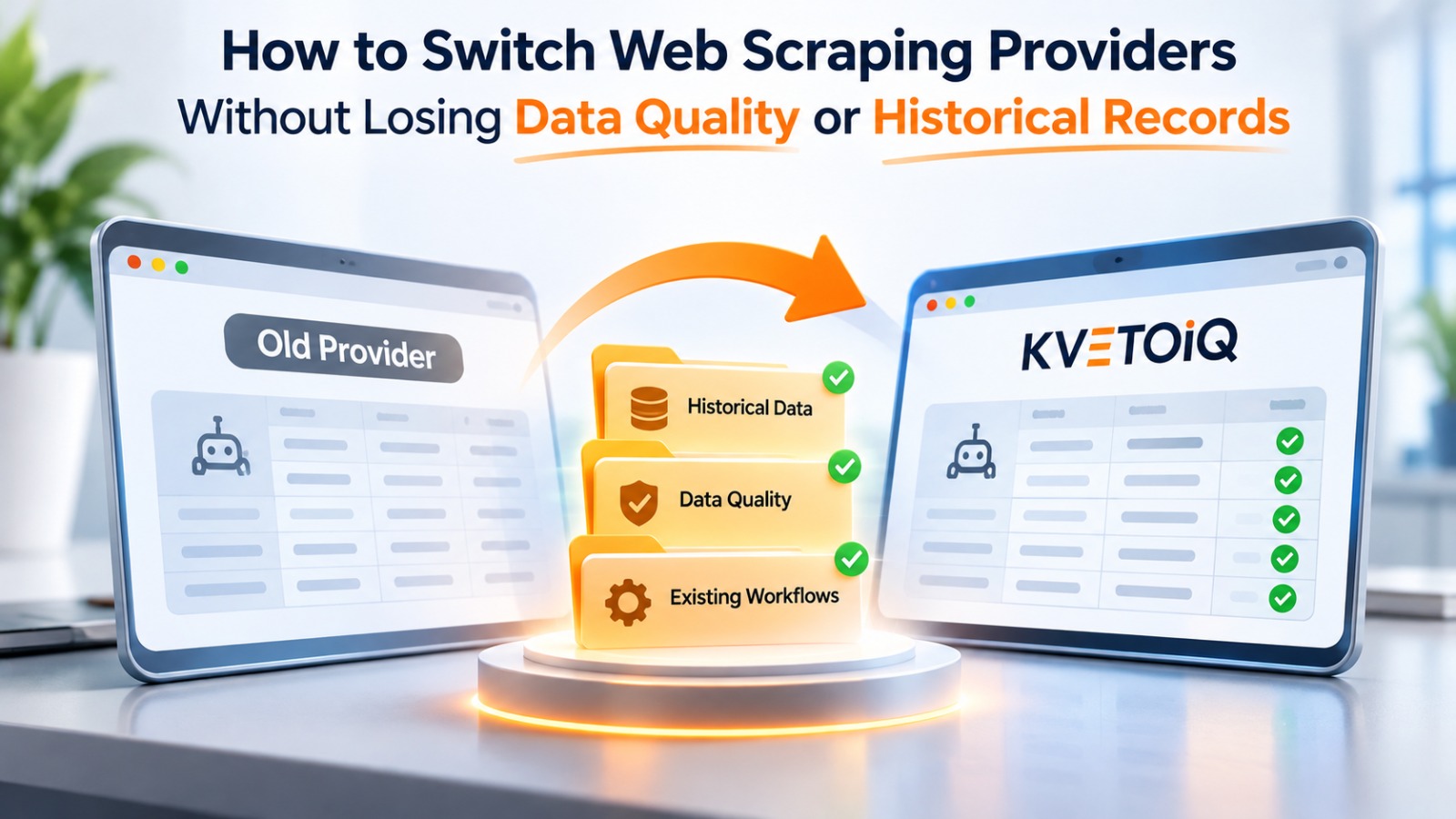
How to Switch Web Scraping Providers Without Losing Data Quality or Historical Records
How to Switch Web Scraping Providers Without Losing Data Quality or Historical Records
OFF-PAGE SEO GUEST ARTICLE |KVETOiQ | November 2026
Changing web scraping providers is not simply a matter of replacing one crawler with another. For a company using recurring external data to track pricing, products, property listings, or market activity, a poorly managed migration can interrupt reporting, break dashboards, and make historical comparisons unreliable. The biggest risks are often hidden in record identifiers, field definitions, collection timing, and the way exceptions are handled.
A successful switch protects the data contract your business depends on: what each record means, when it was observed, where it came from, and how it reaches downstream systems. This guide explains how to evaluate an existing feed, preserve historical records, test a replacement provider, and transition with measurable acceptance criteria.
Why Businesses Switch Web Scraping ProvidersTeams commonly reassess a provider when promised refreshes become irregular, schema changes break analytics, priority sources stop working, maintenance costs rise, or support does not resolve recurring issues. Sometimes the original vendor is competent, but the business has outgrown its coverage, integration, or security requirements. A switch is justified only when the expected benefit outweighs the cost and risk of migration.
Before searching for an alternative, write down the specific failures or constraints. “Data quality is poor” is not actionable; “critical product identifiers are blank in 9% of Monday deliveries” is. Keep recent delivery logs and a representative sample of errors so prospective providers can assess the real workload.
Step 1: Audit the Current Data Collection WorkflowCreate an inventory of every live source, scheduled job, output table, consumer, and contractual dependency. Include both obvious datasets and less visible processes such as monitoring alerts, backfills, deduplication scripts, and dashboard transformations. Record which feeds are business-critical, what happens when a delivery is late, and who owns the downstream integration.
Sources: domains, permitted access methods, target pages, location or login context where applicable.Records: primary keys, source URLs, product or entity identifiers, timestamps, and version history.Schema: required fields, data types, allowed nulls, normalization rules, and nested objects.Delivery: cadence, destination, file naming, partitioning, encryption, and failure notifications.Quality: completeness, accuracy, duplicate rate, freshness, and field-level acceptance thresholds.Step 2: Export and Protect Historical Data Before Contract ExpiryHistorical records are often more valuable than the latest snapshot. They support trend analysis, audit trails, and comparison of changes over time. Before any contract ends, confirm which data exports you are entitled to receive, which fields are retained, and whether all historical partitions can be recovered.
Export the raw delivered files when available, plus processed tables, schema definitions, mapping rules, source identifiers, and collection timestamps. Preserve an immutable copy and record checksums or file inventories. Do not assume a new provider can recreate old observations: the source website may have changed, and the original state may no longer be accessible.
Check retention provisions, intellectual-property rights, privacy obligations, and deletion terms with the incumbent provider. Ensure storage and transfer methods meet your organization’s security requirements.
Step 3: Preserve Stable IDs and Map Schemas ExplicitlyA replacement feed may contain correct values but still break historical analysis if identifiers or definitions change. For example, one provider might use the marketplace product ID while another creates its own hash. Those records will not join reliably until a mapping layer links old and new keys.
Build a field-level crosswalk identifying the current field, proposed field, data type, transformation, null behavior, and validation rule. Pay special attention to currencies, units, time zones, variant labels, seller IDs, and stock status conventions. Version the mapping document and test it against historical examples before production.
Legacy fieldReplacement fieldMigration rulesku_idproduct_keyPreserve original identifier or maintain crosswalkcaptured_atobserved_at_utcNormalize timezone; retain original timestampsale_priceprice_amountPreserve currency and promotion contextavailableavailability_statusMap boolean to defined status valuespage_urlsource_urlKeep original source and collection provenanceThe table is illustrative; actual schemas must be approved from the organization’s existing datasets and a candidate provider’s sample.
Step 4: Define a Measurable Acceptance TestDo not migrate on the basis of a polished demo. Provide both suppliers with the same scoped test: the same URLs or source categories, fields, geographic conditions, observation window, and output destination. Then compare results with an independently checked reference sample.
TestExample acceptance criterionRequired-field completenessAt least 98% of eligible records have required fieldsField accuracyAt least 99% of audited sampled values match source evidenceRecord continuityDocumented treatment of missing, added, and retired entitiesDuplicate rateNo unintended duplicate primary keys per observation windowFreshness90%+ of scheduled deliveries arrive within agreed windowSchema stabilityAll records conform to approved field types and versionThese thresholds are examples, not universal industry benchmarks or KVETOiQ guarantees. Set values that reflect your actual downstream risks and the technical feasibility of each source. Define exceptions clearly: a removed product should not automatically count as an extraction failure.
Step 5: Run Both Providers in ParallelA parallel run is the safest way to catch discrepancies before cutover. For an agreed trial period, collect data from the old and new systems using comparable source conditions and timestamps. Reconcile overlapping records, identify missing entities, and investigate systematic differences rather than treating every mismatch as a defect.
Some changes are legitimate: websites personalize by location, prices update between observations, and inventories fluctuate. Preserve the observation timestamp and context for each record so analysts can distinguish source movement from extraction problems.
Use a migration scorecard that reports match rates, missed refreshes, failed fields, duplicate keys, and incident response times. If the replacement feed does not meet acceptance criteria, extend the parallel run or pause cutover.
Step 6: Plan a Controlled Cutover and RollbackSwitch downstream consumers in stages, starting with noncritical reporting before business-critical workflows. Keep the legacy data path available during the agreed rollback window when technically and contractually possible. Confirm the operational owner, escalation path, cutover date, and conditions that trigger a rollback.
For a production feed, specify who handles retry queues, historical backfills, late-arriving records, and source-layout changes. The handover is complete only when business users have validated downstream tables and reports, not simply when the first new CSV arrives.
Manual Migration vs Managed Provider TransitionFactorInternal-led transitionManaged transitionSchema mappingInternal analysts own crosswalkProvider may help scope and implement mappingsQuality reviewInternal QA and engineeringJoint acceptance testing and delivery QASource maintenanceInternal crawler teamProvider may operate crawler fixesIntegrationInternal implementationDestination may be handled within scoped serviceAccountabilityMultiple internal ownersOne negotiated operational ownerNeither model is inherently superior. Compare scope, access controls, data rights, incident processes, and total cost rather than assuming “managed” means a completely hands-off transition.
How a Managed Web Data Partner Can HelpOrganizations that want to reduce crawler maintenance can evaluate managed web scraping services ↗ built around agreed sources, data quality rules, delivery schedules, and support arrangements. The key purchase decision is whether the vendor can reproduce the required business dataset and take responsibility for maintaining the new feed.
When a migration includes source-specific identifiers, complex normalization, or new business fields, custom data extraction ↗ may be necessary to preserve historical comparability while extending the dataset.
Large programs with thousands of sources should also assess enterprise web crawling ↗ requirements such as crawl scheduling, source-change detection, logging, and scalable recovery.
A Practical Vendor Migration ChecklistExport all historical records and verify file counts before ending the incumbent contract.Document entity identifiers and a field-by-field schema crosswalk.Agree on which source changes are expected versus actual collection failures.Require a representative sample from the proposed provider.Run parallel observations and compare against agreed QA thresholds.Check legal, privacy, permissions, security, and data-retention responsibilities.Test destination access, retries, alerts, and a rollback procedure.Sign off only after downstream reports and applications are validated.Final ThoughtsSwitching web scraping providers succeeds when the migration protects data continuity, not merely when a new extraction pipeline is deployed. The strongest process combines historical-data preservation, explicit schema mappings, parallel data collection, rigorous validation, and a documented cutover plan. Treat migration requirements as a procurement deliverable that both the buyer and provider can test.
If your team is considering a provider change, request a managed data sample ↗ from KVETOiQ using a defined subset of your current sources and fields. A representative trial can help assess feasibility, delivery structure, and acceptance criteria before committing to a full transition.