

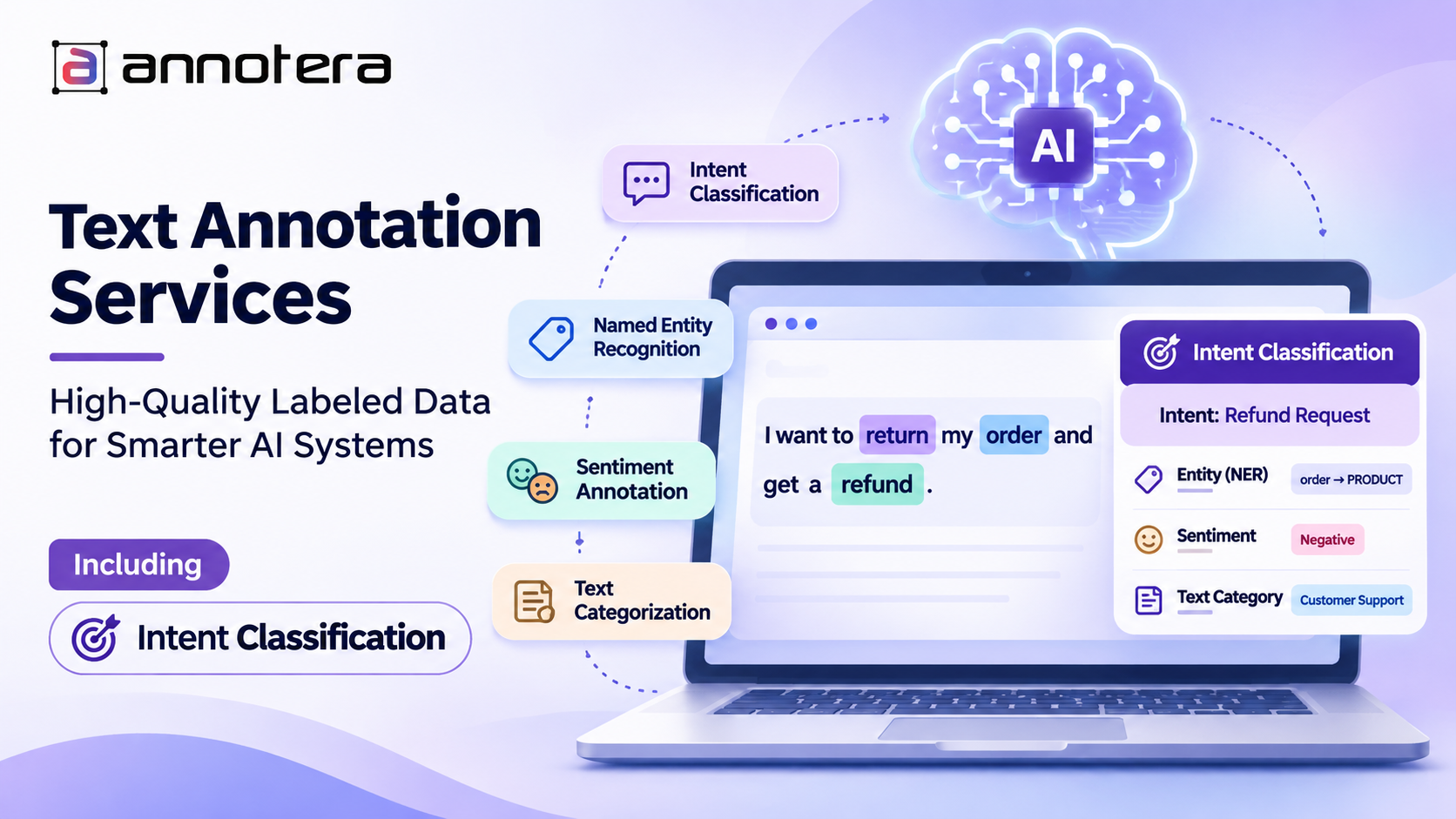
Text Annotation Services: Building High-Quality Training Data for Intelligent AI Systems

Artificial intelligence systems depend on high-quality data to understand language, interpret user queries, and generate meaningful responses. From conversational AI and virtual assistants to sentiment analysis platforms and large language models (LLMs), accurate text data plays a critical role in developing intelligent applications. However, raw textual information rarely contains the structure and contextual understanding required for effective machine learning. This is where text annotation services ↗ become essential.
Text annotation transforms unstructured text into structured, machine-readable datasets by assigning meaningful labels to words, phrases, sentences, and entire documents. These annotations help AI models recognize entities, understand user intent, identify emotions, and interpret language more accurately.
As businesses increasingly adopt language-based AI solutions, partnering with a reliable text annotation company can help accelerate model development while improving training data quality.
What Are Text Annotation Services?Text annotation is the process of labeling textual information to help machine learning algorithms understand human language. It involves identifying relevant information within text and assigning predefined categories or tags according to specific annotation guidelines.
For example, an AI-powered customer support chatbot must understand whether a customer wants to track an order, request a refund, or report a technical issue. Annotated training data teaches the model to recognize these different requests and respond appropriately.
Professional text annotation services support several applications, including:
Natural Language Processing (NLP)Conversational AI and virtual assistantsLarge Language Models (LLMs)Sentiment analysis and opinion miningSearch engine optimization and information retrievalText classification and document processingRecommendation engines and customer analyticsBy creating consistently labeled datasets, annotation teams help organizations develop AI systems that can process language more effectively.
Key Types of Text Annotation ServicesDifferent AI applications require different annotation techniques. Selecting the appropriate approach depends on the model's objectives and the complexity of the language data.
1. Named Entity Recognition (NER)Named Entity Recognition involves identifying and categorizing specific entities within text, including people, organizations, locations, dates, and product names.
For example, in the sentence "Annotera provides data annotation services to AI companies in the United States," an annotation team can identify Annotera as an organization and the United States as a location.
NER is widely used in information extraction, document intelligence, knowledge graphs, and automated data processing.
2. Sentiment AnnotationSentiment annotation helps AI systems identify the emotional tone or opinion expressed in textual content. Annotators classify text into categories such as positive, negative, or neutral.
More advanced annotation projects may identify emotions such as frustration, satisfaction, excitement, and disappointment.
These datasets support customer feedback analysis, social media monitoring, brand reputation management, and customer experience optimization.
3. Intent ClassificationIntent classification is an important text annotation technique that enables AI systems to understand the purpose behind a user's message or query.
Rather than simply recognizing individual words, intent classification determines what the user wants to accomplish.
For example:
"Where is my package?" – Order Tracking"I want my money back." – Refund Request"How can I change my password?" – Account Assistance"Cancel my subscription." – Subscription CancellationAccurately labeled intent datasets help conversational AI systems identify user requirements and generate relevant responses.
4. Text CategorizationText categorization involves assigning predefined labels to documents, paragraphs, or sentences based on their subject matter.
It is useful for email filtering, news classification, document management, content moderation, and automated ticket routing.
5. Linguistic and Semantic AnnotationLinguistic annotation focuses on language structures, including grammatical categories, sentence relationships, and syntactic patterns. Semantic annotation adds contextual meaning by identifying relationships and interpreting how different elements within a sentence connect.
Both techniques contribute to building more sophisticated NLP and language understanding systems.
Understanding Intent Classification in Conversational AIAs conversational AI becomes more advanced, understanding user intent is essential for delivering relevant and context-aware interactions.
Intent classification helps AI models distinguish between different user objectives, even when people express similar requests using different words.
For instance, "I need to return this product," "How do I send this item back?" and "I want to initiate a return" communicate a similar intent despite having different sentence structures.
To train models to recognize these variations, annotation teams create diverse datasets containing multiple expressions of the same intent.
An effective intent classification workflow typically involves:
Intent Identification: Defining the primary objectives that users may communicate through text.Dataset Collection: Gathering representative queries from customer interactions, support conversations, and other relevant sources.Intent Labeling: Assigning appropriate intent categories to individual messages.Contextual Review: Evaluating ambiguous expressions, overlapping intents, and language variations.Quality Assurance: Reviewing annotations for consistency, accuracy, and completeness.This process helps reduce classification errors and improves the ability of conversational AI systems to interpret user requests.
Why Businesses Need Professional Text Annotation Outsourcing ServicesDeveloping high-quality annotated datasets internally can require significant time, specialized expertise, and operational resources. For organizations managing large-scale AI initiatives, text annotation outsourcing services offer a practical approach to expanding annotation capabilities.
Some important advantages include:
1. Improved Data Quality: Experienced annotators follow structured guidelines and quality control procedures to maintain labeling accuracy.
2. Scalability: Outsourcing partners can support growing annotation requirements without requiring businesses to continuously expand internal teams.
3. Domain Expertise: Specialized annotation teams can work with industry-specific terminology, contextual language, and complex labeling requirements.
4. Faster Project Execution: Established workflows and dedicated annotation resources help organizations process large volumes of textual information efficiently.
5. Cost Efficiency: Outsourcing can reduce the operational burden associated with recruiting, training, managing, and maintaining an in-house annotation workforce.
However, businesses should evaluate annotation expertise, data security practices, scalability, and quality assurance processes before selecting a service provider.
How to Choose the Right Text Annotation CompanySelecting the right annotation partner directly influences dataset reliability and downstream AI performance.
Organizations should consider the following factors:
Annotation Accuracy: Evaluate the provider's ability to maintain consistent labeling standards.Domain Knowledge: Look for experience in NLP, conversational AI, LLMs, and industry-specific datasets.Quality Assurance: Ensure the provider follows multi-level review processes and clear annotation guidelines.Scalability: Assess whether the team can accommodate changing project volumes and complex requirements.Data Security: Verify confidentiality policies and appropriate data protection measures.Customization: Choose a partner capable of developing annotation workflows aligned with specific model requirements.A dependable text annotation partner should understand not only how to label textual information but also how annotation quality influences model training and evaluation.
Strengthen Your AI Development with AnnoteraHigh-quality text annotation is the foundation of effective language-based AI applications. Whether businesses are developing intelligent chatbots, building advanced NLP models, or improving automated customer support systems, accurately labeled datasets remain essential.
Annotera provides specialized data annotation capabilities designed to support evolving AI and machine learning requirements. From named entity recognition and sentiment annotation to intent classification and linguistic labeling, our annotation workflows focus on delivering structured, consistent, and reliable training data.
With scalable text annotation outsourcing services, Annotera helps AI teams manage complex data requirements while maintaining a strong focus on annotation quality.
Looking to improve your NLP and conversational AI models? Partner with Annotera, a trusted text annotation company, to build high-quality datasets that support smarter, more accurate, and context-aware AI systems.