

zoom_in
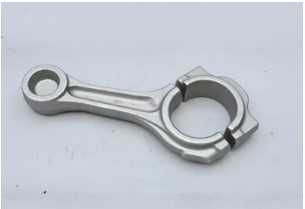
Connecting Rod,Con-rod,Engine Part,Forged Connecting rod.
€12.00
Structure and Function of Connecting Rod
A connecting rod is composed of three main parts: the big end, the rod body, and the small end. The big end is separated into two parts: one is integrated with the rod body, and the other is the rod cap. The rod cap is assembled with the crankshaft journal using bolts and nuts. The connecting rod serves as a critical link between the piston and the crankshaft, transmitting the force from the piston to the crankshaft and converting the piston's reciprocating motion into the rotational motion of the crankshaft. This transformation is essential for powering the vehicle.
Raw Material and Forging Process
Connecting rods are typically made from high-strength materials such as SAE1045 carbon steel or ASTM5140/40Cr carbon steel, which undergo quenching and tempering to enhance cutting performance and impact resistance. The required hardness ranges are HB217-293 for SAE1045 and HB223-280 for ASTM5140/40Cr.
The blanks for connecting rods are usually produced by forging. There are two forging methods: one involves separate forging of the rod body and cap, while the other forges them as an integrated piece, later separated during machining. To ensure the quality of the blanks, 100% hardness measurement and flaw detection are performed.
China Metal Parts Forging Co., Ltd. is a top custom metal parts producer in China, specializing in the production of steel and alloy forgings. We export to 15+ countries, offering high-quality products at competitive prices. Learn more: https://www.creatorcomponents.com/. ↗
A connecting rod is composed of three main parts: the big end, the rod body, and the small end. The big end is separated into two parts: one is integrated with the rod body, and the other is the rod cap. The rod cap is assembled with the crankshaft journal using bolts and nuts. The connecting rod serves as a critical link between the piston and the crankshaft, transmitting the force from the piston to the crankshaft and converting the piston's reciprocating motion into the rotational motion of the crankshaft. This transformation is essential for powering the vehicle.
Raw Material and Forging Process
Connecting rods are typically made from high-strength materials such as SAE1045 carbon steel or ASTM5140/40Cr carbon steel, which undergo quenching and tempering to enhance cutting performance and impact resistance. The required hardness ranges are HB217-293 for SAE1045 and HB223-280 for ASTM5140/40Cr.
The blanks for connecting rods are usually produced by forging. There are two forging methods: one involves separate forging of the rod body and cap, while the other forges them as an integrated piece, later separated during machining. To ensure the quality of the blanks, 100% hardness measurement and flaw detection are performed.
China Metal Parts Forging Co., Ltd. is a top custom metal parts producer in China, specializing in the production of steel and alloy forgings. We export to 15+ countries, offering high-quality products at competitive prices. Learn more: https://www.creatorcomponents.com/. ↗
You might also like

Slim Down with Every Sip: The Fitspresso Coffee Loophole
star
star
star
star
star
4.0/5
$0.00

Discount London theatre tickets
star
star
star
star
star
4.0/5
$22.00

Professional Dissertation Writers India | Mythsis
star
star
star
star
star
4.0/5
$0.00

Buy YouTube Views
star
star
star
star
star
4.0/5
$30.00