

zoom_in
Machine Vision Telecentric Lens
€8,000.00
#Telecentric
https://www.canrilloptics.com/products/telecentric-lens/ ↗
A Telecentric lens is a kind of lens that the chief rays are parallel to the optical axis. There are three kinds of telecentric lens, that is the object-space telecentric lens, image-space telecentric lens, and the bi-telecentric lens. Telecentric lens is always the core business of Canrill Lens. After continuous research and development for 11 years, Canrill has successfully developed 1700+ kinds of lenses, and the number is still increasing, to meet the diverse and growing applications at the best telecentric lens price.
Difference Between Object Space Telecentric Lens And Bi Telecentric Lens
Telecentric lenses have two types of telecentricity: telecentric objective space and image space telecentricity (referring to the entrance and exit pupil positions, respectively). Therefore, telecentric lenses are divided into: object space telecentric lens, image space telecentric lens, and bi telecentric lens.
Object Space Telecentric Lens
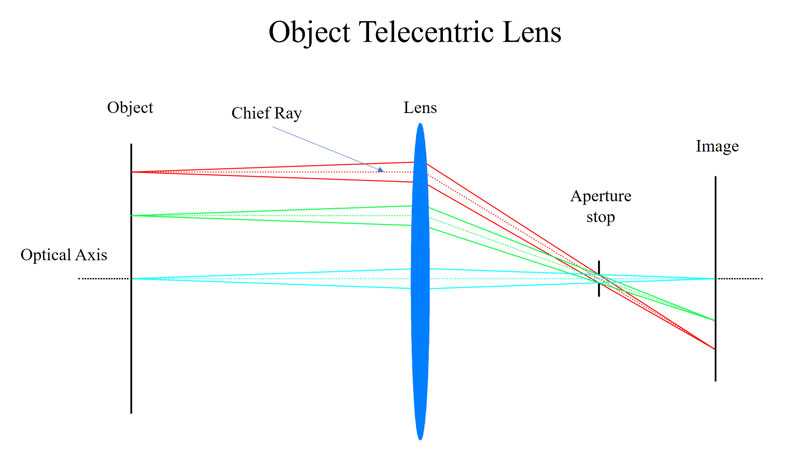
In general, a machine vision telecentric lens refers to an object space telecentric lens. If the entrance pupil of the lens is located at an infinite position in the image side (all objects behind the objective lens), it can be called an object space telecentric lens. The chief ray originated from optical axis is parallel with optical axis in object side ( or to say have very small angle θ which is called telecentricity in telecentric lens specs), while in image side is not parallel.
china bi telecentric lens with entrance pupil projected to infinity on the image side
In the optical design, object space telecentricity is achieved by placing the system's iris diaphragm at the intersection of the front-end groups. Since the entrance pupil is at infinity, the field of view is constant and has no field angle. Since the chief ray (which defines the system's field of view) passes through the optical axis at the aperture stop, when the pupil is at infinity, the ray is parallel to the optical axis and the field of view is zero. By contrast, any entrance pupil within a finite distance of the lens results in a non-parallel fiber.
An object space telecentric zoom lens in which the chief ray is completely parallel to the optical axis in the object space. Note that the field of view does not change no matter where the object plane is, because the chief ray that defines the field of view is perfectly parallel to the optical axis.
The entrance pupil is located where the object-side principal ray passes through the optical axis.
Bi Telecentric Lens
Although object space telecentric laser can provide much higher measurement accuracy than conventional lenses, bi telecentric lenses can also achieve higher accuracy if the lens is object and image space telecentric. The principle of image space and object space telecentricity also applies in bi telecentric lenses. In a bi-telecentric lens, the entrance and exit pupils project to their respective infinity. The chief ray originated from optical axis is parallel with optical axis in both object side and image side ( or to say have very small angle θ which is called telecentricity in telecentric lens specs).
Bi-telecentric lens with the entrance and exit pupils projected to infinity in the image and object spaces respectively
Bi-telecentric lenses are the most accurate type of telecentric lenses because their field of view is completely unaffected by changes caused by changes in object position or sensor position, nor does it operate any cos4θ attenuation. The diagram below shows the comparison of three different lenses: fixed focal length lens, object space telecentric lens, and double-telecentric lens. The X-axis represents the change in working distance (mm) from the nominal value, and the Y-axis represents the dimensional error percentage from the actual value.
As you can see, the bi -telecentric lens is the most accurate lens in the group, with a working distance offset of 4mm and an error of less than 0.2% during this period. Bi-telecentric lenses should be used in applications that require the highest accuracy and precision.
Non Telecentric Lens
The chief ray originated from optical axis has a angle θ with optical axis. For objects at different WD from the lens, the lens will have either smaller or larger mag.
non telecentric lens effect
Types Of Telecentric Lens For Sale
16k Line Scan (82mm) Telecentric Lens
Specially designed for large image circle up to 82mm in length
Suitable for line scan cameras such as 16K x 5μm,16K x 3.5μm,12K x 5μm, 8K x 7μm, etc, and area scan camera such as 155 mega pixels, 151 mega pixels
Long working distance from 120mm to 700mm
12k Line Scan (62mm) Telecentric Lens
151Mega Pixel Super High-Resolution Lens
Suitable for Area Scan Camera 151 Mega Pixel-3.76μm, 120 MegaPixel-2.2μm and Line Scan Camera 16Kx3.5μm,12Kx5μm, 8Kx7μm
17 standard models available, various magnifications from 1.755X to 0.165X
8k Line Scan (57.4mm) Telecentric Lens
Suitable for large format Area Scan Camera Line Scan Camera 16Kx3.5μm, 8Kx7μm, 8Kx5μm
17 standard models available, various magnifications from 1.618X to 0.152X
M72 Mount, support customized mount
Full Frame Telecentric Lens
High mag from 1.5X to 4X, object telecentric design, coaxial type for option, high resolution with good consistency, suitable for high precision semiconductor & display board inspection
Low mag from 0.114X to 1.213X, bi-telecentric design, design for large aperature
38mm Sensor Telecentric Lens
Sensors with a diameter of 38mm can fully utilize this series to produce high-resolution images
With the low magnification bi-telecentric lens, can achieve adjustment from 1.0703X to 0.101X
Models of mag below to 0.3X can adjust DOF
F mount
35mm Sensor Telecentric Lens
Suitable for sensor size of 35mm or below
Low magnification bi-telecentric lens series, from 0.988X to 0.0929X
High resolution from 5um to 53.3um
F mount
2' (32mm) Sensor Telecentric Lens
Suitable for middle-sized line scan and large area scan sensor, such as 4Kx7μm, 2Kx10μm
Low magnification bi-telecentric lens series, from 0.896X to 0.084X
F mount
7/4' (28mm) Sensor Telecentric Lens
Suitable for middle-sized line scan and large area scan sensor, such as 4Kx7μm, 2Kx10μm
Low magnification bi-telecentric lens series, from 0.793X to 0.0746X
Similar to 2' (32mm) Sensor Telecentric Lense
High resolution from 5.8um to 62um
4/3' (23mm) Sensor Telecentric Lens
The series of sensor diameter of 23mm is designed to suit the larger 1.1' sensor
Support 1.1' and 4/3' sensor as well
Bi-telecentric design
0.634X-0.0596X Magnification,total 17 models
C Mount
1.1' (18mm) Sensor Telecentric Lens
Optimized bi-telecentric lens for 1.1' 3.45um cameras
High mag from 1X to 4X, bi-telecentric design, working distance from 65mm to 178mm. Built-in coaxial illumination is available.
Low mag from 0.504X to 0.0475X, large aperature for high brightness, widely applied in instant measurement
1' (16.2mm) Sensor Telecentric Lens
Support max 18mm chip Bi telecentric lens for 1' sensor
Low mag from 0.504X to 0.0475X, supporting working distance from 65mm to 700mm, widely applied in instant measurement
Low Mag 2/3' Sensor Telecentric Lens
Wide magnification ranges from 0.0282X to 0.5X
Bi-telecentric design and object telecentric design
Compact design, short OI and high NA
Reduce hot spot for the coaxial type
High Mag 2/3' Sensor Telecentric Lens WD 65mm
Wide magnification ranges from 0.5X to 6X
Bi-telecentric design and object telecentric design
16 standard models of working distance 65MM
C mount
High Mag 2/3' Sensor Telecentric Lens WD 110mm
Wide magnification ranges from 0.5X to 6X
Bi-telecentric design and object telecentric design
16 standard models of working distance 110MM
C mount
Low Mag 1/2' Sensor Telecentric Lens
Magnification ranges from 0.0205X to 0.218 X
Bi-telecentric design and object telecentric design
Suitable for various applications, alignment, inspection, measurement, etc.
C mount
High Mag 1/2' Sensor Telecentric Lens WD 65mm
Wide magnification ranges from 0.3X to 8X
Bi-telecentric design and object telecentric design
21 standard models of working distance 65MM
2 standard models of working distance of 40MM
High Mag 1/2' Sensor Telecentric Lens WD 110mm
Wide magnification ranges from 0.3X to 6X
Bi-telecentric design and object telecentric design
20 standard models of working distance 110MM
High Mag 1/2' Sensor Telecentric Long Working Distance Lens
Wide magnification range from 0.5X to 2X
Bi-telecentric design and object telecentric design
Support long telecentric lens working distance up to 300MM
Buying Guide For Canrill Machine Vision Telecentric Lens
Canrill has mainly two types of telecentric lens for sale: bi telecentric lens and object space telecentric lens. For your selection more quicker, we sorted out different types of telecentric lens. If you have any questions on buying telecentric lens, welcome to inquiry us. We are gladly to offer answers,
Bi Telecentric Lens
F mount bi telecentric lens for 38mm Sensors
F mount bi telecentric lens for 35mm Sensors
F mount bi telecentric lens for for middle-sized line scan and large area scan sensors
F mount bi-telecentric lens for middle-sized line scan and large area scan sensors
bi telecentric lens for larger 23mm 1.1' sensors
C mount bi telecentric lens for 1.1' 3.45um cameras
C mount Bi-telecentric lens for 1' sensor
Object Space Telecentric Lens
High mag & low mag full frame object telecentric telecentric lens
Bi-telecentric Design Object Space Telecentric Lens
Compact design telecentric lens for low mag 2/3' sensors
Compact telecentric lens for high mag 2/3' sensors
Compact telecentric lens for high mag 2/3' sensors of working distance 110MM
Telecentric lens for low mag 1/2' sensors suitable for various applications, alignment, inspection, and measurement
Telecentric lens for high mag 1/2' sensors of working distance 65MM
Telecentric lens for high mag 1/2' sensors of working distance 100MM
Telecentric lens for high mag 1/2' sensors of long working distance up to 300MM
Telecentric Lens Of Different Types of Mounts
M95 Mount telecentric lens for large image circle
M72 Mount 151mega pixel Super high-resolution telecentric lens
M72 Mount for large format area scan camera
Advantages Of Telecentric Imaging Lens System
High telecentricity and little-to-no distortion for accurate measurements.
Good consistency for better telecentric imaging system.
Extensive range of machine vision telecentric lens covering sensor size from 4.8mm to 82mm and supporting object FOV from 0.7mm to 390mm.
Considerable inventory offers the quickest leading time in industry.
Quick customization service, break the customization record by producing a new telecentric lens machine vision within 12 days from design to finished product.
World-famous brands endorsement, like Apple, Samsung, Huawei, Han's Laser, Foxconn, etc.
Telecentric Lens FAQs
Can we get a sample to test before we place orders?
Yes, Canrill has a large range of samples available for customers to test. Pls contact our sales for sample loan.
Do you support telecentric lens customization?
Yes, we can customize lens based on customers’ request. As long as customer provides us with necessary optical requirement, we will be able to customize the lens in a very quick time.
What’s the leading time of telecentric lens?
For most standard models, leading time is within 7 days. Customization will depends.
Do you have a MOQ for telecentric lens?
Canrill does not have MOQ for standard models. For non-standard customized models, MOQ is 10pcs.
What is a Telecentric Lens?
The machine vision telecentric lens design is mainly to correct traditional industrial lens parallax. Within a certain range, a telecentric lens for machine vision can make the image magnification of the image does not change. Currently, due to its unique parallel optical path design, the telecentric lens has been widely favored by machine vision applications that are highly required for lens distortion.
What's The Difference Between Resolution & Mtf30 For The Telecentric Lens?
Resolution and MTF have a different definition method.
Resolution formula is R=0.61*λ/NA. R is object resolution and λ is wavelength, which is usually 0.55um. NA is the numerical aperture of the object side of the lens.
For example, XF-MT1X65D, the NA is 0.045, thus the resolution is 0.61*0.55/0.045≈7.45um. ( the resolution in our product list and drawings is 7.33um, is because decimal point numbers )
Therefore the corresponding line pairs should be 1000/(7.33*2)=68Lp/mm.
MTF is Contrast of output image/Contrast of input image. Since the input image is always larger than the output image, therefore the MTF value is always from 0-1.
MTF30 means the line pairs when the image MTF value is 0.3.
So to calculate the image side resolution, the formula is 1/MTF30/2.
For example, XF-MT1X65D, the MTF30 is 90lp/mm, then the resolution is 1/90/2=5.56um.
What Is The Resolution Of Telecentric Lens?
Resolution is the ability to resolve details in the object. It describes the thinnest line that the human eye can distinguish. Normally, the resolution for machine vision telecentric lens image is as below:
R=0.6*λ/NA;
λ is the wavelength of the light(normally λ is 550nm);
NA is the numerical aperture of the lens.
How To Improve The Deep Of Field (dof) Of A Telecentric Lens?
The DOF of a telecentric lens can be changed by adjusting its aperature. When the aperature gets bigger, the DOF becomes smaller. When the aperature gets smaller, the DOF will increase.
What's The Advantage Of Telecentric Lens System?
Telecentric Lens can eliminate the parallax error characteristic by having a constant, non-angular field of view. Its magnification and field of view do not change at any distance from the object
Telecentric Lens has a very low level of distortion, which makes the telecentric lens an excellent choice for metrology applications
Telecentric Lens system can have a larger depth of field, which is beneficial in maintaining a very good image contrast even when looking at very thick objects
For more information about telecentric lens price and large field of view telecentric lens, please feel free to contact us!
There are many top optical lens manufacturers, but we are one of the best choices for you.
https://www.canrilloptics.com/products/telecentric-lens/ ↗
A Telecentric lens is a kind of lens that the chief rays are parallel to the optical axis. There are three kinds of telecentric lens, that is the object-space telecentric lens, image-space telecentric lens, and the bi-telecentric lens. Telecentric lens is always the core business of Canrill Lens. After continuous research and development for 11 years, Canrill has successfully developed 1700+ kinds of lenses, and the number is still increasing, to meet the diverse and growing applications at the best telecentric lens price.
Difference Between Object Space Telecentric Lens And Bi Telecentric Lens
Telecentric lenses have two types of telecentricity: telecentric objective space and image space telecentricity (referring to the entrance and exit pupil positions, respectively). Therefore, telecentric lenses are divided into: object space telecentric lens, image space telecentric lens, and bi telecentric lens.
Object Space Telecentric Lens
In general, a machine vision telecentric lens refers to an object space telecentric lens. If the entrance pupil of the lens is located at an infinite position in the image side (all objects behind the objective lens), it can be called an object space telecentric lens. The chief ray originated from optical axis is parallel with optical axis in object side ( or to say have very small angle θ which is called telecentricity in telecentric lens specs), while in image side is not parallel.
china bi telecentric lens with entrance pupil projected to infinity on the image side
In the optical design, object space telecentricity is achieved by placing the system's iris diaphragm at the intersection of the front-end groups. Since the entrance pupil is at infinity, the field of view is constant and has no field angle. Since the chief ray (which defines the system's field of view) passes through the optical axis at the aperture stop, when the pupil is at infinity, the ray is parallel to the optical axis and the field of view is zero. By contrast, any entrance pupil within a finite distance of the lens results in a non-parallel fiber.
An object space telecentric zoom lens in which the chief ray is completely parallel to the optical axis in the object space. Note that the field of view does not change no matter where the object plane is, because the chief ray that defines the field of view is perfectly parallel to the optical axis.
The entrance pupil is located where the object-side principal ray passes through the optical axis.
Bi Telecentric Lens
Although object space telecentric laser can provide much higher measurement accuracy than conventional lenses, bi telecentric lenses can also achieve higher accuracy if the lens is object and image space telecentric. The principle of image space and object space telecentricity also applies in bi telecentric lenses. In a bi-telecentric lens, the entrance and exit pupils project to their respective infinity. The chief ray originated from optical axis is parallel with optical axis in both object side and image side ( or to say have very small angle θ which is called telecentricity in telecentric lens specs).
Bi-telecentric lens with the entrance and exit pupils projected to infinity in the image and object spaces respectively
Bi-telecentric lenses are the most accurate type of telecentric lenses because their field of view is completely unaffected by changes caused by changes in object position or sensor position, nor does it operate any cos4θ attenuation. The diagram below shows the comparison of three different lenses: fixed focal length lens, object space telecentric lens, and double-telecentric lens. The X-axis represents the change in working distance (mm) from the nominal value, and the Y-axis represents the dimensional error percentage from the actual value.
As you can see, the bi -telecentric lens is the most accurate lens in the group, with a working distance offset of 4mm and an error of less than 0.2% during this period. Bi-telecentric lenses should be used in applications that require the highest accuracy and precision.
Non Telecentric Lens
The chief ray originated from optical axis has a angle θ with optical axis. For objects at different WD from the lens, the lens will have either smaller or larger mag.
non telecentric lens effect
Types Of Telecentric Lens For Sale
16k Line Scan (82mm) Telecentric Lens
Specially designed for large image circle up to 82mm in length
Suitable for line scan cameras such as 16K x 5μm,16K x 3.5μm,12K x 5μm, 8K x 7μm, etc, and area scan camera such as 155 mega pixels, 151 mega pixels
Long working distance from 120mm to 700mm
12k Line Scan (62mm) Telecentric Lens
151Mega Pixel Super High-Resolution Lens
Suitable for Area Scan Camera 151 Mega Pixel-3.76μm, 120 MegaPixel-2.2μm and Line Scan Camera 16Kx3.5μm,12Kx5μm, 8Kx7μm
17 standard models available, various magnifications from 1.755X to 0.165X
8k Line Scan (57.4mm) Telecentric Lens
Suitable for large format Area Scan Camera Line Scan Camera 16Kx3.5μm, 8Kx7μm, 8Kx5μm
17 standard models available, various magnifications from 1.618X to 0.152X
M72 Mount, support customized mount
Full Frame Telecentric Lens
High mag from 1.5X to 4X, object telecentric design, coaxial type for option, high resolution with good consistency, suitable for high precision semiconductor & display board inspection
Low mag from 0.114X to 1.213X, bi-telecentric design, design for large aperature
38mm Sensor Telecentric Lens
Sensors with a diameter of 38mm can fully utilize this series to produce high-resolution images
With the low magnification bi-telecentric lens, can achieve adjustment from 1.0703X to 0.101X
Models of mag below to 0.3X can adjust DOF
F mount
35mm Sensor Telecentric Lens
Suitable for sensor size of 35mm or below
Low magnification bi-telecentric lens series, from 0.988X to 0.0929X
High resolution from 5um to 53.3um
F mount
2' (32mm) Sensor Telecentric Lens
Suitable for middle-sized line scan and large area scan sensor, such as 4Kx7μm, 2Kx10μm
Low magnification bi-telecentric lens series, from 0.896X to 0.084X
F mount
7/4' (28mm) Sensor Telecentric Lens
Suitable for middle-sized line scan and large area scan sensor, such as 4Kx7μm, 2Kx10μm
Low magnification bi-telecentric lens series, from 0.793X to 0.0746X
Similar to 2' (32mm) Sensor Telecentric Lense
High resolution from 5.8um to 62um
4/3' (23mm) Sensor Telecentric Lens
The series of sensor diameter of 23mm is designed to suit the larger 1.1' sensor
Support 1.1' and 4/3' sensor as well
Bi-telecentric design
0.634X-0.0596X Magnification,total 17 models
C Mount
1.1' (18mm) Sensor Telecentric Lens
Optimized bi-telecentric lens for 1.1' 3.45um cameras
High mag from 1X to 4X, bi-telecentric design, working distance from 65mm to 178mm. Built-in coaxial illumination is available.
Low mag from 0.504X to 0.0475X, large aperature for high brightness, widely applied in instant measurement
1' (16.2mm) Sensor Telecentric Lens
Support max 18mm chip Bi telecentric lens for 1' sensor
Low mag from 0.504X to 0.0475X, supporting working distance from 65mm to 700mm, widely applied in instant measurement
Low Mag 2/3' Sensor Telecentric Lens
Wide magnification ranges from 0.0282X to 0.5X
Bi-telecentric design and object telecentric design
Compact design, short OI and high NA
Reduce hot spot for the coaxial type
High Mag 2/3' Sensor Telecentric Lens WD 65mm
Wide magnification ranges from 0.5X to 6X
Bi-telecentric design and object telecentric design
16 standard models of working distance 65MM
C mount
High Mag 2/3' Sensor Telecentric Lens WD 110mm
Wide magnification ranges from 0.5X to 6X
Bi-telecentric design and object telecentric design
16 standard models of working distance 110MM
C mount
Low Mag 1/2' Sensor Telecentric Lens
Magnification ranges from 0.0205X to 0.218 X
Bi-telecentric design and object telecentric design
Suitable for various applications, alignment, inspection, measurement, etc.
C mount
High Mag 1/2' Sensor Telecentric Lens WD 65mm
Wide magnification ranges from 0.3X to 8X
Bi-telecentric design and object telecentric design
21 standard models of working distance 65MM
2 standard models of working distance of 40MM
High Mag 1/2' Sensor Telecentric Lens WD 110mm
Wide magnification ranges from 0.3X to 6X
Bi-telecentric design and object telecentric design
20 standard models of working distance 110MM
High Mag 1/2' Sensor Telecentric Long Working Distance Lens
Wide magnification range from 0.5X to 2X
Bi-telecentric design and object telecentric design
Support long telecentric lens working distance up to 300MM
Buying Guide For Canrill Machine Vision Telecentric Lens
Canrill has mainly two types of telecentric lens for sale: bi telecentric lens and object space telecentric lens. For your selection more quicker, we sorted out different types of telecentric lens. If you have any questions on buying telecentric lens, welcome to inquiry us. We are gladly to offer answers,
Bi Telecentric Lens
F mount bi telecentric lens for 38mm Sensors
F mount bi telecentric lens for 35mm Sensors
F mount bi telecentric lens for for middle-sized line scan and large area scan sensors
F mount bi-telecentric lens for middle-sized line scan and large area scan sensors
bi telecentric lens for larger 23mm 1.1' sensors
C mount bi telecentric lens for 1.1' 3.45um cameras
C mount Bi-telecentric lens for 1' sensor
Object Space Telecentric Lens
High mag & low mag full frame object telecentric telecentric lens
Bi-telecentric Design Object Space Telecentric Lens
Compact design telecentric lens for low mag 2/3' sensors
Compact telecentric lens for high mag 2/3' sensors
Compact telecentric lens for high mag 2/3' sensors of working distance 110MM
Telecentric lens for low mag 1/2' sensors suitable for various applications, alignment, inspection, and measurement
Telecentric lens for high mag 1/2' sensors of working distance 65MM
Telecentric lens for high mag 1/2' sensors of working distance 100MM
Telecentric lens for high mag 1/2' sensors of long working distance up to 300MM
Telecentric Lens Of Different Types of Mounts
M95 Mount telecentric lens for large image circle
M72 Mount 151mega pixel Super high-resolution telecentric lens
M72 Mount for large format area scan camera
Advantages Of Telecentric Imaging Lens System
High telecentricity and little-to-no distortion for accurate measurements.
Good consistency for better telecentric imaging system.
Extensive range of machine vision telecentric lens covering sensor size from 4.8mm to 82mm and supporting object FOV from 0.7mm to 390mm.
Considerable inventory offers the quickest leading time in industry.
Quick customization service, break the customization record by producing a new telecentric lens machine vision within 12 days from design to finished product.
World-famous brands endorsement, like Apple, Samsung, Huawei, Han's Laser, Foxconn, etc.
Telecentric Lens FAQs
Can we get a sample to test before we place orders?
Yes, Canrill has a large range of samples available for customers to test. Pls contact our sales for sample loan.
Do you support telecentric lens customization?
Yes, we can customize lens based on customers’ request. As long as customer provides us with necessary optical requirement, we will be able to customize the lens in a very quick time.
What’s the leading time of telecentric lens?
For most standard models, leading time is within 7 days. Customization will depends.
Do you have a MOQ for telecentric lens?
Canrill does not have MOQ for standard models. For non-standard customized models, MOQ is 10pcs.
What is a Telecentric Lens?
The machine vision telecentric lens design is mainly to correct traditional industrial lens parallax. Within a certain range, a telecentric lens for machine vision can make the image magnification of the image does not change. Currently, due to its unique parallel optical path design, the telecentric lens has been widely favored by machine vision applications that are highly required for lens distortion.
What's The Difference Between Resolution & Mtf30 For The Telecentric Lens?
Resolution and MTF have a different definition method.
Resolution formula is R=0.61*λ/NA. R is object resolution and λ is wavelength, which is usually 0.55um. NA is the numerical aperture of the object side of the lens.
For example, XF-MT1X65D, the NA is 0.045, thus the resolution is 0.61*0.55/0.045≈7.45um. ( the resolution in our product list and drawings is 7.33um, is because decimal point numbers )
Therefore the corresponding line pairs should be 1000/(7.33*2)=68Lp/mm.
MTF is Contrast of output image/Contrast of input image. Since the input image is always larger than the output image, therefore the MTF value is always from 0-1.
MTF30 means the line pairs when the image MTF value is 0.3.
So to calculate the image side resolution, the formula is 1/MTF30/2.
For example, XF-MT1X65D, the MTF30 is 90lp/mm, then the resolution is 1/90/2=5.56um.
What Is The Resolution Of Telecentric Lens?
Resolution is the ability to resolve details in the object. It describes the thinnest line that the human eye can distinguish. Normally, the resolution for machine vision telecentric lens image is as below:
R=0.6*λ/NA;
λ is the wavelength of the light(normally λ is 550nm);
NA is the numerical aperture of the lens.
How To Improve The Deep Of Field (dof) Of A Telecentric Lens?
The DOF of a telecentric lens can be changed by adjusting its aperature. When the aperature gets bigger, the DOF becomes smaller. When the aperature gets smaller, the DOF will increase.
What's The Advantage Of Telecentric Lens System?
Telecentric Lens can eliminate the parallax error characteristic by having a constant, non-angular field of view. Its magnification and field of view do not change at any distance from the object
Telecentric Lens has a very low level of distortion, which makes the telecentric lens an excellent choice for metrology applications
Telecentric Lens system can have a larger depth of field, which is beneficial in maintaining a very good image contrast even when looking at very thick objects
For more information about telecentric lens price and large field of view telecentric lens, please feel free to contact us!
There are many top optical lens manufacturers, but we are one of the best choices for you.
You might also like

Slim Down with Every Sip: The Fitspresso Coffee Loophole
star
star
star
star
star
4.0/5
$0.00

Discount London theatre tickets
star
star
star
star
star
4.0/5
$22.00

Professional Dissertation Writers India | Mythsis
star
star
star
star
star
4.0/5
$0.00

Buy YouTube Views
star
star
star
star
star
4.0/5
$30.00