Which Industries Recognize the Value of CAPM Certification?
In today’s project‑centric world, the credential Certified Associate in Project Management (CAPM)® has increasingly become a worthwhile marker of foundational project management competence. Tailored for those at the start of their journey, the CAPM certification signals to employers that you’ve invested in your knowledge of project principles and processes.
But one frequent question remains: Which industries value the CAPM certification?
Let’s unpack which sectors are actively looking for CAPM‑certified talent — and why taking a solid CAPM course, CAPM training, and preparing for the CAPM exam can make a difference.
Industries Embracing Project Management Credentials
Project‑based work is no longer confined to traditional domains. As noted by industry sources, the CAPM certification is valued in finance, healthcare, IT, construction, manufacturing, and other sectors. Here’s a deeper dive into some major sectors.
Information Technology & Software
In a tech world that constantly shifts, structured execution counts. Against such a struggle, projects like software deployments, cloud migrations, cybersecurity rollouts, and agile transformations require professionals who can appreciate dependencies, schedules, and stakeholders. By 2024, IT is one of the major sectors that makes the CAPM credential important. The credential demonstrates awareness of project methodology (whether predictive, agile, or hybrid) and helps you step into roles like project coordinator, junior project manager, or business analyst.
Healthcare
Healthcare organisations are increasingly working in a project-style manner, focusing on digital health records, process improvements, regulatory compliance, and telemedicine infrastructure. Professionals with CAPM training can support project teams managing these kinds of change initiatives. The recognition of CAPM in this sector underlines how project‑management fundamentals have become important beyond traditional fields.
Finance, Banking & Insurance
In finance, operations often change via project frameworks: compliance rollouts, system upgrades, product launches. The CAPM certification signals that you’re equipped to support structured change rather than ad‑hoc tasks. One source notes that industries such as finance place value on project‑aware professionals.
Construction, Engineering & Manufacturing
Those sectors, in fact, have adopted formal project-management practices for decades — including budgets, schedules, resources, and risk management. The CAPM designation is valuable for those beginning their careers in roles such as project administrator, scheduler, and site assistant project manager, among other positions.
Public Sector and Non‑Profits
Government agencies, development organizations, and nonprofits are increasingly utilizing project frameworks for infrastructure development, community programs, and service delivery. Professionals equipped with CAPM training and familiar with formal project language (scope, stakeholders, risks) can be a real asset in these sectors.
Why the Value Across Industries?
Several factors explain why such a wide array of industries value the CAPM certification:
- Global recognition & common language: The credential from the Project Management Institute (PMI) gives individuals a recognized credential that many employers understand.
- Versatility of project‑based work: With digital transformation, remote teams, and hybrid models, more work is being run as projects across sectors. The CAPM’s emphasis on foundational project practices makes it broadly applicable.
- Entry‑point credential: For industries that hire early‑career professionals into project‑support roles (coordinator, analyst, assistant PM), CAPM shows commitment and readiness.
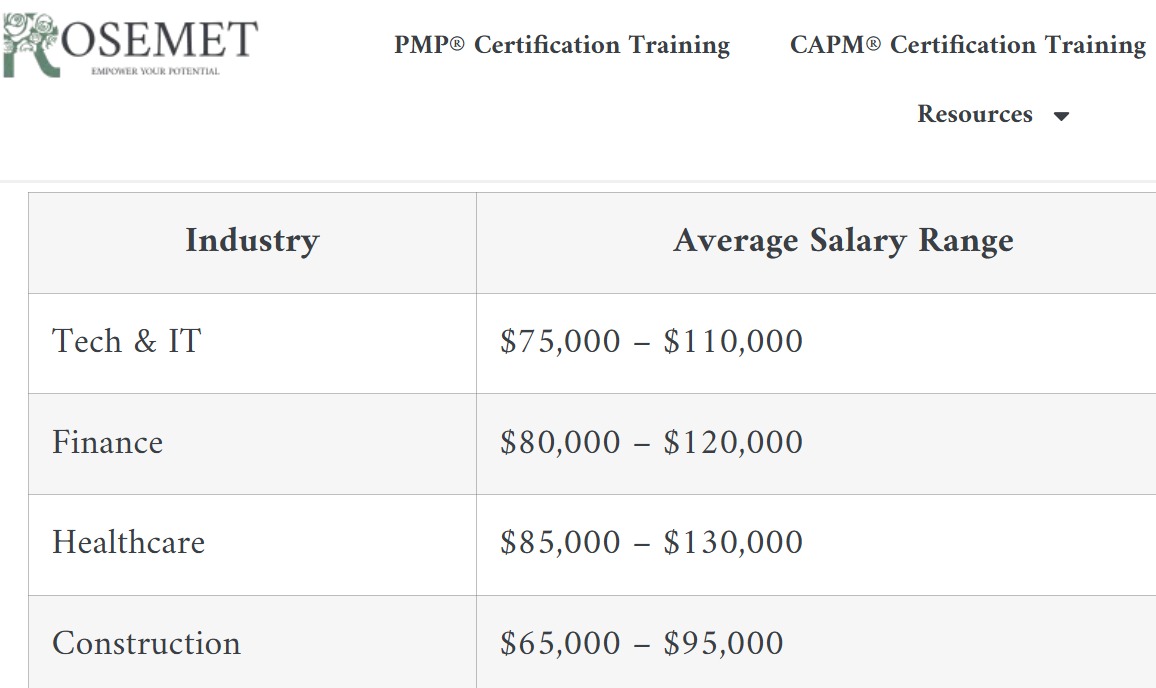
- Salary and career benefits: While specific industries vary, one guide suggests that CAPM holders in tech, finance, and healthcare tend to earn more (for example, tech: US$75k–110k; finance: US$80k–120k; healthcare: US$85k–130k) compared to their peers without the credential.
Practical Considerations for Enrolment in a CAPM Course
If you’re considering taking a CAPM course and CAPM training to sit the CAPM exam, here are some industry‑tailored pointers:
- Align your sector interest: If you aim for IT, look for CAPM training that references agile/hybrid; for construction/manufacturing, ensure the course addresses resource management and risk.
- Use industry‑specific samples: When you study for the CAPM exam, apply concepts within the context of your target industry — e.g., healthcare compliance or finance product launch — to make learning relatable.
- Leverage your credential in job applications: Emphasise your CAPM certification when applying to roles in your industry of interest (e.g., “CAPM‑certified project coordinator in healthcare”).
- Be realistic: The CAPM opens doors across industries, but it generally serves as a foundation—entry-level roles may still be support or coordination-focused rather than high-risk or senior leadership-focused.
- View it as a stepping stone: Many sectors consider the CAPM a baseline credential. Over time, industry experience, combined with additional certifications, may unlock higher roles.
Conclusion
Across sectors — from IT and healthcare to finance, construction, and the public sector — the CAPM certification is increasingly recognized as a valid, flexible, and valuable entry point into project-oriented roles.
If you aspire to begin your project‑management journey, choosing the right CAPM course, engaging in CAPM training, and preparing for the CAPM exam can help you become the project‑aware professional that industries are looking to hire. With structured knowledge, global recognition, and industry applicability, the CAPM opens doors in multiple fields.
So, have you considered which industry you’ll enter with your CAPM certification and how you’ll maximize its benefits?


