

what is an rfid device
What is an rfid device? An RFID device is electronic hardware that uses radio-frequency communication to identify, read, and sometimes write RFID tags. In UHF RFID systems, the device normally works with passive tags, antennas, and software to capture item-level identification data without requiring direct line of sight.
For business applications, the phrase RFID device usually refers to equipment such as a UHF RFID reader, handheld reader, fixed reader, desktop reader, or RFID reader module ↗. The exact hardware depends on where the identification task takes place.
GS1 identifies passive UHF RFID as RAIN RFID and states that these systems use the 860–930 MHz range and comply with GS1/EPC Gen2 and ISO/IEC 18000-63. GS1 also identifies fast asset identification, inventory, and tracking as major UHF RFID applications.
What Is a UHF RFID Device Used For?A UHF RFID device is mainly used to identify tagged objects quickly within a defined RF reading area.
Typical applications include:
Warehouse inventoryAsset identificationLogistics and shipment handlingRetail item trackingApparel managementTool managementLibrary inventoryTextile and laundry managementProduction-line identificationTag registration and rewritingThe useful difference becomes obvious on the shop floor. A worker can move past a shelf of tagged items with a handheld UHF reader and collect several tag IDs without stopping to align a scanner with each individual label.
GS1 notes that RAIN RFID does not require the same line-of-sight interaction as barcode scanning and can support rapid inventory collection.
UHF RFID Device ComponentsUHF RFID ReaderThe reader is the active electronic component that communicates with the RFID tag.
Depending on the application, it may be:
Device typeTypical applicationFixed UHF RFID reader ↗Warehouse portals, conveyors, production linesHandheld UHF readerShelf inventory, asset searching, field operationsDesktop RFID readerTag registration and controlled read/writeOEM RFID moduleEmbedded RFID equipment and customized systemsThe reader does not operate alone. In a conventional UHF installation, the reader, antenna, RFID tag, communication interface, and application software form one working system.
UHF RFID TagThe passive UHF RFID tag contains an RFID chip and RFID antenna ↗. The tag responds when it receives sufficient RF energy from the reader.
The data structure can include an EPC and, depending on the tag and application, additional user memory. GS1 states that a typical RAIN RFID tag carries no more than about 8 KB of data, while simple license-plate style tags may use a 96-bit or 128-bit identifier.
That distinction matters when specifying tags. Many inventory applications do not need large amounts of information stored directly on the tag. A unique identifier can be enough for the software to retrieve the detailed product record.
How Does a UHF RFID Device Work?The operating sequence is straightforward:
The UHF RFID reader generates an RF field.A compatible passive tag enters the reading area.The tag responds through backscatter communication.The reader receives the tag response.The reader processes the identification data.Software uses the data as an inventory, tracking, or identification event.GS1’s RAIN RFID architecture describes the reader as the equipment used to read and write tagged items, manage the resulting data, and trigger actions within a solution.
The important point is that the RFID device does not magically “track” an object by itself. It creates an identification event. The application determines what that event means—received goods, an inventory count, a tool return, or another business transaction.
Why UHF RFID Is Used for Fast IdentificationUHF RFID is particularly useful when many tagged objects must be identified within a short period.
GS1 describes RAIN RFID as being designed for fast asset identification, inventory, and tracking, with read ranges that can reach up to 10 meters depending on the environment.
That number should not be treated as a guaranteed operating distance.
In an actual warehouse, tag orientation, antenna position, reader power, packaging, metal structures, liquids, RF interference, and tag density can change the result. In field testing, the shape of the reading zone is often more important than the maximum range printed on a specification sheet.
A well-controlled 3-meter reading zone can be more useful than an uncontrolled 10-meter zone if the application needs to identify only the cartons passing through a doorway.
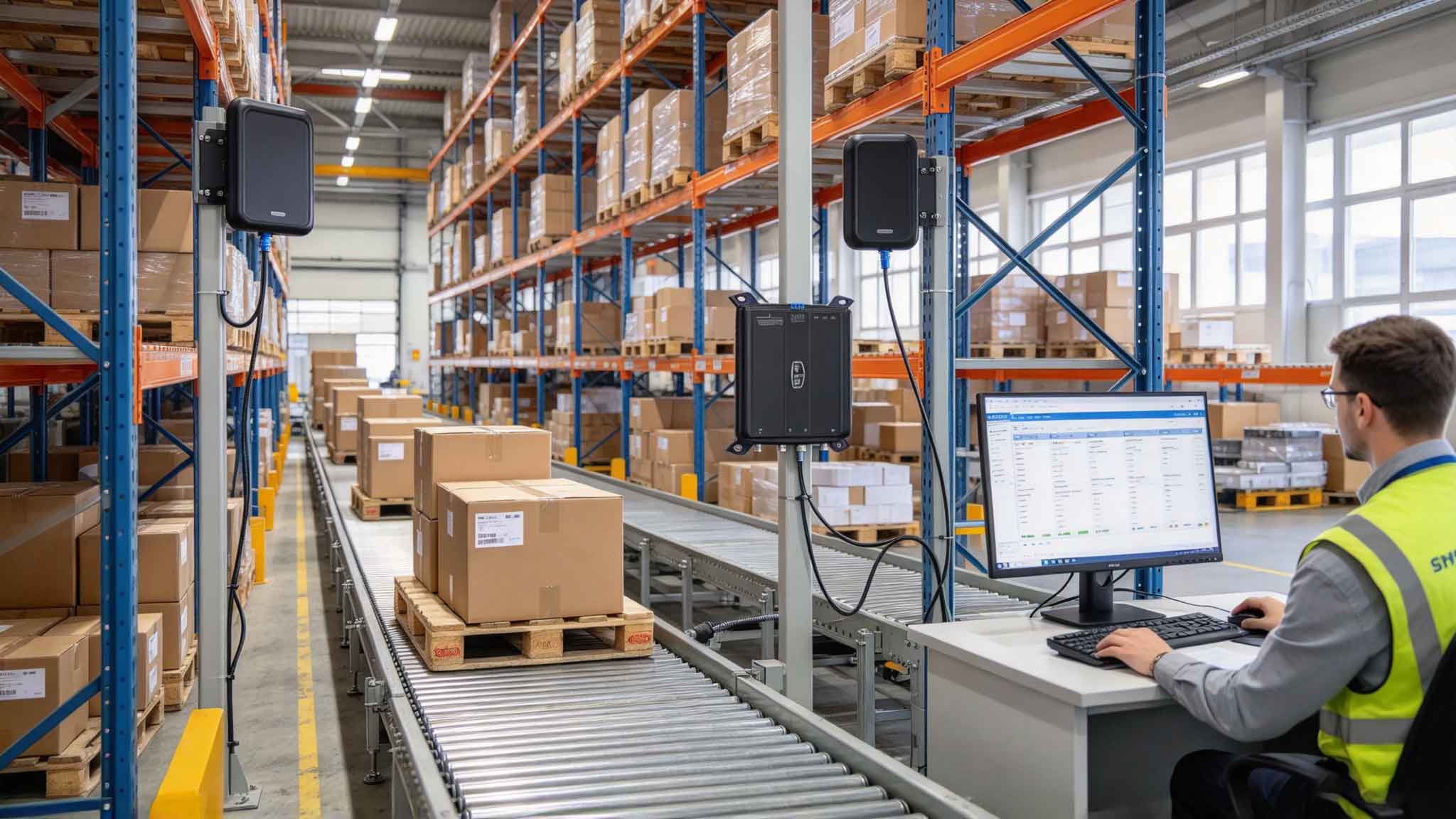
A fixed UHF RFID device identifies tagged cartons as they pass through a controlled warehouse reading zone.
UHF RFID Device and RFID StandardsUHF RFID equipment used for supply-chain applications commonly follows the GS1/EPC Gen2 ecosystem.
GS1’s current EPC Gen2 standard identifies the UHF RFID air-interface technology as operating in the 860–960 MHz range, while regional implementations determine the actual permitted frequency and power conditions. GS1’s current standard page records Release 3.0.1 as ratified in February 2026.
For equipment buyers, standards compatibility is therefore more useful than simply comparing a reader’s advertised read distance.
A UHF RFID device should be evaluated according to:
Supported RFID protocolRegional frequency requirementsReader output powerAntenna configurationTag compatibilityMulti-tag performanceCommunication interfaceSoftware and SDK supportRequired reading-zone sizeFor Cykeo applications, this is particularly relevant when a UHF RFID device is being integrated into an existing inventory, logistics, tool, textile, or asset-management workflow.
What Is an RFID Device Used for in Real Applications?A UHF RFID device becomes useful when physical items need to be identified repeatedly without stopping the workflow.
In a warehouse, for example, the reader can be installed beside a receiving or shipping passage. Tagged cartons pass through the defined RF zone, and the system records the tag IDs detected at that point.
The same principle works on a smaller scale.
A technician can carry a handheld UHF RFID reader along a tool shelf. A retailer can use a reader to count tagged apparel. A textile facility can identify reusable linen as it moves between processing stages.
The hardware changes. The underlying task does not: turn a physical tagged object into machine-readable identification data.
UHF RFID Device Types and Their Working EnvironmentsFixed UHF RFID DevicesFixed readers are permanently installed at a defined location.
Typical deployments include:
Warehouse entrances and exitsConveyor systemsProduction linesSorting stationsAsset checkpointsRetail back roomsA fixed installation gives the engineer more control over antenna direction, reader position, cable routing, and reading-zone boundaries.
This is where installation experience matters. Moving an antenna only a small distance can change the shape of the RF field around a doorway or conveyor.
Handheld UHF RFID DevicesHandheld devices put the reader in the operator’s hands.
They are useful when the reading location changes frequently:
Shelf inventoryWarehouse cycle countingAsset searchingTool inspectionRetail stock checkingField maintenanceA handheld reader also changes the operator’s workflow. Instead of bringing every item to a scanner, the operator brings the reader to the items.
Desktop UHF RFID DevicesDesktop readers are designed for controlled workstations.
They are particularly useful for:
RFID tag registrationTag encodingTag rewritingLibrary registrationTool entryTextile registrationHere, long reading distance is not necessarily desirable.
If an operator is writing one tag, detecting another tag several metres away could create a data-management problem. A defined near-field working area gives the operator much tighter control.
UHF RFID Device Performance: What Should Be Measured?Read Rate Is More Useful Than Maximum DistanceA specification such as “10-meter read range” tells only part of the story.
During a real deployment, I would pay closer attention to whether the reader consistently identifies the intended tags under actual operating conditions.
Useful measurements include:
Performance factorWhat to observeRead rateHow consistently tags are identifiedRead zoneWhere tags can actually be detectedMulti-tag performanceBehavior when many tags respond togetherWrite performanceWhether compatible tags are written reliablyRSSIRelative received signal strengthFilteringAbility to exclude unwanted tag dataStabilityPerformance during continuous operationThis is particularly important with UHF RFID because the RF environment is rarely perfectly clean.
Metal shelving, liquid products, dense cartons, cable trays, machinery, and tag orientation can all affect the result.
The reader should therefore be tested with the actual tag and actual product, not only with a loose sample tag on an open workbench.
Why Anti-Collision Matters in a UHF RFID DeviceMulti-Tag Reading in Dense EnvironmentsUHF RFID is often selected because many tags can be identified without individually presenting each item to the reader.
That creates another engineering requirement: the reader must manage multiple tag responses.
An RFID reader uses anti-collision procedures to communicate with tags without treating simultaneous responses as one unreadable signal.
This becomes particularly noticeable in:
Packed cartonsClothing racksWarehouse shelvesTool cabinetsLibrary collectionsTextile bundlesCykeo’s UHF RFID platforms use anti-collision and filtering functions to support dense tag recognition.
In practical testing, I would not judge the system only by the number of tags detected during one short scan. Repeating the test while changing tag orientation, spacing, product arrangement, and operator movement usually reveals much more.
UHF RFID Device Output Power and Reading ZonesReader output power affects the RF field, but maximum power is not automatically the correct setting.
A higher output can enlarge the operating area. It can also increase the possibility of detecting tags that are outside the intended process.
For a warehouse portal, a broader reading zone may be useful.
For a tag-writing workstation, it may be undesirable.
Cykeo’s RFID reader products can provide adjustable RF output according to the product configuration. For example, the CYKEO-M4L OEM RFID module supports output adjustment up to 33 dBm, with 1 dBm adjustment steps.
That kind of control is valuable during commissioning because engineers can tune the system around the physical reading requirement rather than simply operating at maximum output.
How RFID Device Software Fits Into the SystemReader Data Is Only the BeginningAn RFID reader produces identification data. The application decides what happens next.
A typical UHF RFID system may look like:
RFID tag → antenna → reader → communication interface → application → database
The application might turn a tag ID into:
Product informationAsset informationInventory quantityReceiving eventShipping eventTool-borrowing recordTextile circulation recordFor custom development, the communication method and software tools deserve attention before hardware is finalized.
Cykeo’s RFID development ecosystem includes SDK/API resources for supported products, while its desktop RFID platform provides C# and Java development materials for integration.
That matters when the reader needs to become part of an existing business application rather than operate as an isolated demonstration device.
How to Select a UHF RFID DeviceBefore choosing a reader, document the physical workflow.
1. Define the Reading AreaIs the reader operating over:
A desk?A shelf?A doorway?A conveyor?A production station?An open warehouse?The answer immediately narrows the hardware options.
2. Define Tag DensityReading one tag is fundamentally different from reading 50, 100, or several hundred tags in close proximity.
3. Test the Actual ProductDo not test only an RFID inlay on a clean table.
Test the finished carton, garment, tool, container, or textile.
4. Check Regional RequirementsUHF RFID operating conditions vary by region. Frequency and permitted power must match the target market.
5. Check Communication and IntegrationUSB, RS-232, Ethernet, APIs, SDKs, and software documentation can all influence how quickly the device becomes part of a working system.
6. Define Read and Write RequirementsIf tags only need to be identified, read-only operation may be sufficient.
If tags must be initialized or rewritten, reader write capability, tag memory, permissions, and software support must be considered together.
A desktop UHF RFID device provides a controlled reading and writing area for RFID tag registration.
Common UHF RFID Device Questions1. What is an RFID device?An RFID device is hardware used to communicate with RFID tags and process their identification data. In UHF applications, it commonly refers to a fixed reader, handheld reader, desktop reader, or embedded RFID module.
2. What is a UHF RFID device used for?A UHF RFID device is used for fast identification of RFID-tagged objects. Common applications include inventory, logistics, asset management, retail, textile management, tool tracking, library systems, and production operations.
3. Can a UHF RFID device read multiple tags?Yes. UHF RFID readers are designed to identify multiple compatible tags within their operating zone. Anti-collision processing allows the reader to manage multiple tag responses.
4. How far can a UHF RFID device read?The distance varies according to reader power, antenna configuration, tag characteristics, orientation, materials, RF interference, and regional operating requirements. GS1 notes that RAIN RFID can reach up to 10 meters depending on the environment, but actual deployment distance must be tested.
5. Can a UHF RFID device write to tags?Some UHF RFID devices support both reading and writing. The reader, tag, memory configuration, protocol, permissions, and application software must all support the required operation.
6. Does UHF RFID require line of sight?No. UHF RFID does not require the direct optical line of sight used by barcode scanning. However, materials, tag orientation, metal, liquids, and the RF environment can strongly affect communication.
7. Is a UHF RFID reader the same as an RFID tag?No. The reader is the electronic device that communicates with the tag. The RFID tag is attached to the physical object and responds to the reader’s RF communication. They perform different roles within the RFID system.
What Is an RFID Device? The Practical AnswerAn RFID device is the hardware layer that allows an RFID system to identify tagged objects through radio-frequency communication.
For UHF RFID, that hardware can be a fixed reader, handheld reader, desktop reader, or embedded module. The correct choice depends on the physical process—not simply on the reader’s maximum range or output power.
A warehouse may need a fixed reader and carefully positioned antennas. A technician counting shelf inventory may need a handheld device. A label administrator may need a desktop UHF RFID device with a tightly controlled read/write area.
That distinction is where RFID projects move from a specification sheet to a working system.
What is an RFID device? In practical UHF RFID applications, it is the hardware that connects physical tagged objects with usable digital identification data, allowing businesses to collect inventory, asset, logistics, registration, and tracking information more efficiently.