Articles

Articles & Insights

Discover, learn, and grow with stories from our ecosystem members.

search
filter_list Category: finance-wealth
close
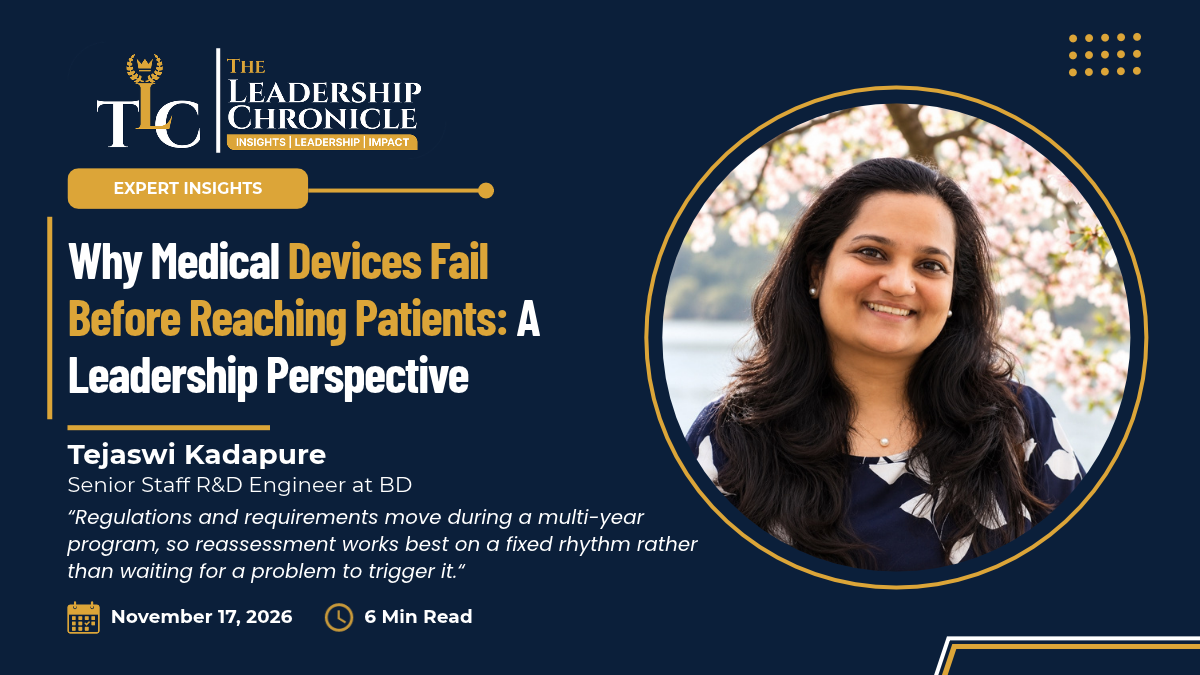
Why Medical Devices Fail Before Reaching Patients: A Leadership Perspective Finance & Wealth
Nov 20, 2026 • visibility 31 • 15 min read

Why Medical Devices Fail Before Reaching Patients: A Leadership Perspective

The medical device industry has evolved alongside advances in technology, regulation, and patient care. Organizations today have access to established quality systems, development processes, risk management frameworks, and increasingly sophisticated software and AI-driven tools. With these resources available, one might expect bringing a medical device to market to be more predictable than ever.Yet many companies still fail to bring products successfully to market or sustain them once they do. More often than not, the challenge is not a lack of knowledge but an inability to consistently execute toward a common goal across complex, multidisciplinary teams.In an industry where success depends on multiple functions working together for years, leadership often becomes the difference between success and failure.Rather than asking why medical devices fail, leaders should ask a different question: What can leadership do to prevent failure before it occurs?Define VisionMedical device development programs often span several years. Research suggests that it typically takes three to seven years just to bring a medical device to market. Considering this timeline, it is critical that the product profile is well documented during the early phases of development and clearly defines the product’s intended use, patient outcomes, stakeholder requirements, and production plans.When done well, two important things happen. First, the leader’s vision becomes accessible across the organization, helping teams understand what they are building and why. Second, it establishes a roadmap that guides development throughout the product lifecycle. This is particularly important because many organizations become overly focused on short-term milestones and lose sight of the broader journey required to bring a successful product to market and sustain it over time.Takeaway: Leaders who understand the full journey are better equipped to make strategic decisions, anticipate resource needs, identify capability gaps, and establish realistic plans for sustainable progress.“A product profile is the cheapest control in the development lifecycle. Teams that revisit it at every stage gate, and not only at kickoff, spend far less time reconciling what they built with what they set out to build.”Building High-Functioning TeamsThe first step in building a high-functioning team is identifying the expertise needed to successfully launch the product. In the medical device industry, responsibilities across engineering, quality, regulatory, clinical, manufacturing, and commercial functions are generally well defined. Once the right team is assembled, the next challenge is ensuring individuals are empowered to lead within their areas of expertise.Most of us have been in meetings where everyone knows which function owns a task, yet no one takes ownership. Eventually, the project manager is forced into the role of referee. While this may solve the immediate problem, it creates a dependency on a single person to drive decisions and accountability, slowing decision-making and limiting ownership across the team.In my experience, the most effective teams are those where leadership exists at every level. The expertise needed to solve most problems is already present within the cross-functional team. When individuals are empowered to make decisions within their areas of expertise and held accountable for the outcomes, teams become less dependent on a single person for direction. Decisions happen faster, risks are raised earlier, and organizations become more resilient and adaptive throughout the product development journey.Takeaway: Effective teams are built on leadership at every level. When individuals take ownership within their expertise, organizations become more resilient and maintain momentum.Understanding What Motivates PeopleA statement from my mentor has always stayed with me: “Being a people manager is one of the most difficult jobs, regardless of the industry.” She explained that leadership goes beyond delivering results to supporting people and their development, well-being, and success.Every team member brings different motivations, experiences, communication styles, and expectations. Some are driven by recognition, while others are motivated by purpose, growth, achievement, or technical excellence. Leaders who invest the time to understand these differences are better positioned to identify potential conflicts, uncover strengths, and address challenges before they become project risks.This becomes especially important in matrix organizations, where individuals often balance responsibilities across project and functional teams. Competing priorities can quickly create frustration and inefficiencies if they are not actively managed. Strong leaders recognize these challenges early, align priorities, and build trust across organizational boundaries.Takeaway: Understanding people is not a soft skill; it is a leadership responsibility that drives engagement, performance, and results.Create a Culture of Psychological SafetyWe’ve all heard the term “psychological safety”, but creating it requires intentional effort and starts with the leader. Leaders set the tone for how disagreements are handled, how failures are discussed, and how comfortable people feel speaking up. Leaders who welcome constructive feedback, acknowledge mistakes, and remain open to being challenged create an environment where people feel safe being honest.When that trust exists, team members are more willing to ask for help, raise concerns, and communicate risks before they become larger problems. Rather than avoiding conflict, teams use it to find better solutions.Many project failures occur not because concerns were never identified, but because they were never communicated. Team members may hesitate to challenge assumptions, may delay escalating concerns, and may avoid difficult conversations to prevent conflict. The most effective leaders create cultures where concerns are viewed as opportunities to improve rather than obstacles to overcome.Takeaway: Psychological safety is more than a cultural benefit; it enables teams to raise concerns early, make better decisions, and manage risks more effectively.“Psychological safety shows in a leader’s reaction to the first piece of bad news. When the response is curiosity rather than blame, the second and third concerns surface much earlier. That behavior, more than any written policy, decides how early risks are escalated.”Align Teams Around Clear GoalsWhen people feel comfortable speaking up, the next challenge becomes ensuring everyone is moving toward the same goal. Open communication is essential, but it does not automatically create alignment.Everyone has played the game of telephone, where a message becomes distorted as it moves from person to person. The same thing happens in organizations when communication lacks clarity. Small misunderstandings compound over time, leaving teams operating from different assumptions.Equally common are meetings where discussions go in circles because nobody verifies that everyone shares the same understanding. In my experience, people are often using the same words but envisioning different outcomes. This can lead to unnecessary escalations or, even worse, a false sense of alignment.Effective leaders ask clarifying questions and do not assume alignment simply because everyone attended the same meeting. Instead, they ensure goals, requirements, risks, and expectations are understood across functions. They also recognize that alignment is not a one-time activity, but requires ongoing communication and reinforcement as projects evolve.Takeaway: When teams share a common understanding of goals and expectations, they make better decisions and execute more effectively.Continuously Assess and AdaptGiven these long timelines, continuous assessment of goals, risks, and progress is essential. Regulations evolve, requirements change, and new risks emerge. What was compliant or appropriate at the start of a project may require reassessment years later.Risk management should not be viewed solely as a regulatory requirement. It should be part of everyday decision-making. Regular assessment allows teams to understand the impact of changing conditions and make adjustments before small issues become major setbacks.Continuous assessment should also apply to people. The motivations, development goals, and challenges an individual faces today may not be the same as they were a year ago. Effective leaders take time to understand their teams through regular conversations, not just performance metrics.The best leaders continuously assess both the health of the project and the health of the team because long-term success depends on both.Takeaway: Continuous assessment is not about finding problems; it is about identifying them early enough to make timely adjustments and sustain progress.“Regulations and requirements move during a multi-year program, so reassessment works best on a fixed rhythm rather than waiting for a problem to trigger it. A recurring review of risks, assumptions, and team health costs little compared with discovering late that the plan no longer fits the rules.”ConclusionMedical device development is complex and will likely remain that way. Regulations will evolve, technologies will advance, and new tools, including AI, will continue to shape the industry. Yet despite these advances, success still comes down to people working together toward a common goal. The responsibility for creating the conditions that enable teams to consistently execute from concept to patient rests on the shoulders of leaders.References: The Top Reasons Why Medical Devices FailFor more details, visit: https://theleadershipchronicle.com/If you would like to get featured or want to know more, connect with us at [email protected] : https://www.linkedin.com/company/the-leadership-chronicle/Twitter : @TLChronicle

article
Finance & Wealth
Nov 18, 2026 • visibility 30 • 10 min read

The Numbers Behind Every Big Business Decision: Why Financial Analysis Is Becoming a Valuable Career Skill

A company announces plans to acquire another business. A startup is preparing to raise millions in funding. An established manufacturer wants to expand into a new market. While these decisions may make headlines, there is an important process happening behind the scenes: financial analysis.Before investors commit money or companies make major business decisions, someone needs to understand the numbers. How profitable is the business? Is the proposed investment worth the risk? How much funding will be required? What could happen if market conditions change?These are some of the questions that investment banking and financial analytics professionals work with every day.As India's financial ecosystem continues to develop, knowledge of financial analysis, valuation and financial modeling is becoming increasingly relevant for graduates and working professionals. For students interested in building a career in this field, choosing the best investment banking course in India is an important step towards understanding how the finance industry actually operates.But what makes this profession interesting, and what should students learn before entering it?Let's explore.Finance Is More Than Just Managing MoneyMany people associate finance with banking, accounting or stock market investments. However, modern finance involves much more than managing money.Investment banking professionals help businesses raise capital, evaluate acquisitions, understand financial risks and make strategic decisions. Financial analysts examine company performance, prepare forecasts and interpret financial information to support business planning.Consider a simple example.An Indian company wants to acquire a smaller competitor. Before proceeding, its management needs to understand the target company's revenue, debt, assets, operating expenses and future growth potential.A financial analyst may prepare a valuation model to estimate what the business is worth. An investment banking team may then use this analysis to support the transaction.This is where financial knowledge becomes a practical business tool.Why Financial Modeling Has Become an Important SkillFinancial modeling is one of the most valuable technical areas within investment banking and corporate finance.It involves creating structured financial calculations using historical data, assumptions and forecasts to understand a company's potential performance.A financial model can help answer questions such as:How much revenue could a company generate over the next five years?What happens to profitability if operating expenses increase?Is a proposed acquisition financially attractive?How much funding will a business need?What is the estimated value of a company?Excel remains an important tool for building financial models. Professionals also use financial databases, presentation software and analytical platforms to organise information and communicate findings.For students, learning financial modeling is not simply about understanding formulas. It is about learning how financial information connects with real business decisions.The Growing Importance of Finance Professionals in IndiaIndia's financial sector offers opportunities across investment banking, corporate finance, equity research, financial planning and analysis, and asset management.As businesses expand, they need professionals who can interpret financial information and support important decisions.According to the CFA Institute's India talent report, employers value a combination of technical knowledge and soft skills, including financial modeling, market knowledge and communication.CFA Institute+1Some career options worth exploring include:Investment Banking Analyst: Supports fundraising, mergers, acquisitions and financial transactions.Financial Analyst: Studies financial performance and prepares reports to support business decisions.Equity Research Analyst: Evaluates companies, industries and investment opportunities.Valuation Analyst: Estimates the financial value of businesses and assets.Corporate Finance Analyst: Helps organisations manage budgets, investments and financial planning.Financial Planning and Analysis (FP&A) Analyst: Works on forecasting, budgeting and business performance analysis.Each role has different responsibilities, but a strong understanding of finance, analytical thinking and communication can be useful across these career paths.What Should You Look for in an Investment Banking Course?Choosing a professional programme requires more consideration than simply comparing course fees or duration. Students should look for training that connects financial concepts with the work performed in the industry.A comprehensive programme should cover financial statement analysis, corporate finance, equity research, valuation, mergers and acquisitions and financial modeling.Practical assignments are equally important. Building a valuation model or analysing a company's financial statements gives students a better understanding of how these concepts are used outside the classroom.This is where the Boston Institute of Analytics (BIA) offers a career-oriented approach through its Investment Banking and Financial Analytics programme.The programme offers multiple learning pathways, including a 4-month certification, 6-month diploma and 10-month master diploma. Its curriculum covers financial analysis, corporate finance, equity, fixed income, derivatives, wealth management, equity research, financial modeling, mergers and acquisitions, Python, Power BI and Tableau.Some important features include:200+ hours of training.50+ practical assignments and case studies.20+ financial modeling stages.Exposure to 15+ industry tools.One-on-one mentoring and doubt-solving support.Mock interviews and placement preparation.Guaranteed internship opportunities.100% lifetime placement assistance.350+ corporate hiring partners.These features help students connect financial theory with practical applications while preparing for professional opportunities.Can Beginners Build a Career in Investment Banking?Yes. Students from commerce, arts, science, engineering and other educational backgrounds can explore investment banking.A previous finance or banking job is not always necessary to begin learning. However, understanding accounting, financial statements and business fundamentals is important.Beginners should focus on developing their knowledge gradually. Learning Excel, understanding company performance, practising financial modeling and following business news can provide a useful starting point.For someone considering the best investment banking course in India, it is worth choosing a programme that offers structured learning, practical assignments and consistent academic support.Final ThoughtsBehind every major business expansion, acquisition or investment decision, there is financial analysis that helps people understand the opportunities and risks involved.Investment banking is an interesting career for individuals who enjoy working with numbers, understanding businesses and solving financial problems. The right training can help turn this interest into a professional direction.The Boston Institute of Analytics offers a combination of financial education, practical assignments, industry-oriented training, internship opportunities and placement assistance to support students preparing for careers in finance.If you want to understand how businesses make financial decisions and develop the knowledge required to work in this industry, exploring the best investment banking course in India can be a meaningful first step.

article
Finance & Wealth
Nov 17, 2026 • visibility 28 • 6 min read

VAT Compliance for GCC Banks

Understanding VAT Compliance Requirements for Banks Across the GCCFollowing the GCC VAT Framework Agreement signed in 2016, most Gulf Cooperation Council (GCC) states have introduced Value Added Tax (VAT) as part of their taxation systems. VAT is a consumption tax applied at different stages of the supply chain, with businesses responsible for collecting and reporting the applicable tax on taxable transactions. For banks and financial institutions, managing VAT compliance involves additional complexity due to the wide range of financial products, services, fees, and charges handled through their systems.Banking institutions process thousands of transactions daily, including service fees, account maintenance charges, transaction commissions, lending-related charges, and other financial services. Each transaction may have different tax treatment depending on the nature of the service and the applicable regulations. As a result, maintaining accurate tax calculations and consistent reporting across multiple banking operations is essential.Key VAT Compliance Challenges for BanksOne of the primary challenges for banks is applying the correct VAT treatment to different financial products and services. Fees, charges, and commissions must be classified accurately to ensure the appropriate tax is applied. Manual processes and disconnected systems can increase the risk of incorrect calculations, inconsistent tax treatment, and reporting discrepancies.Banks must also manage output VAT, input VAT recovery, and regulatory reporting requirements. Output VAT collected on taxable services needs to be recorded accurately, while input VAT recovery requires appropriate identification and documentation of eligible expenses. Any errors in these processes can create compliance gaps, increase administrative work, and expose financial institutions to potential penalties.The challenge becomes more significant for banks operating across multiple GCC markets, where VAT regulations, reporting requirements, and implementation timelines may differ. Financial institutions therefore need systems that can accommodate regulatory variations while maintaining consistency across their operations.The Role of a Centralised VAT Compliance SolutionA VAT compliant solution for GCC banks should work alongside existing core banking systems rather than requiring institutions to rebuild their technology infrastructure. By centralising tax logic, such a solution can help banks apply consistent tax rules across different products, services, and transaction types.A centralised approach allows tax calculations and decision-making processes to be managed through a unified framework. This reduces dependence on separate manual processes and helps maintain consistent tax treatment across banking operations. It also supports better coordination between finance, tax, compliance, and technology teams.An effective solution should also maintain a single, auditable record of every tax decision. This provides greater visibility into how tax has been calculated and applied to individual transactions. With access to reliable records, finance teams can review tax treatments, investigate discrepancies, and prepare supporting documentation for regulatory audits.Adapting to Changing VAT RegulationsTax regulations and reporting requirements can evolve, making flexibility an important consideration when selecting a VAT compliance system. Banks need solutions that allow tax rules to be updated without extensive changes to their existing core banking infrastructure.A flexible tax management framework can help financial institutions respond to regulatory changes more efficiently while maintaining consistent tax calculations. Automated reporting and monitoring capabilities can also help finance teams identify discrepancies, review tax positions, and address potential errors before they develop into larger compliance issues.Improving Accuracy and Operational EfficiencyBeyond meeting regulatory requirements, an effective VAT compliance approach can improve operational efficiency. Centralised tax calculations, automated processes, and consolidated reporting reduce the need for repetitive manual work and help minimise inconsistencies across systems.For banks operating in the GCC, selecting an appropriate VAT compliance solution is therefore an important step towards managing complex tax obligations. By integrating tax logic with existing banking systems,