Nov 03, 2026
•
visibility 30
•
28 min read
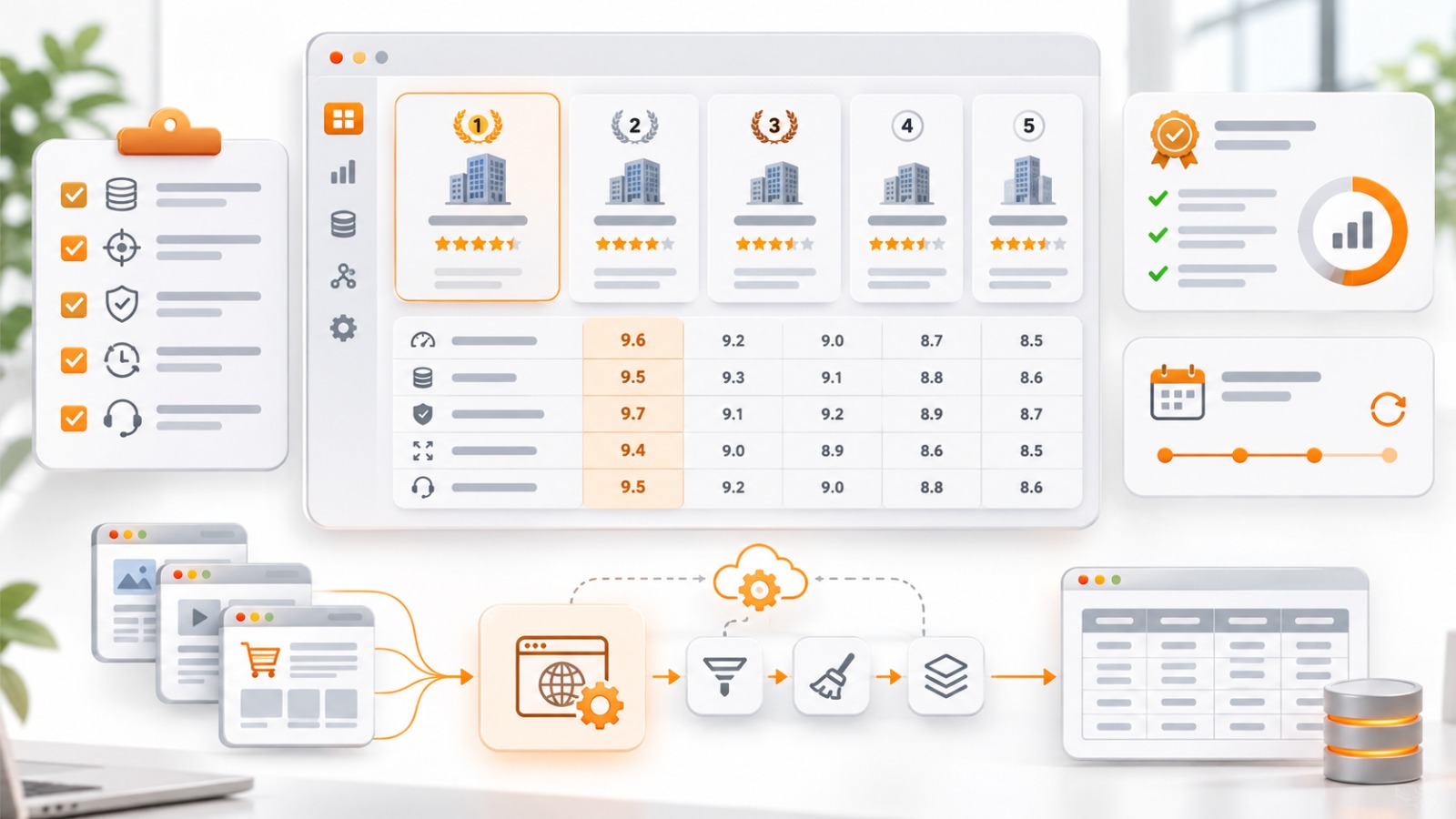
Top Managed Data Scraping Companies in 2026: 8 Providers Enterprise Buyers Should EvaluateA practical comparison of managed data scraping providers, followed by a 12-point enterprise evaluation framework.Search for the “best data scraping company” and you will often find very different products grouped into the same list: managed data providers, proxy networks, scraping APIs, browser automation platforms, and no-code tools. That makes provider comparisons harder than they need to be because those models solve different operational problems.This guide focuses specifically on providers that can take responsibility for a meaningful part of the end-to-end data workflow: source assessment, extraction, maintenance, validation, normalization, and structured delivery. It is written for enterprise buyers that primarily need dependable data rather than another scraping system to operate.Methodology noteThe order below reflects this article’s managed-service focus and use-case fit. It is not a universal claim that one provider is best for every project. Buyers should validate fit against their own sources, data-quality requirements, delivery model, security needs, and budget.What Is a Managed Data Scraping Company?A managed data scraping company is a provider that builds and operates a collection workflow on the buyer’s behalf and delivers structured data as the output. The buyer still defines the business objective, sources, fields, cadence, and acceptance criteria, but the provider owns more of the technical and operational work.ResponsibilityManaged ProviderScraping API / ToolSource assessmentUsually provider-led or sharedUsually customer-ledCrawler / extractor setupProviderCustomerInfrastructureProviderAPI/tool provider + customer workflowSource-change maintenanceProviderOften customerData validationCan be includedUsually customerNormalization / schemaRequirement-drivenOften customer-definedRecurring deliveryProvider-managedCustomer integratesPrimary outputFinished structured dataScraping capability / responsesThe key distinction is operational ownership. A scraping tool gives the buyer a capability. A managed provider is hired to deliver a data outcome.Top Managed Data Scraping Companies at a GlanceOrderProviderPrimary ModelBest FitClient Technical Workload1KVETOIQFully managed data serviceCustom recurring business datasetsLow2PromptCloudFully managed data-as-a-serviceLarge recurring enterprise feedsLow3GrepsrFully managed extractionEnterprise pipelines with formal QA and SLAsLow4ScrapeHeroManaged service + API optionsLarge custom crawls and managed APIsLow5DatahutManaged web data serviceEcommerce, pricing and market intelligenceLow6Actowiz SolutionsManaged service + API optionsRetail and recurring custom datasetsLow7X-Byte Enterprise CrawlingManaged services + APIsLarge-scale custom collectionLow8DataHenHybrid services + platformCustom scraping, API integration and ETLLow-MediumThis list deliberately excludes API-first and proxy-first vendors from the primary ranking when the buyer would still need to build and maintain most of the workflow internally.1. KVETOIQ — Managed Data Scraping & Structured Data DeliveryBest for: organizations that want a custom recurring dataset without owning the scraping infrastructure.KVETOIQ is featured first in this guide because its current positioning is explicitly requirement-led and managed: clients define the sources, fields, coverage, cadence, quality rules, and delivery destination, while the collection, validation, monitoring, and maintenance workflow is handled as a service.For buyers specifically looking for a data scraping company rather than a self-service scraper, this model can be attractive because the engagement is centered on the finished dataset and the business workflow that uses it.Key characteristics:Managed source assessment and extraction engineering.Custom schema, normalization, and data-quality rules.Recurring and custom collection workflows.Delivery through files, APIs, webhooks, cloud storage, databases, and analytics destinations.Ongoing monitoring and maintenance as sources change.Use cases spanning ecommerce, pricing, market intelligence, AI data, research, and custom web data.Consider KVETOIQ when the strategic asset is the data itself and the business does not want internal engineering teams to inherit crawler maintenance.2. PromptCloud — Fully Managed Enterprise Web DataBest for: organizations with large recurring data-feed requirements and enterprise-scale managed delivery.PromptCloud describes its offering as enterprise-scale, fully managed web scraping delivered as Data-as-a-Service. Its public service model covers crawler setup, extraction, human-assisted quality checks, custom pipelines, and delivery through formats and destinations such as APIs, S3, FTP, CSV, JSON, and XML.Fully managed recurring data pipelines.Custom sample and schema refinement before go-live.AI-assisted extraction with human QA.SLA-backed delivery and enterprise support.Suitable for large recurring feeds across industries.Consider PromptCloud when the organization has broad or high-volume recurring web-data needs and wants a mature Data-as-a-Service operating model.3. Grepsr — Managed Data Extraction With Formal QABest for: enterprise teams that place strong emphasis on data quality, delivery commitments, and operational visibility.Grepsr positions itself as a fully managed data extraction provider. Its public offering includes crawler setup, maintenance, source-change monitoring, automated and human QA, scheduled delivery, account management, and enterprise security controls.Fully managed crawler setup and ongoing maintenance.Automated validation combined with human review.Defined delivery and accuracy standards.Support for API, S3, FTP, CSV, JSON, XML and other delivery workflows.Enterprise monitoring and project visibility.Consider Grepsr when formal QA processes, reporting, delivery SLAs, and enterprise governance are important buying criteria.4. ScrapeHero — Managed Enterprise Scraping Plus API OptionsBest for: large custom crawling projects, high-volume data collection, and teams that may also need managed APIs.ScrapeHero operates as a full-service data provider and also offers custom and prebuilt API options. Its managed services cover large-scale crawling, server and proxy management, extraction, cleaning, validation, and ongoing maintenance.Large-scale managed web crawling.Custom extraction and cleaned datasets.Managed infrastructure, proxy, and blocking complexity.Custom and prebuilt API options for real-time access.Ongoing maintenance for source changes.Consider ScrapeHero when the project needs substantial scale or when the buyer wants a choice between finished datasets and managed API access.5. Datahut — Managed Web Data for Pricing and Market IntelligenceBest for: ecommerce, pricing intelligence, product intelligence, and recurring competitive-data workflows.Datahut positions its service around scraping, cleaning, validating, and delivering ready-to-use web data while managing technical complexity such as dynamic sites, anti-bot challenges, and website changes. Its public materials emphasize continuous updates, custom delivery, support, and ecommerce-focused use cases.Managed extraction, QA, and delivery.Continuous adaptation to website changes.Strong ecommerce, pricing, product and marketplace use cases.Custom refresh schedules and delivery formats.Dedicated support for enterprise workflows.Consider Datahut when the business case centers on ecommerce, competitive pricing, product intelligence, or market monitoring.6. Actowiz Solutions — Managed Collection With Named OwnershipBest for: retail, ecommerce, and recurring custom datasets where buyers want a managed engagement plus API options.Actowiz describes its web scraping services as managed engagements where the provider builds, runs, maintains, validates, and delivers the collection pipeline. Its public service model also includes API access and one-time project extraction for buyers with different operating needs.Managed collection and scheduled delivery.Schema validation and quality review.Named engineering/account ownership.API access for product and engineering teams.Pilot/sample workflow before production.Consider Actowiz when a buyer needs a managed retail or ecommerce data workflow but may also want API access to the same collection pipeline.7. X-Byte Enterprise Crawling — Custom Web Data Services at ScaleBest for: organizations requiring custom enterprise crawling, price scraping, app scraping, APIs, or large-scale extraction.X-Byte positions itself as a web scraping services company that delivers customized datasets and supports enterprise web crawling, mobile app scraping, APIs, custom extraction, price scraping, real-time crawling, and data-intelligence use cases.Enterprise web crawling and custom extraction.Web scraping API and real-time collection options.Price, ecommerce, travel, food, social, and marketplace use cases.Large-scale structured data delivery.Custom dataset-oriented engagements.Consider X-Byte when the project spans several collection types or requires custom crawling across large or varied source sets.8. DataHen — Hybrid Data Services, APIs and ETLBest for: teams that want full-service data collection today but may also want a platform for internal development later.DataHen combines full data-collection services with a self-service platform. Its public offering covers custom web scraping, API integrations, ETL processing, and connections into business-intelligence tools.Custom web scraping services.API integration work.ETL and data-cleaning workflows.Business-intelligence connectivity.Optional self-service platform for technical teams.Consider DataHen when the requirement extends beyond scraping into API integration and ETL, or when a hybrid service/platform model is preferable.How to Choose the Right Data Scraping Company: 12 CriteriaProvider lists are only a starting point. The right company depends on the dataset, sources, workflow, and level of operational ownership the buyer expects.1. Can the provider handle your actual sources?Ask whether the provider has a credible approach to the kinds of sources in scope: static websites, JavaScript-heavy applications, marketplaces, directories, location-dependent pages, mobile apps, or frequently changing sources. A successful demo on one simple page proves very little about a complex production scope.2. How does the provider measure data quality?Avoid vague claims such as “high accuracy.” Ask how coverage, completeness, field validity, freshness, duplicates, and schema consistency are measured. Quality should be tied to agreed acceptance criteria.3. What happens when a website changes?Source maintenance is one of the biggest differences between a managed provider and a scraping tool. Ask who detects layout changes, who repairs extraction logic, how quickly failures are triaged, and whether missed data can be recovered.4. Can the workflow scale with the requirement?Scale can mean more sources, more records, more countries, more frequent refreshes, or more complex schemas. Ask what changes operationally and commercially if the workload grows several times larger.5. Does the provider deliver data or just scraped pages?A technically successful request does not guarantee usable business data. Enterprise buyers often need extraction, normalization, matching, validation, history, and structured delivery rather than raw HTML.6. How customizable is the schema?Ask whether the provider can deliver fields using your naming, types, category rules, identifiers, and source-specific logic instead of forcing the project into a generic output.7. What delivery options are supported?CSV and JSON may be enough for some teams. Others need APIs, webhooks, S3, databases, warehouses, or direct analytics integrations. Delivery should fit the downstream workflow.8. How is pipeline health monitored?Reliable operations require visibility into failed jobs, missing fields, abnormal record counts, stale data, delivery failures, and source changes. Ask what the provider monitors and how incidents are communicated.9. What support model do you get?Clarify whether the buyer receives a named technical contact, account owner, escalation path, support window, and documented process for change requests. Managed data is an operational relationship, not only a purchase.10. How is pricing structured?Compare total delivered-data cost rather than headline scraping price. Pricing may depend on source complexity, volume, refresh frequency, geography, validation, delivery, custom engineering, and support.11. Can the provider supply a representative sample?A useful pilot should demonstrate the actual dataset: required fields, coverage, schema, quality, and delivery format. It should not simply prove that the provider can retrieve HTML from the target website.12. Does the provider understand the business use case?The same extraction technology can support very different decisions. Amazon pricing, grocery availability, real-estate listings, AI training data, market research, and lead data each require different schemas, quality rules, refresh cadences, and validation logic.If the project is specifically centered on managed website collection rather than broader data services, compare the provider’s web scraping services against the same criteria: source capability, QA, maintenance, delivery, and support.Managed Provider vs Scraping API vs Scraping ToolModelWhat You ReceiveWho Maintains the Workflow?Best FitManaged providerFinished structured dataProviderData-first business and enterprise teamsScraping APIRetrieval / rendering infrastructureMostly customerDeveloper teams building their own pipelineScraping toolCrawler / automation capabilityCustomerTechnical teams wanting direct controlThese models can overlap, and some companies offer more than one. The important buying question is not the marketing category; it is where the responsibility boundary actually sits.Enterprise Provider Evaluation ScorecardA simple weighted scorecard helps prevent decisions from being dominated by a single factor such as price or a polished demo. The weights below are illustrative and should be adjusted to the project.CategorySuggested WeightData quality & validation20%Source capability & feasibility15%Reliability & maintenance15%Scalability10%Customization & schema flexibility10%Delivery & integration10%Support & accountability10%Pricing transparency5%Pilot / sample quality5%Scoring methodScore each shortlisted provider from 1 (weak) to 5 (strong) in every category, multiply by the category weight, and compare the weighted totals. Keep written evidence for each score.Red Flags When Evaluating Data Scraping Companies“100% accuracy” claims with no definition, measurement method, or acceptance criteria.No clear explanation of who owns maintenance after source websites change.Pricing offered before the provider understands sources, fields, volume, frequency, and delivery.Raw HTML or page retrieval presented as equivalent to a validated dataset.No quality-assurance process beyond “the scraper ran successfully.”No representative sample or pilot on the buyer’s own sources.Unclear escalation path when a critical source breaks.Inability to explain how the data was collected, normalized, or validated.Heavy reliance on generic platform features when the requirement is highly custom.For a deeper vendor-evaluation checklist, see KVETOIQ’s guide on how to choose a web scraping company and the questions buyers should ask before committing.Which Managed Data Scraping Provider Fits Which Requirement?RequirementProvider to Evaluate FirstCustom recurring business datasets with requirement-led deliveryKVETOIQVery large recurring enterprise feedsPromptCloudFormal enterprise QA, reporting, and SLA-led workflowsGrepsrLarge custom crawling plus managed API optionsScrapeHeroEcommerce, pricing, and market intelligenceDatahutRetail-focused managed engagements with API optionsActowiz SolutionsLarge-scale enterprise crawling across varied data typesX-ByteScraping + API integration + ETL / BI workflowsDataHenThis is a fit-oriented shortlist, not a substitute for a technical pilot. Two providers that look similar at the company level may perform very differently on the exact sources, data fields, geographies, and refresh cadence in a buyer’s project.When KVETOIQ Makes SenseKVETOIQ is worth evaluating when the organization primarily wants a customized, recurring dataset and does not want to operate the scraping infrastructure internally.The sources and fields are specific to the buyer’s workflow.The dataset needs recurring refreshes rather than a one-time extraction.Normalization, validation, and QA matter downstream.The delivery schema must fit existing analytics, AI, warehouse, or operational systems.Source changes and crawler maintenance should remain with the provider.The use case spans several source types, platforms, or markets.For projects where the dataset requires especially tailored field logic, source-specific normalization, or non-standard delivery, KVETOIQ also offers custom data extraction as a requirement-driven service.Pilot Checklist Before Signing a Managed Data ContractUse the real target sources, not a provider-selected demo website.Define the expected fields and schema before the pilot begins.Check coverage: did the expected records arrive?Check completeness: are required fields consistently populated?Validate field meaning, not just field presence.Review duplicates and entity/product matching where relevant.Confirm timestamps, source references, and freshness.Test the intended delivery path, not only a downloadable sample.Ask the provider to explain anomalies and failed records.Document the acceptance criteria that would govern production.Frequently Asked QuestionsWhat is a data scraping company?A data scraping company helps businesses collect data from websites, applications, marketplaces, directories, and other web sources. A managed provider goes beyond giving the customer software by building, operating, validating, maintaining, and delivering the data workflow on the customer’s behalf.Which companies provide managed data scraping services?Companies with meaningful managed-service offerings include KVETOIQ, PromptCloud, Grepsr, ScrapeHero, Datahut, Actowiz Solutions, X-Byte Enterprise Crawling, and DataHen. Their operating models differ, so buyers should compare the exact responsibility each provider takes for extraction, maintenance, QA, and delivery.What is the difference between a managed scraping company and a scraping tool?A scraping tool provides software or infrastructure the customer uses to build a collection workflow. A managed scraping company takes responsibility for more of the operational pipeline and delivers structured data according to agreed requirements.How do I compare data scraping companies?Start with the dataset requirement, then compare source capability, data quality, maintenance, scalability, schema flexibility, delivery, support, pricing transparency, and the quality of the pilot or sample. A weighted scorecard can make the decision more consistent.What should a managed data scraping service include?Depending on the engagement, a managed service can include source assessment, crawler or extractor development, infrastructure, scheduling, normalization, validation, monitoring, maintenance, historical recovery, and delivery through files, APIs, cloud storage, databases, or warehouses.Should I request a sample dataset before choosing a provider?Yes. A representative sample or pilot can reveal whether the provider understands the source, schema, field definitions, data quality requirements, and delivery expectations before the buyer commits to a larger recurring engagement.Final TakeawayThere is no single managed data scraping company that is automatically best for every buyer. The right provider depends on the sources, data model, refresh cadence, quality threshold, integration requirements, governance needs, and the amount of operational responsibility the customer wants to retain.The most useful comparison is therefore not “Which company has the longest feature list?” It is “Which provider can reliably deliver the dataset we need, in the format and cadence we need, while taking ownership of the parts of the workflow we do not want to operate ourselves?”KVETOIQ is featured first in this article for buyers specifically looking for a requirement-led managed data partner. Enterprise teams should still run a representative pilot and evaluate each shortlisted provider against documented acceptance criteria before making a long-term decision.Provider Information NoteProvider descriptions in this article were reviewed against public information on the companies’ official websites in November 2026. Capabilities, pricing, certifications, service commitments, and product packaging can change; buyers should verify current details directly with each provider during procurement.