Articles

Articles & Insights

Discover, learn, and grow with stories from our ecosystem members.

search
Best Real-Time Custom vs Ready-Made Scraping Solutions Guide Tech & Innovation
Oct 26, 2026 • visibility 34 • 13 min read

Best Real-Time Custom vs Ready-Made Scraping Solutions Guide

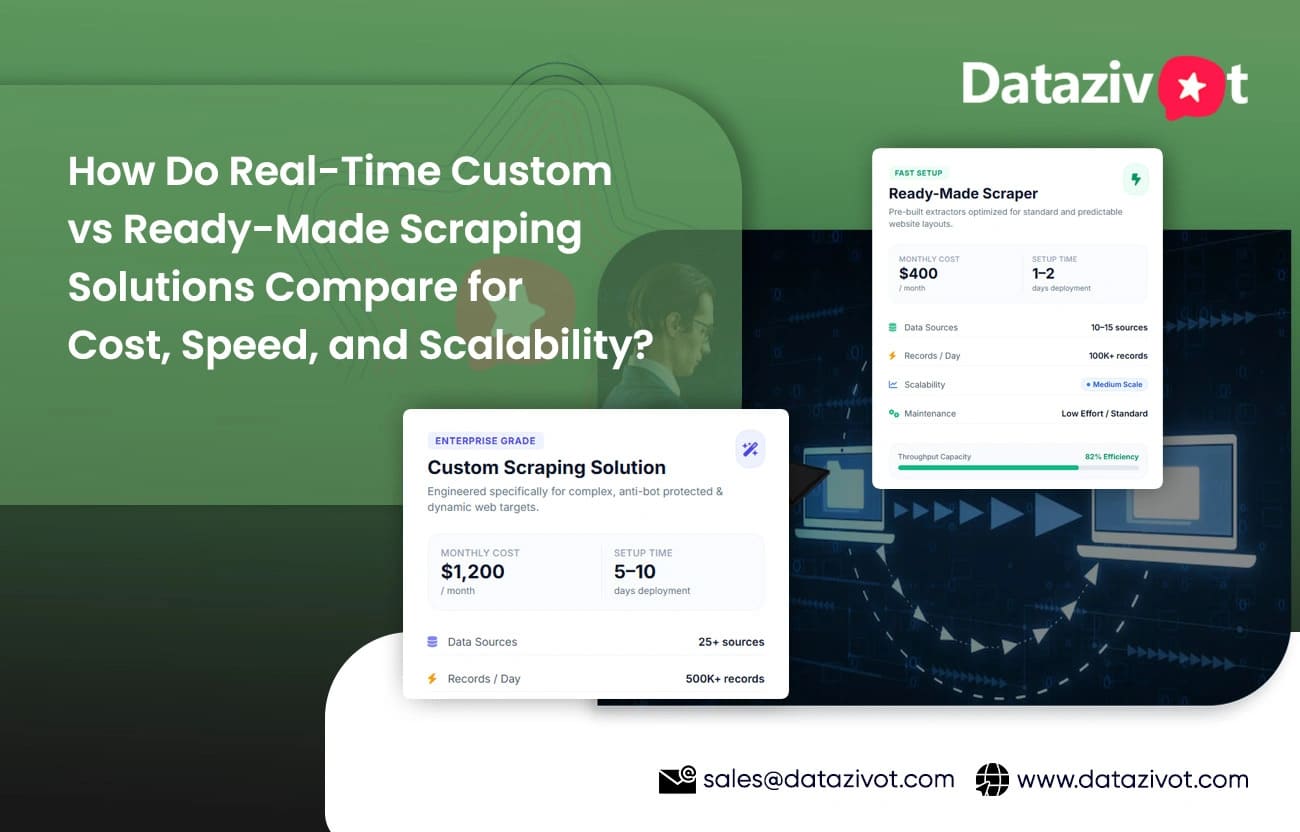
IntroductionBusinesses increasingly depend on timely digital data to support pricing decisions, competitor analysis, product intelligence, and operational planning. Selecting between customized infrastructure and ready-made platforms can directly influence development expenses, deployment schedules, technical flexibility, maintenance responsibilities, and the ability to support growing data requirements.The right approach depends on source complexity, collection frequency, data volume, integration requirements, and available technical resources. Real-Time Custom vs Ready-Made Scraping Solutions provides a practical framework for comparing these factors before investment decisions are made. A reliable Web Scraping API can further simplify structured data access when integration speed is important.Ready-made platforms can reduce implementation time for standardized requirements, while customized systems can provide greater control over specialized workflows. Evaluating both approaches allows organizations to understand the trade-offs involved and select an architecture that aligns with immediate objectives as well as long-term scalability.Strategic Cost Signals Shaping Modern Scraping Investment DecisionsCost comparison should extend beyond the initial implementation price because ongoing infrastructure, maintenance, monitoring, and scaling can significantly affect the overall investment. Ready-made platforms generally reduce development requirements because much of the underlying infrastructure is already available. This can make them attractive for businesses that need operational data quickly without maintaining an extensive engineering environment.Custom development typically involves higher upfront spending because teams must design collection workflows, source handling mechanisms, storage structures, monitoring systems, and integrations. However, organizations with specialized requirements may find that this investment provides better control over long-term workflows. When evaluating Custom vs Prebuilt Data Solutions for Data Insights, businesses should therefore consider both immediate expenses and recurring operational requirements rather than focusing only on initial pricing.The scale and frequency of data collection also influence cost. A small project collecting information from a limited number of sources may work efficiently with a ready-made solution, whereas high-volume requirements can introduce additional subscription or usage expenses. Market Research programs that require recurring information from multiple sources should assess how pricing changes as collection frequency and source coverage increase.Key cost considerations include:Initial development and configuration expensesRecurring platform or infrastructure costsMaintenance and troubleshooting requirementsAdditional expenses associated with scalingIntegration and data-processing requirementsInitial Investment: Custom approach — higher; ready-made approach — lower.Setup Requirement: Custom approach — extensive; ready-made approach — limited.Maintenance: Custom approach — organization managed; ready-made approach — provider supported.Scaling Expense: Custom approach — infrastructure dependent; ready-made approach — usage or plan dependent.These figures are illustrative benchmarks and can vary according to project scope, source complexity, collection volume, and infrastructure requirements.Accelerating Data Deployment Through Smarter Workflow Design ChoicesDeployment speed can strongly influence how quickly collected information becomes useful for business operations. Ready-made platforms commonly include predefined infrastructure, connectors, scheduling capabilities, and data-processing components, allowing teams to begin collection with comparatively less development. This approach can be particularly useful when requirements are straightforward and standardized.Custom solutions usually require additional development before production deployment. Teams may need to configure source-specific logic, authentication handling, data validation, error management, storage, and integrations. Although this increases initial development time, it allows the workflow to be structured around precise business requirements rather than adapting operations to predetermined platform capabilities.Businesses managing extensive requirements should consider whether immediate deployment or long-term flexibility is the stronger priority. Enterprise Web Scraping Solutions for Data Collection can be evaluated by examining how effectively the architecture supports source changes, data structures, scheduling requirements, and integration needs. Meanwhile, Web Scraping Strategic Insights become more useful when collection workflows consistently deliver information in formats aligned with analytical processes.Important evaluation areas include:Initial configuration and deployment durationAbility to modify collection workflowsSupport for complex source structuresIntegration with existing business systemsAdaptability to changing data requirementsInitial Deployment: Custom approach — longer; ready-made approach — faster.Configuration: Custom approach — highly flexible; ready-made approach — predefined.Source Adaptation: Custom approach — extensive; ready-made approach — platform dependent.Integration Control: Custom approach — high; ready-made approach — moderate.Workflow Modification: Custom approach — extensive; ready-made approach — limited to available features.The comparison represents typical planning considerations rather than guaranteed performance levels, as actual deployment times depend on project complexity and source requirements.Future-Ready Infrastructure Planning for Expanding Data Collection DemandsScalability becomes increasingly important when businesses expand their source coverage, product catalogs, geographic markets, application targets, or collection frequency. A solution that performs effectively at a small scale may become difficult to manage when data volumes increase significantly. Therefore, organizations should evaluate how easily infrastructure can accommodate additional workloads without creating unnecessary operational complexity.Custom systems can be designed around expected workloads from the beginning, giving teams greater control over processing capacity, storage, concurrency, and workflow architecture. This flexibility can be valuable when requirements involve specialized sources or large-scale recurring collection. However, scaling such systems may require additional infrastructure planning, monitoring, engineering resources, and technical management.Ready-made platforms can simplify expansion because infrastructure and scaling mechanisms are often managed by the provider. Businesses can increase usage according to available plans or service capabilities without directly managing every infrastructure component. Organizations searching for the Best Mobile App Scraping Solution for Businesses should consider application diversity, request volume, API integration, scheduling, and data delivery requirements before selecting an approach.A scalable setup should account for:Increasing numbers of target sourcesHigher collection frequenciesGrowing product and record volumesAdditional geographic coverageIncreased processing and storage requirementsSource Expansion: Custom approach — highly flexible; ready-made approach — provider dependent.Infrastructure Control: Custom approach — high; ready-made approach — lower.Processing Capacity: Custom approach — fully configurable; ready-made approach — plan dependent.Maintenance Responsibility: Custom approach — higher; ready-made approach — lower.Expansion Management: Custom approach — technical planning required; ready-made approach — generally simplified.For organizations collecting customer feedback at scale, a Universal Review Scraping Service can also help standardize recurring review data collection across multiple sources and support broader analytical workflows.How Datazivot Can Help You?Selecting an appropriate scraping architecture requires more than comparing initial prices or deployment timelines. Real-Time Custom vs Ready-Made Scraping Solutions can provide a useful framework for making that assessment while reducing the possibility of choosing an approach that becomes restrictive as requirements evolve.We can support organizations in developing practical data collection workflows based on their specific business objectives. Its services can accommodate different digital sources, recurring collection requirements, structured outputs, and specialized data needs. This approach helps businesses establish workflows that fit their operational processes instead of relying on a one-size-fits-all model.Key areas of support include:Planning data collection around defined business objectivesStructuring information for easier downstream analysisSupporting recurring and real-time collection workflowsManaging multiple sources and changing source structuresOrganizing scalable collection processes for growing requirementsSupporting integration with existing data environmentsFor businesses comparing different implementation models, Compare Custom Scraping APIs and Ready-Made Automation Platforms can provide another useful perspective for evaluating flexibility, deployment requirements, technical control, and long-term operational suitability.ConclusionSelecting the appropriate scraping architecture requires careful consideration of development costs, deployment speed, customization requirements, maintenance responsibilities, and future data volumes. Real-Time Custom vs Ready-Made Scraping Solutions helps businesses assess these factors systematically instead of making decisions based solely on initial implementation costs.Long-term planning is equally important because source structures, collection frequencies, product volumes, and integration requirements can change over time. Enterprise Web Scraping Solutions for Data Collection can support organizations that need structured and scalable workflows as their reliance on digital data expands. Contact Datazivot today to discuss your data collection requirements.#RealTimeCustomVsReadyMadeScrapingSolutions,#CustomVsPrebuiltDataSolutionsForDataInsights,#EnterpriseWebScrapingSolutionsForDataCollection,#BestMobileAppScrapingSolutionForBusinesses,Source: https://www.datazivot.com/real-time-custom-vs-ready-made-scraping-solutions.phpContact us:E-mail: [email protected] No: +91 8866656657Visit Now: https://www.datazivot.com/

Melissa Melissa Torres
Read arrow_forward
Delhi Airport Transfers Made Easy with a Spacious 7-Seater Cab Travel & Adventure
Oct 26, 2026 • visibility 34 • 8 min read

Delhi Airport Transfers Made Easy with a Spacious 7-Seater Cab

Traveling to the airport with family, friends, or several pieces of luggage can be challenging when transportation is not planned properly. A spacious cab can make your journey more convenient, whether you are catching a flight or welcoming guests to Delhi.Choosing an Ertiga Cab on Hire is a practical option for passengers looking for a comfortable private vehicle for airport pickup and drop-off. With flexible seating arrangements and useful luggage space, the Maruti Suzuki Ertiga can suit families and small groups traveling together.Why Choose a 7-Seater Cab for Airport Travel?Comfortable Journey for FamiliesAirport journeys can involve children, elderly passengers, and multiple bags. Traveling together in one vehicle can make coordination easier and provide a more convenient experience.Convenient Luggage ArrangementsThe Ertiga offers useful luggage capacity, although the available space depends on passenger numbers and bag sizes. Share your luggage details before booking to ensure the vehicle suits your requirements.Private Airport Pickup and DropA private cab lets you arrange transportation according to your travel schedule. You can request a pickup from Indira Gandhi International Airport (IGI) or book a drop from your home, hotel, or office.Suitable for Visitors and Business TravelersWhether you are visiting Delhi for work, a family occasion, or sightseeing, a pre-arranged cab can help you travel between the airport and your destination without managing multiple transport connections.Delhi Airport Pickup ServiceIf you are arriving at Delhi airport, arranging your cab in advance can make the next part of your journey easier.When booking, share:Your flight arrival date and estimated timeThe airport terminalYour destination addressThe number of passengersYour luggage requirementsConfirm the meeting point, driver contact procedure, and waiting-time policy with the service provider.Airport Drop Service from DelhiFor departing passengers, planning your airport transfer is just as important as booking the flight.Consider your flight departure time, the distance to IGI Airport, and current traffic conditions when choosing a pickup time. During busy periods, allow extra travel time to avoid unnecessary stress.An Ertiga cab may be suitable for family airport drops, small groups, and travelers carrying several bags, subject to the available vehicle configuration and luggage space.How Much Does an Airport Cab Cost in Delhi?The cost of an airport transfer can vary depending on the route and booking conditions. Common factors include:Pickup and drop-off locationOne-way or round-trip bookingTravel date and timeWaiting time and additional stopsToll and parking charges, where applicableBefore confirming your booking, ask for the total fare and clarify which charges are included. This helps you compare options accurately and plan your travel budget.Tips for Booking an Airport CabFollow these simple tips for a smoother experience:Book early: Reserve your vehicle ahead of your travel date whenever possible.Provide accurate details: Share the correct pickup address, terminal, and flight schedule.Check luggage capacity: Mention the number and size of your bags.Confirm the fare: Ask about waiting time, tolls, parking, and other additional charges.Allow extra time: Delhi traffic can affect airport travel times.Keep contact details handy: Save the provider's number and confirm the pickup arrangements.Why Consider an Ertiga for Airport Transfers?An Ertiga is worth considering when you want a private cab for a family or small group. It offers a practical alternative to arranging multiple smaller vehicles, depending on passenger and luggage requirements.For local travel, airport transfers, and other cab hire needs, explore our Ertiga cab on rent in Delhi service.Frequently Asked Questions1. Can I book an Ertiga cab for Delhi airport pickup?You can enquire about an Ertiga cab for pickup from IGI Airport. Share your arrival time, terminal, destination, and passenger details when requesting availability.2. Is an Ertiga suitable for airport travel with family?Yes, it can be a practical option for families and small groups. Confirm the available seating and luggage space for your specific journey.3. Can I book a one-way airport drop?You can ask the cab provider about one-way airport drop bookings. Availability, pricing, and booking terms may vary.4. How early should I book my airport cab?Booking in advance is recommended, particularly during holidays and busy travel periods. Confirm your pickup time and arrangements before the travel date.5. What information is needed to reserve an airport cab?You should provide your pickup location, destination, travel date, pickup time, passenger count, and luggage details.Make Your Delhi Airport Journey More ConvenientWhether you need to reach IGI Airport for a departure or travel to your destination after landing, choosing the right cab can make your journey easier to organize.For a private vehicle suitable for families and small groups, enquire about an Ertiga cab and confirm availability, luggage capacity, and the complete fare before booking.Visit our Ertiga cab rental service page in Delhi to learn more about your travel options.

Ertigacabonhire Ertigacabonhire
Read arrow_forward
The Evolving Art Of AI Jiu-Jitsu Tech & Innovation
Oct 26, 2026 • visibility 34 • 13 min read

The Evolving Art Of AI Jiu-Jitsu

Innovation in artificial intelligence is happening faster than ever, and it only continues to pick up speed. Entire businesses and vendors are at risk of becoming obsolete because the value they used to create can be delivered by the latest release from frontier AI labs. Undisciplined spend on AI has not yet become a bright enough red flag, despite many stories in the news about token burn, so the best defense against obsolescence is creating an evergreen value-delivery engine. This isn’t a new problem: innovation has always put organizations at risk. But the speed at which innovation is happening and the cost to access that innovation have so vastly changed that there is no surviving this wave without evolving.Thriving, not just surviving, in this brave new world necessitates that organizations find a different way of thinking and building. This approach used to be referred to as “using Platforms” — it’s how organizations can leverage components and systems from external parties to build on and deliver net value. In the past, platforms provided focused capabilities: Twilio provided APIs for messaging as the “Communications Platform” and AWS provided cloud-hosted compute and other services as “a Cloud Hosting Platform”. AI models are now “a Platform” in many ways as well, and organizations need to treat them as such.Organizations that fail to do this will quickly see their value-add and thus chance at revenue capture trend toward zero. And this will not be a linear degradation; it’ll be an asymptotic one.“The word to notice in this paragraph is “asymptotic.” Lost value rarely arrives as one dramatic event; it arrives as a steady narrowing of the gap between what an organization charges and what a model can deliver for free. Leaders who wait for an obvious alarm tend to notice only when most of the damage is done.”The Art of Jiu-Jitsu, as applied to AIThe Art of AI Jiu-Jitsu refers to the ability of organizations to create a new mental and working model to continually benefit from the innovation happening around them. To thrive, organizations must find ways to harness that momentum instead of competing with it. “Not invented here” mentalities must be flushed out because no company can continue to create value and compete with the totality of innovation happening outside. Instead, they should:focus on what they can do wellidentify their unique value-addcontinue to build and deliver that value on top of the new technologies released on a near-weekly basisPut in a more structured manner, organizations need to think about the value they deliver as an [x + y] value proposition where:[x] is the value offered by a new AI technology (“Platform”);[y] is the maximized value the organization can uniquely create and deliver.Explicitly incorporating and leveraging AI in that value delivery (“[x]”) means organizations will always be more valuable and thus harder to replace by a single AI innovation.This looks a bit different for Independent Software Vendors (ISVs) than it does for standalone businesses. For ISVs, this change also means starting to think more like systems integrators. Development and delivery frameworks that allow for “plug-and-play” of new AI technologies and tools are critical in determining how well ISVs can continue to be relevant to their customers. The same [x + y] style value-math applies. However, whereas ISVs used to be able to claim value for all of the components they brought to the table (including the “[x]”), AI innovation and capabilities are public-domain knowledge, so ISVs are forced to compete purely on their ability to provide a differentiated [y] value. For ISVs to be truly successful, the value story needs to feel closer to [x*y] than [x + y].“Treat [x + y] as a practical test. List what in your offering is [x], available to any competitor using the same model, and what is genuinely [y]. If the second list is short, the strategic question is no longer whether to adopt AI. It is what you can build that AI cannot hand to a rival.”So, what do you do?Ironically, the skills and frameworks required to perform this AI Jiu-Jitsu lean on many principles that already exist and were once coveted across the technology and business worlds. The SWOT (strengths, weaknesses, opportunities, threats) analysis framework is one such tool. For years, this was taught in business classrooms and online courses as a key tool for organizations to assess their potential strategies and plays. It is the same battle-tested framework, except there is now a special emphasis on two of the dimensions:Strengths: what you do uniquely well, which others can’t easily replicate.Threats: AI being able to “do” the things that are in your Strengths, or enabling competitors to do these things as well.Organizations must find durable Strengths — those that are hardest for AI to replace. The ability to execute repetitive tasks at scale is no longer a Strength — in fact, it was the first differentiator to be cannibalized by AI in many forums. Tasks that require domain expertise are often more durable.Organizations must also be realistic about the Threats that exist — AI is now a Threat. But it doesn’t have to be. Without change, AI will be both a direct threat when new releases automate things that were previously organizational value or Strength, and also a threat when it is an enabling technology for competitors to replicate those Strengths or value. AI Jiu-Jitsu is about recognizing this Threat and finding ways to incorporate AI so it amplifies your Strengths rather than fighting it head-on.Lingering is tantamount to LosingIf there is one lesson everyone must take away from this in-progress AI-driven transformation, it is that no one can feel confident in standing still, even if you are differentiated in some way. Everyone must continue to innovate and evolve to survive. Past business “moats” such as large corpora of data or high migration costs that act as barriers to exit have been negated by the speed and scale of what AI can do. Businesses are no longer building mountains to stand on; they are building piles of sand at the beach. Every innovation in AI will chip away at or entirely wash away those differentiators.“The article makes a pointed case that standing still is itself a decision. A useful question for any leadership team this quarter: which of our current differentiators would still hold if a competitor had access to the same AI tools tomorrow?”Start today to have a tomorrow.“Harnessing the power.” “Leveraging the momentum.” “Building on top of.” The trends and patterns are clear: it is of the utmost importance and urgency for organizations to structure themselves to capitalize on the innovation happening outside their four walls. Organizations will never be able to put enough capital into trying to outcompete the frontier labs. So why waste energy and, more importantly, time and dollars? Find a way to fit that innovation into your organization and accelerate from it. Those that haven’t already are at existential risk. Those that won’t will quickly find themselves searching for entirely new lines of work.For more details, visit: https://theleadershipchronicle.com/If you would like to get featured or want to know more, connect with us at [email protected] : https://www.linkedin.com/company/the-leadership-chronicle/Twitter : @TLChronicle

When Should You Visit the Best Orthodontist Mesquite TX for Crooked Teeth or Bite Problems? Health & Wellness
Oct 26, 2026 • visibility 34 • 13 min read

When Should You Visit the Best Orthodontist Mesquite TX for Crooked Teeth or Bite Problems?

A crooked tooth may seem like a minor cosmetic concern, but sometimes it can signal a deeper issue with tooth alignment or the way your jaws fit together. Crowding, gaps, uneven bites, and difficulty chewing are reasons to consider an orthodontic evaluation. Knowing when to seek professional guidance can help you understand your options and decide whether treatment is appropriate. Consulting the best orthodontist mesquite tx can be a useful first step toward understanding your smile and bite concerns.Warning Signs That Your Teeth May Need AttentionOrthodontic problems can develop during childhood, adolescence, or adulthood. Some are easy to see, while others become noticeable through everyday activities such as chewing or brushing.Common signs include:Crowded or overlapping teeth that are difficult to clean.Noticeable gaps between teeth.Upper front teeth that extend significantly over the lower teeth.Lower teeth that sit in front of the upper teeth.Teeth that do not meet comfortably when biting.Frequent cheek or tongue biting caused by tooth positioning.These signs do not automatically mean braces are necessary. An assessment by the best orthodontist mesquite tx can help determine whether the concern involves tooth alignment, jaw relationships, or another dental issue.How Crooked Teeth Can Affect Everyday Oral CareWhen teeth overlap or sit too closely together, toothbrush bristles and floss may have difficulty reaching certain surfaces. This can make plaque removal more challenging and may contribute to gum inflammation, tooth decay, or other oral health problems.Spacing concerns can also affect the way teeth contact one another. However, crooked teeth do not always cause disease, and good oral hygiene remains important regardless of alignment.If cleaning certain areas is consistently difficult, ask your dentist whether an orthodontic evaluation could help. The best orthodontist mesquite tx for your needs should explain how your tooth positions affect cleaning and whether correcting them may improve your oral care routine.Recognizing Common Bite ProblemsA healthy bite allows the upper and lower teeth to meet in a functional relationship. When that relationship is uneven, chewing comfort and tooth wear may be affected.OverbiteAn overbite describes the vertical overlap of the upper front teeth over the lower front teeth. A certain amount of overlap is normal, but an excessive overlap may require evaluation.UnderbiteAn underbite occurs when the lower front teeth sit ahead of the upper front teeth. Depending on its cause and severity, it may involve tooth positioning, jaw growth, or both.CrossbiteA crossbite occurs when some upper teeth bite inside the lower teeth rather than outside them. It can affect individual teeth or larger sections of the bite.Open BiteAn open bite occurs when some upper and lower teeth do not meet when the mouth is closed. This may affect biting into certain foods and can have several underlying causes.The best orthodontist mesquite tx can assess these conditions and explain whether orthodontic treatment, monitoring, or another type of dental care is appropriate.When Children Should Receive an Orthodontic EvaluationChildren's teeth and jaws change as they grow, so early assessment can help identify developing concerns. An initial orthodontic check is generally recommended by age seven, even if a child still has some baby teeth.An early visit does not necessarily mean treatment must begin immediately. In many cases, the provider may recommend monitoring growth and waiting until more permanent teeth emerge. In other situations, early intervention may help address a specific developing problem.Parents should consider an evaluation if a child has difficulty biting or chewing, loses baby teeth unusually early or late, or has visibly protruding teeth or significant crowding. The best orthodontist mesquite tx should explain whether early treatment is beneficial or whether observation is the better approach.Why Adults Should Not Ignore Alignment ChangesOrthodontic treatment is not limited to teenagers. Adults can seek treatment for longstanding crowding, spacing, or bite problems, provided their teeth and gums are suitable for care.If your teeth appear to be shifting, consider discussing the change with a dental professional. Movement can occur for several reasons, including changes after previous orthodontic treatment, gum disease, or natural changes over time. Sudden changes should not automatically be attributed to ordinary aging.Adults with gum inflammation, loose teeth, or significant dental pain should have those concerns evaluated before pursuing tooth straightening. The best orthodontist mesquite tx can help determine whether orthodontic treatment is appropriate after considering your oral health.What Happens During an Orthodontic Assessment?An orthodontic consultation usually begins with a discussion of your concerns, dental history, and treatment goals. The provider examines tooth alignment, bite relationships, and the condition of the teeth and surrounding tissues.Depending on your needs, photographs, dental scans, or X-rays may be recommended to gather additional information. These records can help establish a diagnosis and guide treatment planning.After the assessment, you may discuss options such as traditional braces, ceramic braces, or clear aligners. Not every option is suitable for every case, and some patients may need other dental treatment before orthodontic care begins.When visiting the best orthodontist mesquite tx, ask what the evaluation reveals, which options are available, and what the likely benefits and limitations of each approach may be.What Can Happen If Bite Problems Are Left Untreated?The effects of untreated orthodontic problems vary. Mild spacing or crowding may cause few functional difficulties, while more significant bite irregularities can contribute to uneven tooth wear, difficulty biting, or challenges with oral hygiene.Not every alignment issue will worsen or require correction. Treatment decisions should consider the severity of the problem, the patient's oral health, functional concerns, and personal goals.An orthodontic consultation can help distinguish a concern that needs treatment from one that can be monitored. The best orthodontist mesquite tx should provide realistic information instead of suggesting that every imperfectly aligned tooth requires braces.Choosing a Treatment Plan That Fits Your NeedsIf treatment is recommended, your provider will consider the type of alignment problem, your age, dental health, and expected tooth movement.Metal braces can treat a broad range of concerns. Ceramic braces offer a less noticeable fixed option, while clear aligners may suit patients who prefer removable appliances and can wear them consistently as directed.Treatment duration varies according to the complexity of the case and how well instructions are followed. Retainers are generally needed after active treatment to help prevent teeth from shifting back.Before beginning, ask about expected costs, appointment frequency, oral hygiene requirements, possible discomfort, and long-term retention. These details will help you make a decision that reflects your needs and expectations.ConclusionCrooked teeth and bite irregularities can affect appearance, cleaning, and sometimes everyday oral function. Recognizing common warning signs and arranging an orthodontic assessment can help you understand whether treatment is necessary. Children and adults can both benefit from appropriate evaluation, although the best timing and treatment approach vary by individual. Choosing the best orthodontist mesquite tx means seeking clear explanations, a personalized plan, and recommendations based on your actual dental needs.Frequently Asked Questions1. Can crooked teeth cause headaches or jaw pain?Crooked teeth alone do not necessarily cause headaches or jaw pain. These symptoms can have several causes, so a dental or medical evaluation may be appropriate if they persist.2. Is orthodontic treatment possible if I have dental fillings or crowns?Often, yes. Existing fillings and crowns do not automatically prevent orthodontic treatment, but they may affect treatment planning and appliance selection. Your provider will assess your individual dental condition.3. Do teeth become crooked again after braces?Teeth can shift after orthodontic treatment, especially without appropriate retainer use. Following the prescribed retention plan helps maintain alignment over time.4. Should I see an orthodontist if my bite suddenly changes?Yes, arrange a dental evaluation, particularly if the change occurs quickly or comes with pain, swelling, or loose teeth. Sudden bite changes may indicate a dental problem that needs attention rather than routine orthodontic treatment.

What Is Protected 18650 Battery and How Does It Work? Tech & Innovation
Oct 26, 2026 • visibility 36 • 17 min read

What Is Protected 18650 Battery and How Does It Work?

18650 protected battery is rechargeable lithium-ion battery built around 18650 cylindrical cell with an added protection circuit. The cell provides energy, while the protection circuit monitors electrical conditions and can disconnect the battery when conditions move outside the designed operating range.For equipment manufacturers and battery buyers, this distinction matters. An 18650 cell may have the required capacity and voltage, but that does not automatically mean it is suitable for a device. The protection system, discharge current, physical dimensions, and charging design also need to match the application.This article explains what a protected 18650 battery is, what its protection circuit does, and what OEM buyers should check before selecting one.What Is 18650 Protected Battery?A protected 18650 battery normally combines two main parts:An 18650 lithium-ion cellA protection circuitThe 18650 cell is the energy storage component. The protection circuit monitors the electrical condition of the cell and controls the connection between the cell and the external circuit.Depending on the design, the protection circuit can provide functions such as overcharge protection, over-discharge protection, short-circuit protection, and over-current protection.The result is a battery that has additional electrical protection compared with a bare, unprotected 18650 cell.The protection circuit is often installed at one end of the cylindrical cell. Because of this additional electronics layer, a protected battery can be longer than the original bare cell.This small dimensional difference can become important when the battery is installed inside a compact device.What Does the Protection Circuit Do?The protection circuit continuously monitors the battery’s electrical condition.During charging, the circuit can monitor the cell voltage. If the voltage reaches the protection threshold specified by the circuit design, the charging path can be disconnected.During discharge, the circuit can monitor the voltage again. If the cell voltage falls below the designed cutoff level, the circuit can disconnect the load.The circuit can also respond to abnormal current conditions.For example, a short circuit can cause a sudden increase in current. A suitable protection circuit can detect this condition and interrupt the electrical path.This means the protection board acts as a control layer between the lithium-ion cell and the external device.It does not replace correct charger design, suitable cell selection, or proper battery assembly.How Does 18650 Battery Protection Circuit Work?A simplified protected 18650 battery can be viewed like this:18650 Cell → Protection Circuit → External DeviceThe protection circuit sits between the cell and the device.Under normal conditions, current can flow through the circuit.When a specified abnormal condition is detected, the circuit can switch off the output or charging path.The exact behavior depends on the protection IC, MOSFETs, PCB design, and electrical thresholds used by the manufacturer.For this reason, the phrase “protected 18650” alone is not a complete technical specification.Two batteries can both be called protected 18650 batteries while having different:Protection currentOvercharge thresholdOver-discharge thresholdShort-circuit responseMaximum continuous discharge currentPCB dimensionsConnection methodFor OEM projects, these values should be confirmed before production.What Is Protected on 18650 Battery?The protection circuit is generally designed to help protect the cell from several abnormal operating conditions.Overcharge ProtectionLithium-ion cells should not be charged beyond their specified voltage range.An overcharge protection function can disconnect the charging path when the cell reaches the circuit’s designed upper threshold.This helps prevent continued charging after the battery has reached its intended charge level.Over-Discharge ProtectionDeep discharge can negatively affect lithium-ion cells.An over-discharge protection function can disconnect the load when the cell voltage drops below the designed cutoff threshold.The exact cutoff value depends on the protection circuit and cell specification.Over-Current ProtectionIf the load draws more current than the protection circuit is designed to handle, the circuit can interrupt the output.This is particularly relevant for applications where motors, heaters, high-power LEDs, or other loads can create relatively high current demand.Short-Circuit ProtectionA short circuit can create a very high current path.The protection circuit can detect this abnormal condition and disconnect the battery from the load.The response behavior and recovery method depend on the protection circuit design.Does a Protected 18650 Battery Have a BMS?This question often causes confusion.A small protection circuit on a single 18650 battery is sometimes casually called a BMS, but technically, a simple single-cell protection circuit and a multi-cell battery management system are not necessarily the same thing.A single-cell protected battery may use a protection IC and MOSFET-based circuit to provide basic protection functions.A multi-cell battery pack may require a more sophisticated BMS capable of monitoring multiple cells, balancing cells, and managing the complete pack.For example, a 4S 18650 battery pack has four cells or cell groups connected in series. The system has different monitoring requirements from a single 18650 battery.Therefore, OEM buyers should describe the actual battery configuration and protection requirements rather than simply asking for a “BMS battery.”Protected 18650 Battery VoltageA typical lithium-ion 18650 cell has a nominal voltage around 3.6V or 3.7V, depending on the cell specification.The full-charge voltage for many conventional lithium-ion 18650 cells is around 4.2V.The protection circuit operates within this electrical system. It does not mean that the protected battery becomes a different voltage class.For procurement, it is better to specify:Nominal voltageCharging voltageCapacityDischarge currentProtection currentCutoff thresholdsThis gives the manufacturer enough information to identify an appropriate cell and protection design.Does Protection Reduce Battery Capacity?The protection circuit itself does not normally change the rated capacity of the cell in the same way that changing the cell chemistry would.However, the usable energy of a battery in a real application depends on several factors.These can include:Cell capacityDischarge currentCutoff voltageTemperatureBattery ageDevice power consumptionThe protection circuit can disconnect the battery when the cell reaches its designed cutoff condition. As a result, the usable capacity measured by a particular device may differ from a simple laboratory capacity rating.This is one reason engineers should test the complete battery and device combination rather than relying only on the printed mAh value.Why Are Protected 18650 Batteries Used?Protected 18650 batteries can be useful in applications where an individual rechargeable battery requires an integrated protection function.Examples can include:Portable electronic equipmentLighting equipmentInstrumentsSmall backup power systemsConsumer devicesIndustrial equipmentCustomized battery productsThe actual suitability depends on the electrical requirements of the device.For equipment that already contains a dedicated battery management system, using individual protected cells may not always be the appropriate architecture.This is why the battery should be selected together with the device’s electrical design.What Should OEM Buyers Specify?For OEM and wholesale purchasing, “18650 protected battery” is only the starting point.A more useful RFQ should include the complete specification.Electrical RequirementsSpecify:Nominal voltageCapacityMaximum continuous currentPeak current if applicableCharging methodProtection requirementsMechanical RequirementsSpecify:Maximum battery lengthDiameterConnectorWire lengthTerminal configurationHousing or PVC requirementsProduction RequirementsFor volume projects, buyers may also need:Required quantitySample quantityPackagingLabelsLogoTesting requirementsDocumentationShipping requirementsA drawing or existing battery sample can make the specification process much easier.Protected 18650 Battery vs Custom Battery PackA protected 18650 battery is usually an individual cell with an integrated protection circuit.A custom 18650 battery pack is a larger assembly that can contain multiple cells and additional components.For example, a custom pack may include:18650 cells + BMS/PCM + wires + connector + insulation + enclosureThe final design depends on the equipment.If the device needs higher voltage or higher capacity, multiple 18650 cells may be combined into a series, parallel, or series-parallel configuration.The protection system then needs to be designed around the complete pack.How to Select a Protected 18650 BatteryA practical selection process can start with five questions:1. What voltage does the device require?Determine the required nominal and charging voltage.2. How much capacity is needed?Estimate the required operating time and energy demand.3. What current does the device draw?Check both normal and peak current where applicable.4. Does the device already have battery protection?If the equipment already contains an appropriate protection or battery management system, adding another protection circuit may require engineering review.5. What are the mechanical limitations?Measure the battery compartment and confirm the maximum allowable battery dimensions.These questions can prevent a common purchasing problem: ordering a battery that looks correct on paper but does not fit the actual device.18650 Protected Battery for OEM and Wholesale SupplyFor OEM buyers, protected 18650 batteries can be supplied with different cell capacities and protection configurations according to the project.Depending on the design, customization may include cell capacity, protection circuit, connector, cable, dimensions, PVC, labeling, and packaging.For larger projects, the same design process can be extended to a custom 18650 battery pack.The key is to define the electrical and mechanical requirements before selecting the battery.ConclusionAn 18650 protected battery combines an 18650 lithium-ion cell with an additional protection circuit. The circuit can monitor conditions such as voltage and current and disconnect the battery when specific abnormal conditions are detected.The protection circuit is useful, but it should not be viewed as a replacement for correct cell selection, charger design, battery assembly, and system-level engineering.For OEM and wholesale buyers, the most important information includes capacity, voltage, current, protection requirements, dimensions, connector, and battery configuration.For a broader overview of protected 18650 batteries, protection circuits, specifications, and OEM battery applications, see our 18650 protected battery complete guide.For available 18650 lithium battery options, visit the 18650 Lithium Battery product category.FAQ1. What is a protected 18650 battery?A protected 18650 battery combines an 18650 lithium-ion cell with a protection circuit. The circuit can help manage overcharge, over-discharge, over-current, and short-circuit conditions.2. How does an 18650 protection circuit work?The circuit monitors electrical conditions around the cell. When a specified abnormal condition is detected, it can disconnect the charging or discharge path.3. Is a protected 18650 battery the same as a BMS?Not necessarily. A single protected 18650 commonly uses a protection circuit, while a multi-cell battery pack may require a dedicated BMS with additional monitoring and balancing functions.4. Does a protection circuit change the 18650 battery voltage?No. The protection circuit does not normally change the basic voltage rating of the lithium-ion cell. A typical 18650 lithium-ion cell has a nominal voltage around 3.6V or 3.7V.5. Can protected 18650 batteries be customized?Yes. OEM customization can include capacity, protection circuit, dimensions, connector, wiring, PVC, labeling, and packaging.

article
Oct 26, 2026 • visibility 30 • 13 min read

How to Score High in PSIR Optional: A Practical UPSC 2027 Strategy

Political Science and International Relations (PSIR) is an optional subject chosen by many UPSC Civil Services aspirants. It covers political theory, political thinkers, Indian government and politics, comparative politics, international relations, and India's foreign policy. Preparing for such a broad syllabus requires more than reading books or memorising notes.If you want to learn how to score high in PSIR Optional, focus on understanding concepts, analysing previous years' questions, writing structured answers, and revising consistently. The goal is to present relevant knowledge through clear arguments, suitable examples, and balanced analysis.With a focused strategy, you can identify your weak areas, use your study time effectively, and improve the quality of your Mains answers. Roundtable IAS supports UPSC aspirants through PSIR-focused preparation resources and mentorship-oriented learning.1. Understand the Complete PSIR Optional SyllabusThe first step towards improving your PSIR performance is understanding the syllabus. It helps you identify important topics, organise your study plan, and avoid spending too much time on material outside the examination requirements.The PSIR optional consists of two papers:Paper I: Political theory and thought, Indian government and politics, and comparative politics.Paper II: International relations and India's foreign policy.Read the official syllabus carefully and divide it into smaller topics. Use it as a checklist to track your progress.How to Use the Syllabus EffectivelyPrepare a topic-wise study plan.Connect each book or resource to a specific syllabus section.Mark topics that require more revision.Identify areas that frequently appear in previous years' questions.Schedule answer writing alongside your reading.A syllabus-based approach helps you study with a clear purpose rather than collecting information without direction.2. Build Strong Conceptual UnderstandingOne of the most important PSIR preparation strategies is to understand political concepts instead of relying only on memorised definitions.Study key concepts such as liberty, equality, justice, power, democracy, sovereignty, and political obligation. Understand the arguments of major thinkers and learn how their ideas differ.For example, when studying democracy, explore its meaning, major theories, strengths, limitations, and relevance to contemporary political systems.For each important thinker or theory, prepare short notes covering:Core ideas and arguments.Key concepts and contributions.Criticisms and limitations.Comparisons with other thinkers.Contemporary relevance and suitable examples.This approach helps you develop analytical answers instead of writing only descriptive information.3. Practise PSIR Answer Writing RegularlyAnswer writing is a crucial part of Mains preparation. Knowing a topic is not enough; you must also answer the specific question being asked.Follow a Clear Answer StructureIntroduction: Define the central concept, introduce the relevant thinker, or establish the context.Main body: Present logical arguments, explain relevant theories, compare perspectives, and include appropriate examples.Conclusion: Summarise your analysis and provide a balanced closing statement that directly addresses the question.Tips to Improve PSIR AnswersIdentify the question's demand before writing.Use political thinkers and scholars where relevant.Support arguments with suitable examples.Maintain clear paragraphs and logical transitions.Avoid unnecessary introductions and repetitive points.Practise within the prescribed word limit and time.Review your answers to identify recurring mistakes.Start with topic-wise questions and gradually move to timed practice. If possible, seek feedback from a teacher or mentor to understand how you can improve content, structure, and analysis.4. Connect Current Affairs with PSIR ConceptsCurrent affairs can add depth to PSIR answers when used correctly. Developments in Indian politics, global governance, international relations, and foreign policy can help illustrate theoretical concepts.For example, relevant international developments may help explain balance of power, interdependence, multilateralism, or the changing role of international institutions.To use current affairs effectively:Follow reliable newspapers and official sources.Make concise notes on relevant developments.Connect each example to a syllabus topic.Update your notes when significant developments occur.Avoid adding current affairs that do not support your argument.Remember that current affairs should strengthen conceptual analysis, not replace it.5. Choose Reliable Books and Study MaterialsToo many books can make preparation confusing and leave less time for revision. Choose a limited set of resources that covers the syllabus adequately.Your study materials should include:The official UPSC PSIR syllabus.Previous years' question papers.Core books for political theory and political thought.Resources for Indian government and politics.References for comparative politics and international relations.Reliable current affairs sources.Concise notes for revision and answer writing.Read selectively according to the syllabus. After understanding a topic, focus on revising it and applying your knowledge to questions rather than repeatedly collecting new material.6. Follow a Consistent Revision StrategyRevision helps you recall concepts, thinkers, examples, and arguments when you need them in the examination.Divide your revision into manageable stages:First revision: Review concepts soon after completing a topic.Second revision: Revisit your notes and practise questions from the topic.Final revision: Focus on key arguments, thinkers, comparisons, examples, and areas where you frequently make mistakes.Maintain a separate list of weak topics and review it regularly. This helps you use your available time more efficiently.7. Avoid Common PSIR Preparation MistakesAspirants should avoid these common mistakes:Ignoring parts of the syllabus.Memorising thinkers without understanding their arguments.Reading too many overlapping books.Neglecting either Paper I or Paper II.Using current affairs without linking them to concepts.Delaying answer writing until the syllabus is complete.Writing lengthy answers without addressing the question.Skipping revision and feedback.A balanced preparation plan should include reading, revision, current affairs, and answer writing throughout the preparation period.How Roundtable IAS Can Support Your PSIR PreparationRoundtable IAS offers PSIR-focused preparation resources and mentorship-oriented learning for UPSC aspirants. If you need help organising your study plan, strengthening conceptual understanding, or improving your answer writing routine, explore the available PSIR preparation options.Before choosing a course, review its syllabus coverage, practice opportunities, evaluation process, mentorship facilities, and schedule to ensure they match your needs.Ready to improve your PSIR preparation? Visit Roundtable IAS, explore the available learning resources, and build a study plan that supports your UPSC Mains goals.Frequently Asked Questions (FAQs)1. How can I score high in PSIR Optional in UPSC?Focus on syllabus coverage, conceptual clarity, previous years' questions, regular answer writing, current affairs integration, and revision. Review your practice answers and work on recurring weaknesses.2. Is answer writing important for PSIR Optional?Yes. Answer writing helps you present concepts and arguments clearly within the examination's time and word limits. Regular practice can improve structure, relevance, and analytical depth.3. How should I prepare Paper I and Paper II?Divide both papers into syllabus-based topics and allocate time according to your preparation level. Study political theory and Indian politics alongside international relations and India's foreign policy, ensuring that neither paper is neglected.4. How important are current affairs in PSIR preparation?Current affairs help you connect theories with contemporary developments, particularly in international relations and Indian foreign policy. Use relevant examples to support your analysis while maintaining a strong theoretical foundation.5. Can mentorship help improve PSIR Optional preparation?Mentorship may help you organise your preparation, identify weak areas, and improve answer writing through feedback. Check the actual course features and evaluation support before enrolling in a programme.ConclusionLearning how to score high in PSIR Optional requires a clear understanding of the syllabus, strong conceptual knowledge, relevant current affairs, regular answer writing, and consistent revision. No single book or shortcut can replace a disciplined preparation process.Focus on writing answers that directly address the question, use relevant thinkers and examples, and present arguments in a logical manner. Track your progress and improve one weakness at a time.With a practical study plan and sustained effort, you can strengthen your PSIR preparation for UPSC Mains 2027. Explore the PSIR learning resources at Roundtable IAS and take the next step towards a more focused preparation strategy.

Roundtable IAS
Read arrow_forward