

zoom_in
Interview: Digitalisation in Construction Industry Facilitates Data-driven Decisions to Reduce Environmental Impact
€0.00
https://www.glodon.com/en/solutions/Digital-Construction-Solution-1 ↗
#Glodon
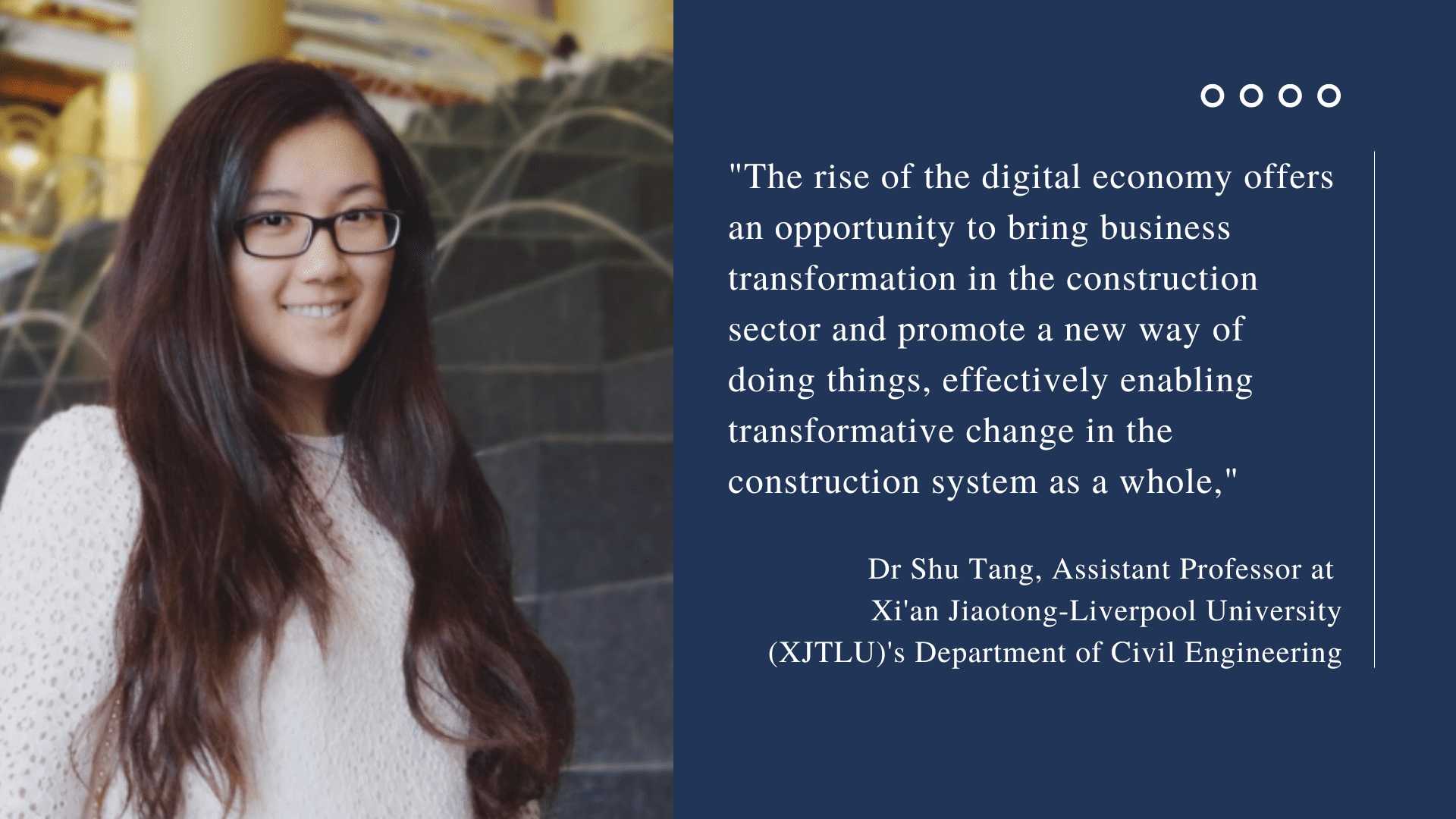
"The rise of the digital economy offers an opportunity to bring business transformation in the construction sector and promote a new way of doing things, effectively enabling transformative change in the construction system as a whole," said Dr. Shu Tang, assistant professor at Xi'an Jiaotong-Liverpool University (XJTLU)'s Department of Civil Engineering, during a recent interview with Glodon.
Dr. Tang is in charge of research on low-carbon operation strategies in the green building industry based on big data under an MoU signed between Glodon and XJTLU. She added that the construction industry's inevitable progression trend includes green concepts and intelligent means.
What follows are highlights of Dr. Tang's answer to the interview, edited and condensed for clarity.
Green Building and the Impact of Digitalisation on the Environment
The construction industry is known as a significant contributor to carbon dioxide emissions because it consumes a sizable amount of global energy. The construction industry consumes more than 40% of the world's energy and emits one-third of all greenhouse gases, other environmental impacts of the building industry are wide. Green building has gained substantial support as a panacea for minimising the environmental impacts of buildings to achieve sustainable development.
The primary benefits of green building are known to include enhanced human health and well-being, environmental protection, increased profitability, and energy efficiency. Green building demands the integration of green technologies and interactions among other building components to achieve sustainability goals. It is evident that the application of green technologies can contribute to sustainable development.
For instance, in southern California, the application of efficient water heating, energy-efficient HVAC systems, the introduction of daylight, optimisation of building orientation and configuration, insulation, and application of passive solar have helped designers to achieve a 59% reduction in building energy consumption.
Digital technology adoption promotes the quality and efficiency of information acquisition in the project network. Existing research indicates that a digital construction framework incorporating BIM, three-dimensional (3D) laser scanning, and other technologies help to optimise the efficiency of the renovation project process by 15% and helps to shorten the duration by two months, with cost savings of 7.41%.
It also facilitates data computation and analysis, which assists stakeholders in making rational decisions.
#Glodon
"The rise of the digital economy offers an opportunity to bring business transformation in the construction sector and promote a new way of doing things, effectively enabling transformative change in the construction system as a whole," said Dr. Shu Tang, assistant professor at Xi'an Jiaotong-Liverpool University (XJTLU)'s Department of Civil Engineering, during a recent interview with Glodon.
Dr. Tang is in charge of research on low-carbon operation strategies in the green building industry based on big data under an MoU signed between Glodon and XJTLU. She added that the construction industry's inevitable progression trend includes green concepts and intelligent means.
What follows are highlights of Dr. Tang's answer to the interview, edited and condensed for clarity.
Green Building and the Impact of Digitalisation on the Environment
The construction industry is known as a significant contributor to carbon dioxide emissions because it consumes a sizable amount of global energy. The construction industry consumes more than 40% of the world's energy and emits one-third of all greenhouse gases, other environmental impacts of the building industry are wide. Green building has gained substantial support as a panacea for minimising the environmental impacts of buildings to achieve sustainable development.
The primary benefits of green building are known to include enhanced human health and well-being, environmental protection, increased profitability, and energy efficiency. Green building demands the integration of green technologies and interactions among other building components to achieve sustainability goals. It is evident that the application of green technologies can contribute to sustainable development.
For instance, in southern California, the application of efficient water heating, energy-efficient HVAC systems, the introduction of daylight, optimisation of building orientation and configuration, insulation, and application of passive solar have helped designers to achieve a 59% reduction in building energy consumption.
Digital technology adoption promotes the quality and efficiency of information acquisition in the project network. Existing research indicates that a digital construction framework incorporating BIM, three-dimensional (3D) laser scanning, and other technologies help to optimise the efficiency of the renovation project process by 15% and helps to shorten the duration by two months, with cost savings of 7.41%.
It also facilitates data computation and analysis, which assists stakeholders in making rational decisions.
You might also like

Slim Down with Every Sip: The Fitspresso Coffee Loophole
star
star
star
star
star
4.0/5
$0.00

Discount London theatre tickets
star
star
star
star
star
4.0/5
$22.00

Professional Dissertation Writers India | Mythsis
star
star
star
star
star
4.0/5
$0.00

Buy YouTube Views
star
star
star
star
star
4.0/5
$30.00