Enterprise Web Scraping at Scale: How to Build Reliable Recurring Data Pipelines
$0.00
Enterprise Web Scraping at Scale: How to Build Reliable Recurring Data Pipelines
A practical guide to designing recurring web-data operations around dataset quality, recoverability, observability, and delivery - not just request volume.
ARTICLE TYPE
Enterprise authority / off-page AUDIENCE
Data, engineering & operations teams FORMAT
Long-form editorial guide
Scraping 100,000 pages once is not the same problem as delivering a validated dataset from 100,000 changing pages every day. At enterprise scale, the challenge shifts from writing extraction code to operating a dependable data pipeline: scheduling work, handling source diversity, normalizing fields, validating records, detecting changes, recovering from failures, preserving history, and delivering usable data on time.
Key idea
Enterprise scale should be measured by how reliably the expected dataset is delivered at the required cadence - not only by how many requests the system can send.
What Makes Web Scraping “Enterprise”?
Enterprise web scraping usually combines several operating requirements at once: many sources, recurring schedules, large record volumes, dynamic pages, multiple markets or locations, strict schemas, downstream integrations, monitoring, recovery, and clear ownership when something breaks.
A useful distinction is: basic scraping asks, “Can we extract this page?” Enterprise scraping asks, “Can we deliver the required dataset reliably, repeatedly, and in a form the business can use?”
Think in Data Pipelines, Not Scrapers
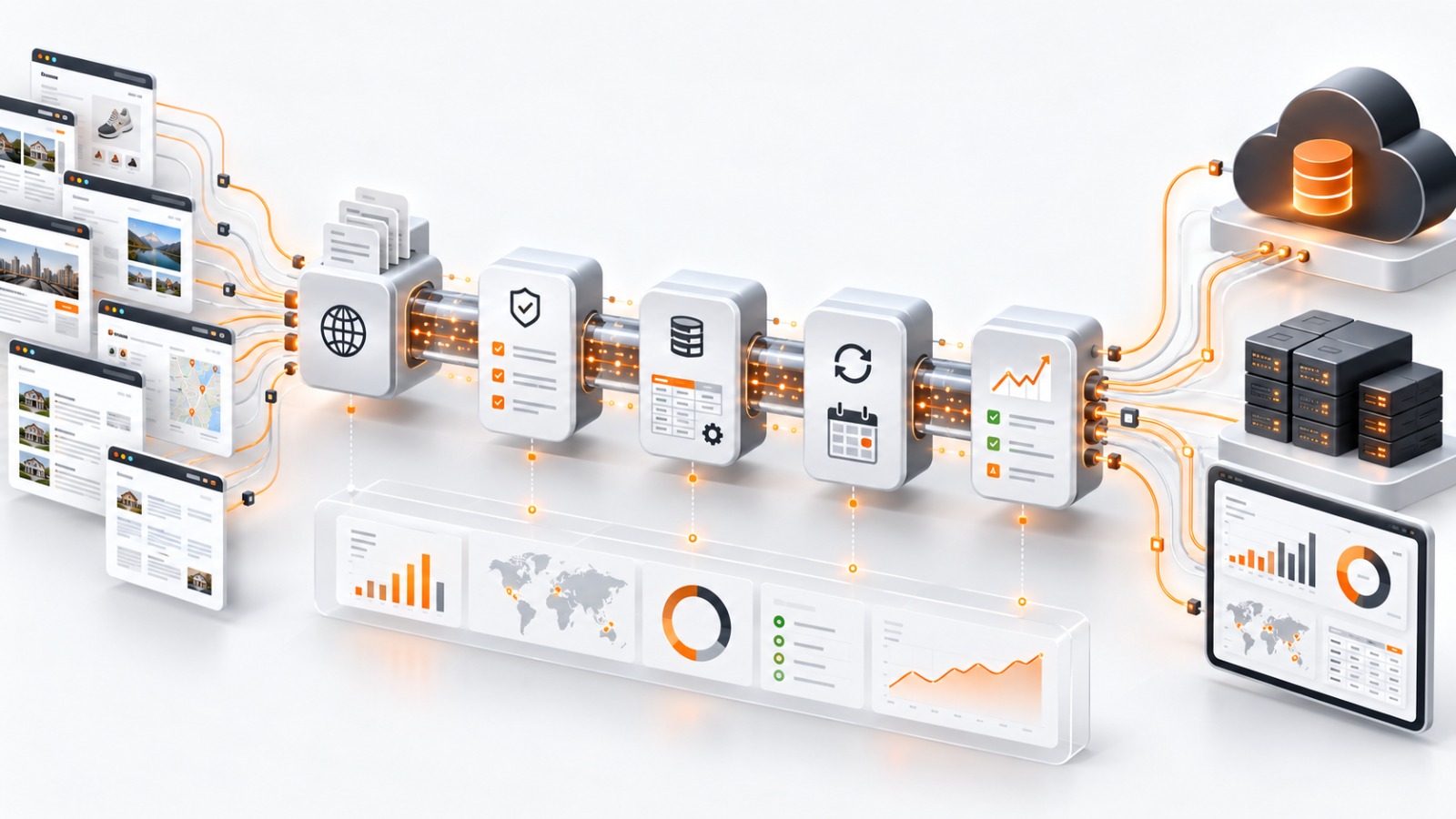
A scraper is only one component of a production system. A recurring enterprise workflow normally includes discovery, collection, rendering or retrieval, extraction, normalization, validation, storage, delivery, monitoring, and recovery. Treating the entire process as a pipeline makes ownership and failure handling much easier to design.
Sources Queue Collect Extract Normalize Validate Store Deliver
Monitoring, retries, backfills, logs, and alerting sit across the pipeline rather than at one single step. That is why the architecture should be designed around the data outcome instead of around a single crawler.
1. Define the Dataset Before the Infrastructure
Before deciding how many browser workers, proxies, or servers are needed, define the dataset contract. Infrastructure choices should follow the required output.
• Sources: the websites, apps, marketplaces, or public endpoints that must be covered.
• Entities: products, companies, properties, jobs, listings, locations, or another business object.
• Fields: the exact schema, including required and optional fields.
• Coverage: expected records, markets, locations, categories, or pages.
• Cadence: hourly, daily, weekly, event-driven, or on demand.
• Freshness: how old data may be before it is no longer useful.
• Acceptance criteria: the minimum completeness, coverage, validity, and delivery requirements.
Design principle
Infrastructure should be designed around the dataset SLA, not the other way around.
2. Design for Source Diversity
At scale, source diversity is often harder than raw page volume. A static product page, a JavaScript-heavy marketplace, a location-dependent retailer, and a paginated directory may all require different collection strategies.
Source pattern Operational consideration
Static pages Simple HTTP retrieval may be sufficient; keep extraction and quality checks separate.
JavaScript-heavy pages Rendering, interactions, lazy loading, or browser automation may be required.
Search/listing pages Discovery, pagination, sorting, filters, and result-set changes need monitoring.
Location-dependent pages Store, ZIP code, region, currency, or session context can change the observed data.
Marketplaces Seller, variant, offer, and identifier complexity can make matching harder.
Frequently changing sources Higher monitoring and maintenance effort should be expected.
A single “universal” collector may simplify the diagram but make operations brittle. Enterprise systems usually benefit from grouping sources by behavior and routing them through the appropriate collection path.
3. Schedule and Queue Work by Business Priority
Recurring scraping needs a scheduler, a work queue, concurrency controls, retry rules, and prioritization. The important point is that not every source needs the same refresh rate.
Tier 1 - high-value signals: Critical price, stock, or availability records may need frequent refreshes.
Tier 2 - core catalog: Full product or listing coverage may run daily.
Tier 3 - enrichment and history: Lower-priority enrichment may run weekly or during spare capacity.
This approach aligns infrastructure usage with business value and makes backlogs easier to manage when a source becomes slow or unstable.
4. Separate Collection From Extraction
Collection and extraction solve different problems. Keeping them separate reduces the blast radius when one layer changes.
Collection layer Extraction layer
Fetching or rendering pages
Session and access context
Retries and backoff
Browser or HTTP execution Field selection and parsing
Schema mapping
Type conversion
Entity and identifier logic
If a source switches from simple HTML to heavier client-side rendering, the collection layer may need to change while the normalized output schema remains stable.
5. Normalize Before Data Reaches Downstream Systems
Page-level extraction does not automatically create a usable enterprise dataset. Equivalent values should be normalized into consistent types and units before analytics, matching, or downstream automation depends on them.
Source value Normalized value Context
$1,299.00 1299.00 currency = USD
1299 USD 1299.00 currency = USD
$1.08/oz 1.08 unit = ounce
Other common normalization areas include dates, units, availability states, categories, addresses, identifiers, seller names, and location context. Raw extraction scales page volume; normalization scales usability.
For a broader view of how collection, validation, storage, and delivery fit together, see KVETOIQ’s guide to building a web scraping data pipeline for reliable data delivery.
6. Build Data Quality Into the Pipeline
Quality checks should run as part of production, not as a manual inspection after the dataset is delivered. At minimum, separate quality into several layers:
Schema validation: Are required fields present and named correctly?
Type validation: Is a price numeric? Is a timestamp parseable?
Business-rule validation: Can a sale price exceed the list price? Is an availability value from the allowed set?
Historical/anomaly validation: Did record count, null rate, price distribution, or category coverage change unexpectedly?
Metric What it answers
Coverage Did we collect the expected records or source population?
Completeness Are required fields populated?
Freshness Was the dataset collected and delivered inside the required window?
Validity Do values pass schema and business rules?
Duplicate rate Are repeated entities or records controlled?
Successful Requests Are Not a Reliability Metric
An HTTP request can be handled successfully while the extracted business data is incomplete, stale, or wrong. For example, the page may return normally while a price field disappears, a variant is mismatched, or only part of a result set is rendered. The HTTP specification defines what status codes mean at the protocol level; it does not validate the business semantics of an extracted dataset. RFC 9110: HTTP Semantics is a useful neutral reference for that distinction.
Better reliability question
Instead of asking only “What percentage of requests succeeded?”, ask “What percentage of expected records passed acceptance criteria and arrived on time?”
7. Detect Schema Drift and Source Changes
Websites evolve continuously. Reliable pipelines need both technical alerts and data-level alerts so silent changes are detected before they become bad downstream decisions.
• A required field disappears or moves.
• DOM or rendering behavior changes.
• Pagination or URL patterns change.
• Record counts shift unexpectedly.
• New variants, categories, or seller structures appear.
• A field changes type or meaning.
Technical monitoring may show that a request failed. Data monitoring should also catch the harder case: the job “succeeded” but the resulting dataset no longer behaves as expected.
8. Design Retries, Backfills, and Recovery
Recurring systems should have an explicit recovery model. Without one, transient failures turn into permanent gaps in historical data.
Retry: Repeat a temporarily failed task.
Re-run: Execute a failed job again after the issue is corrected.
Backfill: Restore a missing historical window or expected partition.
Replay: Reprocess previously stored raw data through updated extraction or normalization logic.
For a daily feed, recovery should be designed so a Tuesday failure does not create a permanent Monday-to-Wednesday gap. The pipeline should know what is missing, what can be replayed, and how the restored data will be delivered without creating duplicates.
9. Preserve Historical Observations
Overwriting yesterday’s state removes much of the value of recurring collection. Where the use case supports it, preserve enough context to reconstruct what changed and when.
• Entity or product identifier
• Source and source URL
• Observed value(s)
• Location, seller, query, or other context
• Collected-at timestamp
• Job or run identifier
A current price of $79 is useful. A sequence of $99 → $89 → $79 is market intelligence. The same principle applies to rankings, availability, seller counts, reviews, assortment, listings, and many other web signals.
10. Build Observability Around the Dataset
Infrastructure monitoring is necessary, but it is not sufficient. Enterprise teams should observe the pipeline at three levels:
Layer Signals to monitor
Infrastructure Request errors, latency, worker health, browser failures, resource saturation.
Pipeline Jobs completed, queue depth, retries, backfills, delivery failures, processing time.
Dataset Record count, null rates, freshness, coverage, duplicates, schema drift, anomalies.
Operational insight
The most important dashboard may not be server health. It may be the comparison between yesterday’s dataset and today’s dataset.
11. Treat Delivery as Part of the Pipeline
A collection workflow is not complete when extraction finishes. The data still has to reach the system where it is consumed, with the correct schema and timing.
Push delivery: The pipeline writes to a customer destination such as S3, a database, or warehouse.
Pull delivery: The customer retrieves data through an API or storage location.
Incremental delivery: Only new or changed records are delivered.
Full snapshot: Each run delivers the complete current dataset.
Common formats and destinations include CSV, JSON, APIs, object storage, relational databases, and data warehouses. The right model depends on downstream operations, not on which format is easiest for the scraper.
What Should an Enterprise Web Scraping SLA Measure?
A web-data SLA should reflect the usefulness of the delivered dataset, not only system uptime. Depending on the engagement, useful service measures can include:
Dataset freshness: Was the data collected and delivered before the agreed deadline?
Coverage: What percentage of the expected records or sources were captured?
Completeness: How consistently are required fields populated?
Delivery success: Did the output reach the agreed destination?
Incident response: How quickly are important failures detected and acknowledged?
Recovery objective: How quickly can missing data or a failed window be restored?
These concerns become increasingly important as source count, frequency, or geographic coverage grows. KVETOIQ’s guide to large-scale web scraping explores additional scaling considerations beyond a single crawler or site.
Scaling Means More Than Page Volume
Dimension What grows
Source scale More independent websites, apps, or marketplaces.
Volume scale More pages, products, entities, or records.
Frequency scale More refreshes per day or shorter freshness windows.
Geographic scale More countries, regions, stores, ZIP codes, or languages.
Schema scale More fields, entities, relationships, and transformation rules.
Delivery scale More downstream consumers and destinations.
Reliability scale More monitoring, retries, incident handling, and recovery paths.
A pipeline processing ten million structurally similar pages may be easier to operate than one processing fifty thousand pages across hundreds of different source architectures. Operational diversity often matters as much as volume.
Common Enterprise Pipeline Failure Modes
Silent field failure: The job completes but an important field becomes empty or incorrect.
Partial dataset: Only a fraction of the expected source population is collected.
Duplicate records: Retries or replay logic create repeated entities.
Stale data: Old responses or failed refreshes are presented as current.
Schema drift: A field changes type, meaning, or position without downstream systems being updated.
Delivery failure: A valid dataset is produced but never reaches the warehouse, API consumer, or storage destination.
Source-specific bottleneck: One difficult source delays an entire batch because isolation and prioritization are weak.
Many of these failures are reduced by applying consistent web scraping best practices around validation, monitoring, throttling, retries, and change handling.
Build Internally or Use a Managed Enterprise Service?
Some organizations should own the scraping stack. Others primarily need the resulting data. The right model depends on whether collection infrastructure itself creates strategic value.
Build internally when:
• Web collection is core intellectual property or central to the product.
• The company already has experienced scraping and data-platform engineers.
• Maximum control over runtime behavior and architecture is strategically important.
• The source portfolio is well understood and the organization is prepared to own ongoing maintenance.
Consider a managed model when:
• The business primarily needs dependable recurring datasets.
• Many sources need continuous monitoring and maintenance.
• Quality checks, normalization, recovery, and delivery must be operated as one workflow.
• Internal engineering time is better spent on downstream products, analytics, or decision systems.
Organizations that need production-grade recurring datasets without owning every collection, monitoring, validation, and maintenance component may use enterprise web scraping services to shift more of the operational pipeline responsibility to a specialist provider. The provider should still be evaluated against explicit source, quality, freshness, delivery, and recovery requirements.
Enterprise Web Scraping Reference Architecture
Control Scheduler / Priorities Monitoring
Sources Discovery & Queue Alerts
Collection HTTP / Browser Workers Retries
Raw layer Raw responses / snapshots Replay
Data layer Extraction → Normalize → Validate Quality rules
State History / accepted dataset Backfills
Delivery API / S3 / DB / Warehouse SLA reporting
Production Readiness Checklist
☐ Sources and source ownership documented
☐ Output schema and required fields defined
☐ Cadence and freshness targets agreed
☐ Coverage and completeness thresholds defined
☐ Retry and backoff rules established
☐ Backfill and replay processes tested
☐ Schema-drift and record-count monitoring active
☐ Dataset freshness monitored
☐ Delivery failure alerts configured
☐ Historical storage and retention defined
☐ Escalation ownership documented
☐ SLA or acceptance criteria agreed
Frequently Asked Questions
What is enterprise web scraping?
Enterprise web scraping is recurring web-data collection operated with production requirements such as scale, monitoring, validation, normalization, recovery, structured delivery, and clear ownership. The important distinction is not only how much data is collected, but how reliably the expected dataset is produced and delivered.
How is enterprise web scraping different from basic scraping?
Basic scraping may focus on extracting data from a page or small set of sources. Enterprise workflows typically add scheduling, source diversity, distributed execution, schema consistency, quality controls, historical state, observability, recovery, integrations, and service-level expectations.
How do you make a web scraping pipeline reliable?
Define the expected dataset first, separate collection from extraction, validate records, monitor data-level behavior, isolate source failures, use retries and backfills, preserve historical context, and monitor delivery. Reliability should be measured at the dataset level rather than only by request success.
How often can an enterprise scraping pipeline run?
Cadence depends on source behavior, business value, volume, technical feasibility, and how quickly the organization can act on changes. Some signals may need frequent refreshes while full catalog or enrichment workflows can run less often.
What metrics should enterprise scraping teams monitor?
Useful metrics include coverage, completeness, freshness, validity, duplicate rate, job success, retry volume, queue depth, schema drift, record-count anomalies, delivery success, and recovery time. The exact set should reflect the dataset SLA and downstream use case.
When should companies use enterprise web scraping services?
A managed service can be appropriate when the organization primarily needs recurring structured data rather than scraping infrastructure, especially when many changing sources, quality controls, monitoring, recovery, or multiple delivery destinations would otherwise require significant internal engineering ownership.
Final Takeaway
Enterprise web scraping is not simply “scraping with more servers.” The difficult part is maintaining a dependable flow of accepted data as sources change, volumes grow, schemas evolve, and downstream teams depend on predictable delivery.
The most resilient programs start with the dataset contract, design source-specific collection paths, normalize and validate before delivery, monitor dataset behavior, preserve history, and plan recovery before failure occurs. Whether the pipeline is built internally or managed externally, the success criterion should remain the same: the right data, at the expected quality, delivered when the business needs it.
About KVETOIQ
KVETOIQ helps organizations collect, validate, normalize, and deliver structured web data for recurring business, analytics, and AI workflows. Visit KVETOIQ
sell
Computers/Gaming
storefront
Pradip Valand's Store