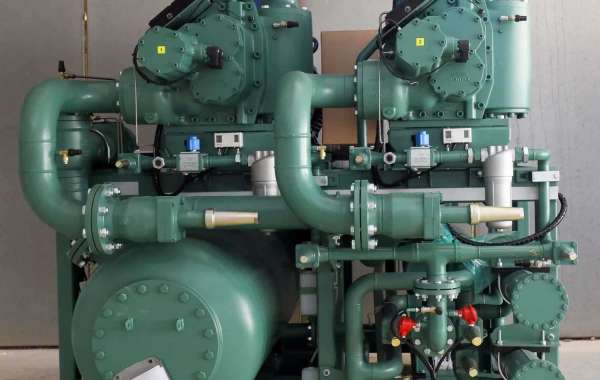
A Quick Guide to Ammonia Compressors
When it comes to large-scale refrigeration systems the most commonly used contraption is the ammonia compressor. Ammonia refrigeration is implemented within industries in a number of ways including beverage and food manufacturing facilities, cold storage warehouses, combined cycle power plants, and petrochemical facilities.
However, the question arises, what are ammonia compressors? and to answer that here is a quick guide to help you understand what they are all about:
What is an Ammonia Compressor?
The ammonia compressor is a mechanical device that creates refrigeration by removing heat from objects or spaces. The compression system changes ammonia from a liquid state to a gaseous state and back to liquid. Ammonia is a naturally occurring colourless gas that is a compound of nitrogen and hydrogen.
How Does the Ammonia Compressor Work?
Normally the compressor will heat up the ammonia gas when it is pressurized. From here on the hot and compressed vapours of ammonia gas travel through the coils similar to the ones found on the backside of a refrigerator and dissipate the heat.
As the gas cools down and condenses into a liquid there is still high pressure that is instilled within it. The liquid ammonia then flows through an expansion valve that is akin to a small hole or port, allowing the liquid ammonia to enter a low-pressure area.
The drop in the pressure then causes the gas to immediately boil and vaporize. This creates the refrigeration effect as the temperature drops to -27 degrees Fahrenheit or -32.8 degrees Celsius. The important point to note here is that ammonia is used because it has a very low boiling point in its liquid form.
Components of Ammonia Refrigeration System
As you can tell already the ammonia refrigeration system is like any other vapour-compression refrigeration system which is made up of a number of components that work together. If any one of them breaks down or goes missing the refrigeration system will stop working almost immediately.
The required components are an evaporator, expansion device, compressor, and condenser. Furthermore, you can also find additional components being installed into the system such as a fan to directly cool the area where it is needed. This allows the refrigeration unit to work more effectively without being overloaded.
Types of Ammonia Compressors
Generally, we find three types of ammonia compressors that are widely used to this day. These include namely the reciprocating compressor, screw or helical compressor, and scroll compressor. The Reciprocating type is also known as the piston type compressor which is similar to an automobile’s engine system.
On the other hand, the screw or helical rotary compressors are either single-screw or twin screws. In the single screw compressor, the screw turns and compresses the ammonia gas and forces it to enter between the grooves and housing section thereby discharging it into the coil area.
The twin-screw type contains a shared housing that is meshed closely with precisely synchronized rotors. With one screw turning clockwise the motor turns the other screw counterclockwise. It is important here to point out that single-screw compressors are quieter and have less vibration.
Lastly, the scroll compressors usually have one fixed and one orbiting scroll to compress ammonia vapors. The stationary upper scroll contains the gas discharge port while the lower scroll’s rotation causes the scroll to move in a circular path around the shaft’s center.
Final Word
I hope this post was able to clarify what ammonia compressors are and how different types of ammonia compressors work in an industrial setting. However, if you feel that I have left out something important that should have been included in this post then do let me know by leaving a mention in the comment section below. Till then happy reading and BANZAI!


