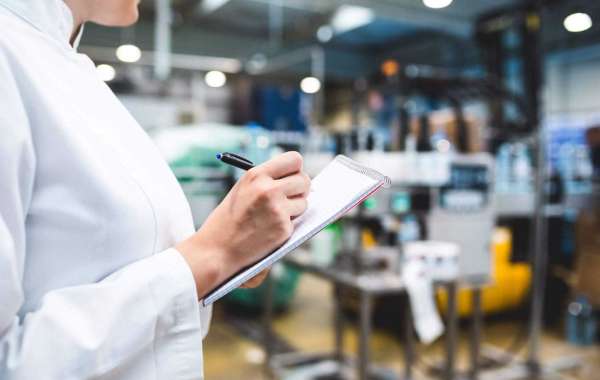
Best Guide About Product Inspection and Quality Control
Quality control management refers to the verification of the conformity of the quantitative or qualitative characteristics of a product or process, on which product quality depends , to established technical requirements.
Product inspection and quality control is an integral part of the production process and is aimed at checking the reliability in the process of its manufacture, consumption or operation.
The essence of product quality control at the enterprise is to obtain information about the state of the object and compare the results obtained with the established requirements recorded in the drawings, standards, supply contracts, technical specifications. NTD, TU and other documents.
Control involves checking products at the very beginning of the production process and during the period of operational maintenance, ensuring that, in case of deviation from the regulated quality requirements, corrective measures are taken to produce products of good quality, proper maintenance during operation and full satisfaction of customer requirements.
Thus, product control includes such measures at the place of its manufacture or at the place of its use, as a result of which deviations from the norm of the required level of quality can be corrected even before defective or non-compliant products are released. Quality control includes:
● incoming quality control of raw materials , basic and auxiliary materials, semi-finished products, components, tools entering the warehouses of the enterprise;
● production step-by-step control over compliance with the established technological regime, and sometimes inter-operational acceptance of products;
● systematic monitoring of the condition of equipment, machines, cutting and measuring tools, instrumentation, various measuring instruments, stamps, models of test equipment and weight facilities, new and in-service devices, production and transportation conditions of products and other checks;
● control of models and prototypes;
● control of finished products (parts, small assembly units, subassemblies, assemblies, blocks, products).
Quality Promotion
The quality promotion process covers:
● development of documentation reflecting the methods and means of motivation in the field of product quality assurance;
● development of provisions on bonuses to employees of the enterprise for the quality of work (together with the department of organization of labor and wages);
● training and professional development.
A special type of quality control is finished product testing - this is the determination or study of one or more product characteristics under the influence of a combination of physical, chemical, natural or operational factors and conditions.
Tests are carried out according to the relevant programs. Depending on the goals, there are the following main types of tests:
● preliminary tests are tests of prototypes to determine the possibility of acceptance tests;
● acceptance tests are tests of prototypes to determine the possibility of putting them into production;
● acceptance tests are tests of each product to determine the possibility of its delivery to the customer;
● periodic tests are tests that are carried out once every 3 to 5 years to check the stability of production;
● type tests are tests of serial products after significant changes in design or technology have been made.
Product Inspection and Quality Control Measures
The following product control measures may be applied at various enterprises. In individual enterprises, product control measures may cover the entire cycle of mass production, during which raw materials and purchased elements are transformed, moving from one process to another, into the final product.
However, in enterprises specializing in the processing of parts, these measures can cover only that part of the full cycle that is associated with the processing of elements.
In other plants, product control may be limited to the control of assembly processes. However, in all cases, product control is associated with an orderly flow of workpieces and materials.
Here, as a rule, the following stages are distinguished:
1. Receipt of an order for a part, material, or assembly.
2. Studying the requirements contained in the order and taking the steps necessary to fulfill the order, including the correct distribution of the available process and control equipment.
3. Transfer of the order to production.
4. Material control in the manufacturing process.
5. Product approval.
6. Checking the quality of products and evaluating the results.
7. Product packaging and delivery The product
control measures applied during these seven stages can be divided into two groups:
1. Measures to establish and maintain production standards (carried out at stages 13).
2. Measures to control the material during serial production (carried out at stages 47).
Types of Control Operations
A variety of forms and types of product quality control allow us to distinguish the following types of control operations:
According to the Stages of the Product Life Cycle:
● control of the design of new products;
● control of production and sales of products;
● control of exploitation or consumption.
By Objects of Control:
● control of objects of labor;
● control of means of production;
● technology control;
● control of work of executors;
● control of working conditions.
According to the Stages of the Production Process:
● input control designed to check the quality of materials, semi-finished products, tools and fixtures before the start of production;
● intermediate control performed during the technological process (operational);
● final acceptance control carried out over blanks, parts, assembly units, finished products;
● control of transportation and storage of products.
By Product Coverage:
Continuous control performed with 100% coverage of the presented products.
It is used in the following cases:
- when the quality of supplied materials, semi-finished products, blanks, parts, assembly units is unreliable;
- when the equipment or features of the technological process do not ensure the homogeneity of the manufactured objects;
- during assembly in the absence of interchangeability;
after operations that are decisive for the quality of subsequent processing or assembly;
- after operations with a possible high defect rate;
- when testing finished products for special purposes;
Selective control, carried out not over the entire mass of products, but only over a sample. It is usually used in the following cases:
- with a large number of identical parts;
- with a high degree of stability of the technological process;
- after minor operations. • At the place of execution:
Stationary control performed in stationary control points, which are created in the following cases:
When it is necessary to check a large number of identical production facilities that require specially equipped control points (complex measuring equipment);
If it is possible to include the work of a stationary control point in the flow of the final operations of the production process;
Sliding control performed directly at the workplace, as a rule, in the following cases:
When checking bulky products that are inconvenient for transportation;
In the manufacture of a small number of identical products;
If it is possible to use simple instrumentation or instruments.
By Execution Time:
● Continuous;
● Periodic.
By Organizational Forms of Detection and Prevention of Marriage:
Volatile control performed by the controller arbitrarily without a schedule with a systematic bypass of the jobs assigned to him;
Ring control, which consists in the fact that a certain number of jobs are assigned to the controller, which he bypasses around the ring periodically in accordance with the hourly schedule, and the products are controlled at the place of their manufacture;
Statistical control, which is a form of periodic selective control, based on the methods of mathematical statistics and allowing to detect and eliminate deviations from the normal course of the technological process before these deviations lead to marriage;
The current preventive control, performed to prevent rejects at the beginning and during processing. It includes:
● verification of the first copies of products;
● control of compliance with technological regimes;
● verification of materials, tools, technological equipment entering production, etc.
By Influence on the Possibility of Subsequent Use of Products:
● Destructive control;
● Unbreakable control.
According to the Degree of Mechanization and Automation:
● Manual control;
● Mechanized control;
● automated (automated quality management systems) control;
● automatic control;
● active and passive control.
By Performers:
● Self-control;
● Master control;
● OTK control
● Inspection control;
● Single-stage control (executor plus acceptance by QCD);
● Multi-stage control (performer plus operational plus special, plus acceptance).
By Means Used:
● Measuring quality control , used to evaluate the values of the controlled parameters of the product: by the exact value (tools and instruments are scale, pointer, etc.) and by the permissible range of parameter values (templates, gauges, etc. are used);
● Registration quality control , carried out to evaluate the object of control based on the results of the calculation (registration of certain qualitative features, events, products);
● Organoleptic quality control carried out through only the senses without determining the numerical values of the controlled object;
● Visual quality control is a variant of organoleptic quality control, in which control is carried out only by the organs of vision;
● Sample quality control , carried out by comparing the characteristics of a controlled product with the characteristics of a control sample (standard);
● Technical inspection , carried out mainly with the help of the senses and, if necessary, with the involvement of the simplest means of control.
Methods of technical control are typical for each production site and control object. Here they distinguish:
● Visual inspection to determine the absence of surface defects;
● Measurement of dimensions, which allows you to determine the correctness of shapes and compliance with established dimensions in materials, workpieces, parts and assembly joints;
● The total set of subjects of product quality control can be classified according to the levels of management at which they carry out their activities, as well as by types of control.
Source:
https://bluegraydaily.com/best-guide-about-product-inspection-and-quality-control/


