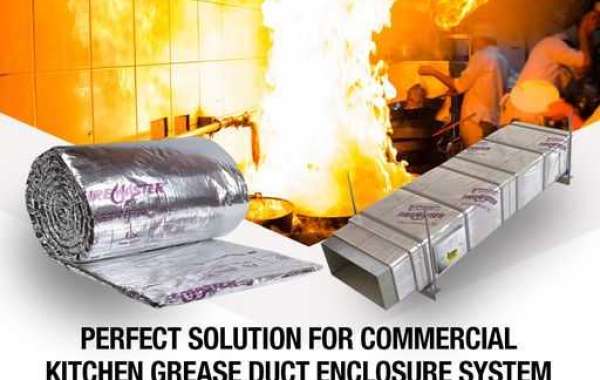
Fire Wrap Systems as Alternative to Fire Rated Shaft Construction
Life safety is paramount. Ducts such as those supplying fresh pressurization air to an exit stairwell or those designed to extract smoke from a fire area in a building are just a few amongst the many air-distribution system (ADS) duct types required by code to be protected from fire in a commercial building. As building codes and fire test standards have evolved over the years, the presence and acceptance of flexible fire rated duct wrap systems as alternatives to gypsum shaft enclosures to provide the required hourly duration of protection has immensely increased.
Many situations arise in a commercial building that make flexible duct wrap systems an attractive alternative to gypsum shaft assemblies for providing the required fire resistance rating. Here are a few examples of these scenarios:
Insufficient space to construct a properly designed code-compliant gypsum shaft
Difficult duct configurations
Other building materials, such as ducts, pipelines, and equipment, as well as their support structures, contribute to the space limits.
Floor ducts that come out of one fire-rated gypsum shaft, run horizontally to the other side of the building, and re-enter another gypsum shaft are known as "cross-overs."
Ducts that run through fire-resistant stairwells and exits
What is a flexible fire wrap system?
Because the flexible wrap materials are fire tested in conjunction with the duct to be protected, they are referred to as "systems." As a result, they are not fire rated wrap "products," but rather a fire resistance-rated duct "system" consisting of the product and duct tested together. A gypsum shaft assembly, on the other hand, is not tested as four walls enclosing the duct, but as a single shaftwall, which is clearly not a duct "system."
High temperature (operating temperatures upwards of 2000°F) low bio persistence fiber blankets are completely encapsulated in scrim reinforced foil in flexible fire wrap products. These fiber blankets are typically made without the use of organic binders, instead relying on a needling process to intertwine the fibers and create a completely noncombustible product form. The scrim reinforced foil encapsulation adds handling strength for installation, helps the product resist moisture, as well as providing a location to print the product identification and certification information for use by Code Officials to properly identify the product installed.
Duct types
As previously stated, numerous duct types are required by building codes to be fire-resistant. The following are examples of duct types:
Pressurization of the stairwell and vestibule
Controlling the smoke
Supply/return
exhaust from a commercial dryer
Exhaust from hazardous and laboratory environments
Exhaust from the bathroom and toilet
Flexible wrap systems have several advantages:
Thin profile construction takes up less space than shaft construction, allowing for more habitable square footage in each building space while also addressing space constraints.
It shapes easily to fit intricate duct designs.
Easy handling is made possible by the lightweight material (usually 6 lbs/ft3 density).
Installed costs are less than those of a gypsum shaft.
Systems that are listed and labeled have been fire tested as a whole, including the ductwork.
Choosing the right fire rated ductwork needs to consider the complexity of the ductwork and the function of the system. It significantly helps to reduce the spread of flames and smokes spreading through gaps and unsecured elements in your building. Bin Dasmal General Trading supplies intelligently engineered thermal ceramics and fire rated insulation solutions by Morgan Advanced Materials. We offer a wide range of solutions for both ventilation and smoke extraction – for different operating pressures, sizes, orientations, configurations, and even for partial fire exposures.


