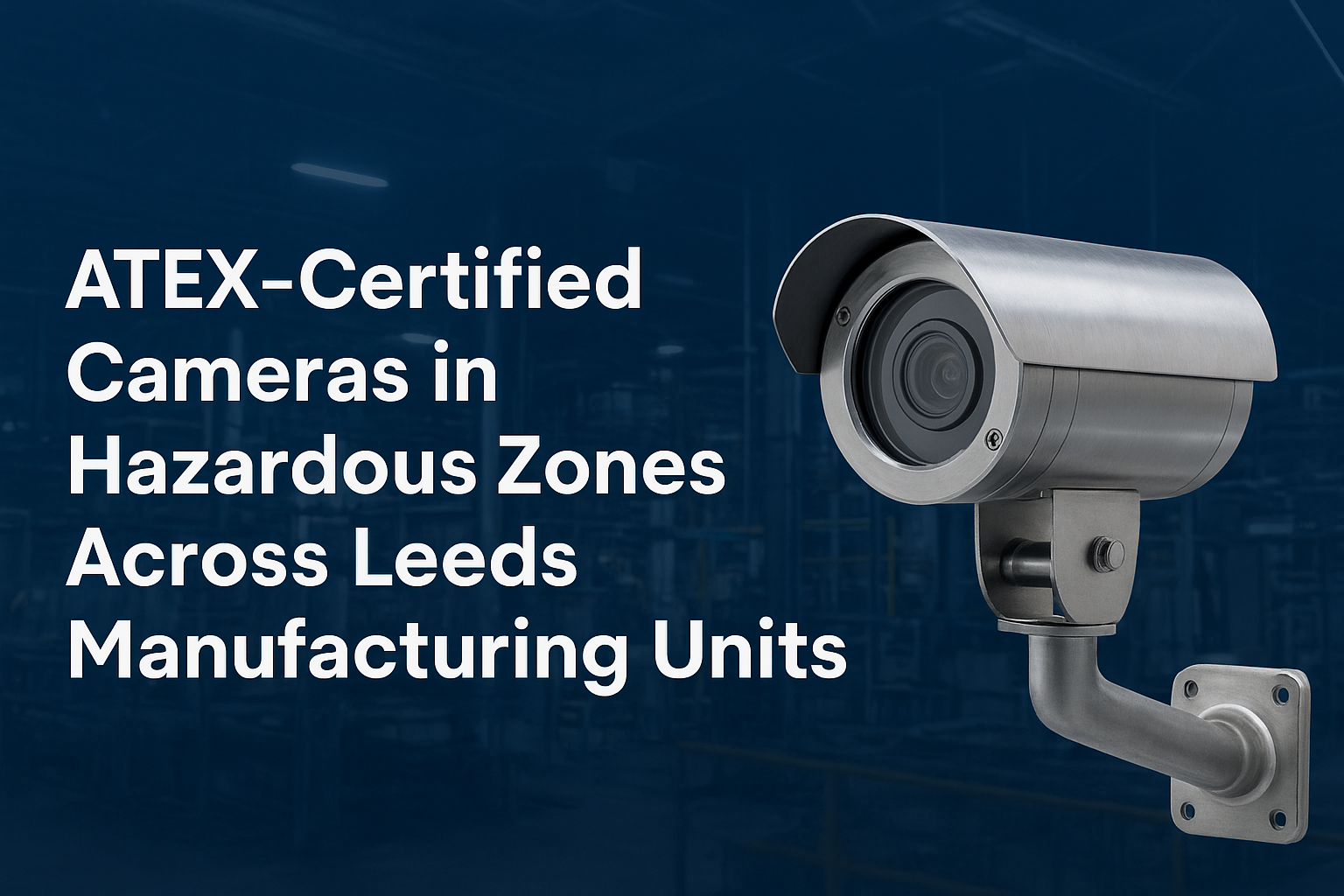
ATEX-Certified Cameras in Hazardous Zones Across Leeds Manufacturing Units
Leeds has long been one of the UK’s strongest industrial hubs, home to a wide range of manufacturing facilities including chemicals, textiles, pharmaceuticals, metalworking, food processing, and energy production. Many of these sites involve processes that generate explosive gases, vapours, or combustible dusts, making them legally classifiable under ATEX zones. For such environments, traditional CCTV is not enough—ATEX-certified cameras are essential to ensure safety, compliance, and continuous monitoring without introducing ignition risks.
What Does ATEX Certification Mean?
ATEX (ATmosphères EXplosibles) is the European directive that governs equipment used in potentially explosive atmospheres. Cameras carrying ATEX certification are tested to ensure they can operate safely in Zone 0, Zone 1, or Zone 2 (gas/vapour risks) and Zone 20, 21, or 22 (dust risks).
In Leeds, manufacturing units handling solvents, petrochemicals, spray-painting, flour milling, or even battery charging rooms are subject to ATEX zoning. By deploying certified CCTV systems, factories demonstrate compliance with the UK DSEAR (Dangerous Substances and Explosive Atmospheres Regulations) and protect both people and assets.
Why ATEX-Certified CCTV is Essential for Leeds Factories
-
Worker Safety – Provides real-time monitoring of hazardous processes, detecting unsafe practices or accidents.
-
Incident Investigation – Recorded video becomes crucial evidence for root cause analysis after fires, leaks, or spills.
-
HSE Compliance – Satisfies Health & Safety Executive expectations during inspections and reduces the risk of non-compliance penalties.
-
Operational Continuity – Ensures that production can be safely monitored without downtime caused by inadequate surveillance.
-
Insurance & Liability Reduction – Certified cameras demonstrate risk mitigation, lowering insurance claims and disputes.
Applications Across Leeds Manufacturing Sectors
-
Chemical & Petrochemical Plants – Monitoring mixing, pumping, and tank storage where solvent vapours are common.
-
Food & Beverage Production – Flour mills, sugar processing, and breweries where dust explosions are a significant hazard.
-
Textiles & Printing – Surveillance in dyeing, coating, and printing sections where flammable liquids are used.
-
Pharmaceutical Manufacturing – Hazardous solvent-based processes, sterile filling zones, and cleanrooms requiring certified monitoring.
-
Metalworking & Engineering – Dusty machining areas, spray-painting booths, and welding bays that fall under ATEX zoning.
Types of ATEX-Certified Cameras
-
Fixed Explosion-Proof Cameras – For continuous monitoring of chemical tanks, conveyors, or storage zones.
-
PTZ Dome Cameras – Provide full situational awareness in large halls or outdoor tank farms. Operators can pan, tilt, and zoom to track activity in real time.
-
Thermal Imaging Cameras – Detect abnormal temperature rises, gas leaks, or smouldering dust accumulations before they escalate into emergencies.
-
Compact Ex Cameras – Designed for tight, confined spaces like paint booths, battery charging areas, or small hazardous enclosures.
Technical Features to Prioritise
-
316L Stainless Steel Housing – Corrosion resistance in facilities exposed to chemicals, solvents, or humid conditions.
-
IP66/IP67 Protection – Safeguards against dust, water spray, and high-pressure washdowns.
-
Anti-Fog/Pressurised Enclosures – Prevent condensation build-up in varying Leeds climate conditions.
-
IR/Night Vision – Ensures visibility in low-light environments such as warehouses and outdoor yards.
-
Smart Analytics – Automatic alerts for PPE compliance, restricted zone entry, smoke/flame detection, and perimeter breaches.
-
Redundant Recording – Edge storage ensures footage is preserved even during power or network interruptions.
Installation Considerations
-
Zone Mapping – Work with DSEAR risk assessments to determine exact ATEX zone boundaries inside the facility.
-
Cable & Junction Protection – Use ATEX-rated glands and explosion-proof junction boxes for safe wiring.
-
Strategic Camera Placement – Focus on high-risk areas such as mixing vessels, storage silos, dust collectors, and solvent bays.
-
Maintenance Planning – Schedule inspections and cleaning using ATEX-certified service providers to maintain compliance.
-
Integration with Security & Operations – Cameras should connect with VMS (Video Management Systems), alarm systems, and access control for a unified safety network.
Benefits for Leeds Manufacturing Units
-
Enhanced Safety Culture – Employees operate with greater accountability knowing hazardous zones are monitored.
-
Operational Efficiency – Supervisors can oversee processes remotely, reducing unnecessary exposure to risk.
-
Rapid Emergency Response – Real-time visuals allow quicker and safer coordination of firefighting or spill-control teams.
-
Future-Proof Compliance – Investing in ATEX-certified CCTV ensures long-term alignment with evolving UK safety regulations.
Conclusion
For Leeds’ diverse manufacturing base, ATEX-certified cameras are more than a security measure—they are an integral component of a safe and compliant industrial environment. By deploying these specialised surveillance systems across hazardous zones, factories protect workers, safeguard assets, and demonstrate full compliance with ATEX and DSEAR obligations. In a city where industry continues to thrive, integrating certified CCTV is not optional—it’s essential for sustainable and responsible growth.


