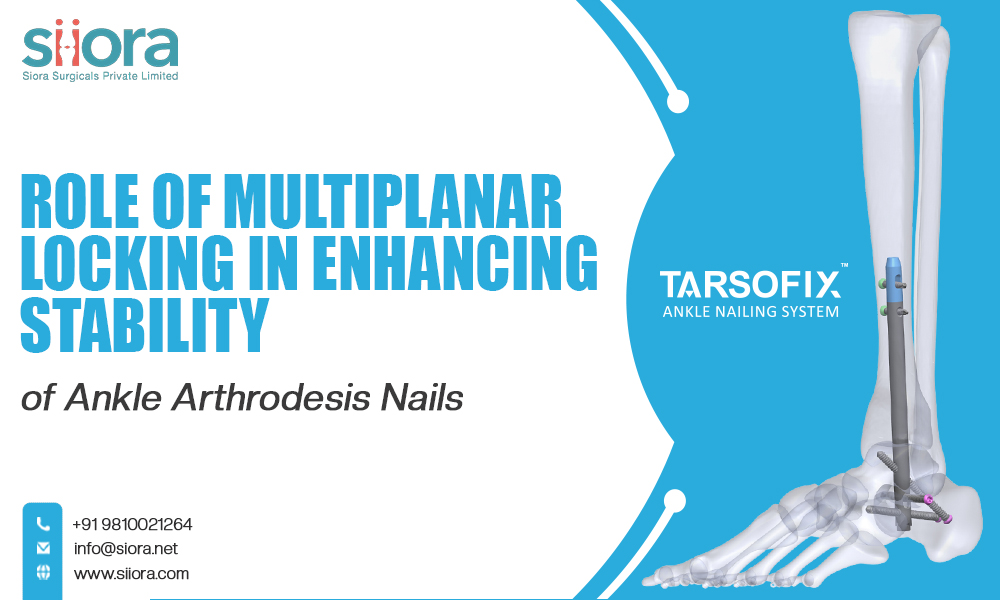
Role of Multiplanar Locking in Enhancing Stability of Ankle Arthrodesis Nails
Ankle arthrodesis remains a reliable solution for patients suffering from severe ankle arthritis, deformity, or failed previous surgeries. The main goal of the procedure is to achieve solid fusion while allowing the patient to return to pain-free weight bearing. Among the different fixation methods available today, intramedullary ankle arthrodesis nails have gained popularity because of their strength and ability to provide stable fixation. One important feature that significantly improves their performance is multiplanar locking.
Understanding Stability in Ankle Arthrodesis
Stability is the foundation of successful ankle fusion. The ankle joint is exposed to high rotational and axial forces during daily activities such as standing and walking. If these forces are not properly controlled, micromotion at the fusion site can delay union or lead to non-union.
Traditional fixation methods often rely on screws placed in a single direction. While this may work in simple cases, it may not be enough in patients with poor bone quality, deformities, or high functional demands. This is where multiplanar locking becomes important.
What Is Multiplanar Locking?
Multiplanar locking refers to the placement of locking screws in different planes around the nail. Instead of screws being aligned in a single straight direction, they are inserted at varying angles—typically in sagittal, coronal, and sometimes oblique planes.
This screw configuration allows the nail to resist forces coming from multiple directions. As a result, the construct becomes more stable and better suited to handle the complex load patterns experienced at the ankle and hindfoot.
How Multiplanar Locking Improves Mechanical Stability?
One of the key advantages of multiplanar locking is improved resistance to rotation. Rotational instability is a common reason for delayed fusion in ankle arthrodesis. By locking the nail in multiple planes, rotational forces are distributed more evenly across the construct.
Multiplanar locking also improves axial stability. During weight bearing, compressive forces act along the length of the limb. Locking screws placed at different angles help prevent nail migration and maintain compression at the fusion site, which is essential for bone healing.
Benefits in Osteoporotic and Complex Cases
Patients undergoing ankle arthrodesis often have compromised bone quality due to age, chronic disease, or previous surgeries. In such cases, single-plane fixation may not provide sufficient hold.
Multiplanar locking increases screw purchase by engaging more cortical bone in different regions. This improves fixation strength and reduces the risk of screw loosening. It is especially helpful in revision cases, Charcot joints, or patients with deformities where standard fixation techniques may fail.
Influence on Fusion Rates and Rehabilitation
Stable fixation allows surgeons to follow more confident postoperative protocols. With improved construct stability, early controlled weight bearing may be possible in selected cases. This can be beneficial for patient comfort and overall recovery.
By limiting unwanted movement at the fusion site, multiplanar locking supports consistent bone healing. Reduced micromotion encourages fusion and lowers the risk of complications such as delayed union or implant failure.
Surgical Considerations
While multiplanar locking offers clear advantages, accurate screw placement is essential. Surgeons must carefully plan screw trajectories to avoid joint penetration and neurovascular structures. Modern nail systems with guided instrumentation have made this process more precise and reproducible.
Understanding the anatomy and biomechanics of the ankle and hindfoot remains critical to achieving optimal outcomes.
Conclusion
Multiplanar locking plays a vital role in enhancing the stability of ankle arthrodesis nails. By controlling rotational and axial forces more effectively, it supports reliable fusion and improves overall construct strength. For surgeons managing complex ankle pathology, multiplanar locking in orthopaedic implant nails offers a practical and biomechanically sound solution that aligns with modern principles of fracture fixation and joint fusion.


