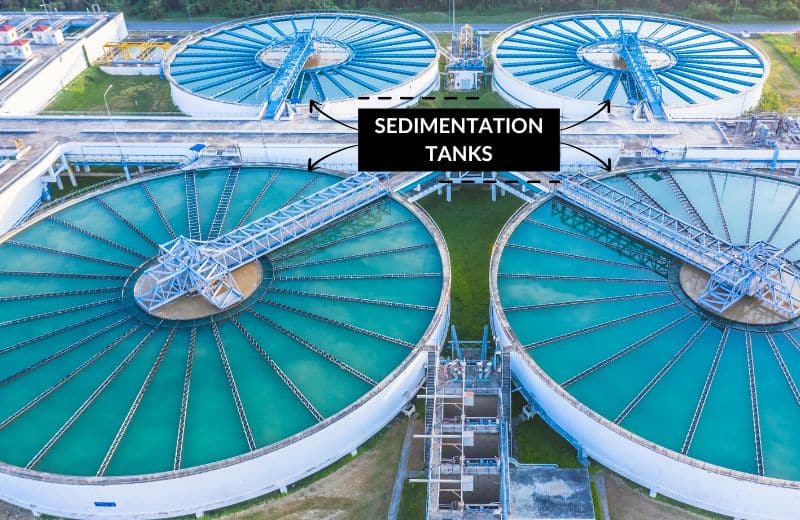
Why Sedimentation Is the Secret to Purification in WTP?
In the complex world of water treatment, we often focus on high-tech membranes, UV lasers, and sophisticated chemical sensors. But one of the most powerful tools in our arsenal is actually the simplest force in the universe: gravity.
Sedimentation is the quiet hero of the water purification process. It is the stage where we stop "fighting" the water and let physics take over. By slowing everything down, we allow the heavy lifting to happen naturally, ensuring the water flowing into our homes is clear, safe, and free of debris from the outside world.
The Power of the "Big Slow Down"
At its core, sedimentation is about patience. When water moves quickly through a river or a pipe, it carries a heavy load of "passengers"—sand, silt, clay, and organic matter. As long as the water is rushing, these particles stay suspended.
Once that water enters a treatment plant's sedimentation tank, the velocity drops almost to zero. Without the current's energy to keep them afloat, the heavier contaminants begin their slow descent to the bottom. This creates a distinct separation: a layer of clean, clarified water at the top and a thick layer of "sludge" at the base.
Why We Can't Skip This Step
Why not just filter everything out?
- Protect the Equipment: Sand and grit are abrasive; removing them prevents wear and tear on pumps and pipes.
- Increase Efficiency: Filters can focus on the microscopic threats because the "big stuff" has already been handled.
- This stage is what turns murky, brown "raw" water into the crystal-clear liquid we recognize as a resource.
The Architecture of Settling: Rectangular vs. Circular
- Rectangular Tanks: These are the industry's reliable workhorses. They are straightforward to build and offer a long path for water to travel, giving particles ample time to settle.
- Circular Tanks: Also known as clarifiers, these are prized for their compact footprint. Water usually enters from the centre and flows outward, making them highly efficient for smaller facilities or specialized industrial applications.
The "Group Hug" Effect: Enhancing the Process
Sometimes, gravity needs a little help. Some particles are so small and light that they could float for days without ever sinking. To speed things up, engineers use coagulants.
Fun Fact: Water temperature actually changes how fast things sink. In warmer water, the liquid is less dense, allowing particles to fall to the bottom more quickly than they would in near-freezing winter water.
Conclusion: The Foundation of Public Health
Sedimentation might not be the flashiest part of a water treatment plant, but it is undoubtedly the foundation. By working with, rather than against, the laws of nature, we can transform environmental water into a safe community resource. It is a testament to the idea that sometimes, the best way to solve a complex problem is to slow down and let gravity do the work.
Are you looking to place a water treatment plant in Madurai?
Nanneer Solutions offers a wide range of water treatment plant series based on your site requirements. We always use top-quality materials to ensure life and easy maintenance.
Ready to optimize your water treatment process? Contact Nanneer Solutions today for customized, efficient, cost-effective water treatment plant tailored to your needs!


