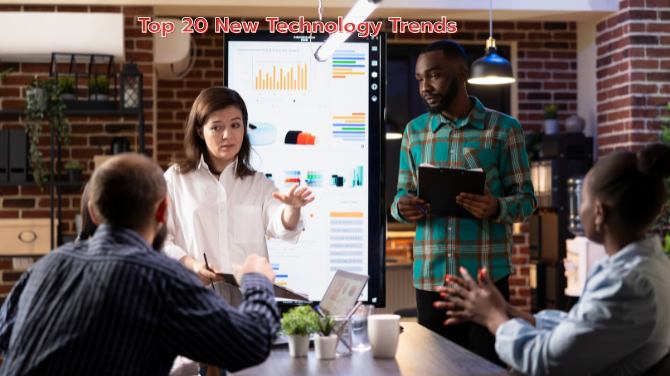
The Next Big Shift: Top 20 New Technology Trends Driving Global Transformation:
The world is entering a powerful phase of technological evolution where innovation is no longer optional but essential for survival and growth. From intelligent systems to immersive digital experiences, modern technologies are reshaping how businesses operate, how people communicate, and how industries deliver value. This next big shift is defined by convergence—where data, automation, and experience-driven solutions work together to drive global transformation.
Artificial Intelligence :
One of the most influential trends is Artificial Intelligence (AI). AI is rapidly moving beyond automation into predictive analytics, personalization, and decision-making. Businesses now use AI to analyze customer behavior, optimize supply chains, and deliver smarter services. Closely connected is Machine Learning, which allows systems to improve continuously without human intervention, enabling faster insights and greater efficiency across industries.
Internet of Things:
Another major trend is Automation and Robotics, transforming manufacturing, logistics, and even service sectors. Intelligent automation reduces human error, cuts costs, and accelerates productivity. When combined with Internet of Things (IoT) technology, automation becomes even more powerful. Connected devices collect real-time data, enabling smarter environments in factories, offices, and smart cities.
Cloud Computing and Edge Computing:
Are also redefining how data is processed and stored. Cloud platforms offer scalability and flexibility, while edge computing ensures faster response times by processing data closer to the source. Together, they support real-time applications such as autonomous systems and interactive digital platforms.
Digital Signage has emerged as a key experience-driven technology in this transformation era. Modern businesses are replacing static displays with dynamic, data-driven screens that deliver targeted messages in real time. This trend is particularly impactful in retail, transportation hubs, corporate environments, and public spaces where attention and engagement are critical.
Cybersecurity continues to grow in importance as digital systems expand. With increased data exchange and connected infrastructure, protecting digital assets is no longer just an IT responsibility—it is a business priority. Advanced security solutions powered by AI are helping organizations detect threats proactively and respond faster.
5G connectivity:
Is another game-changing trend, enabling ultra-fast data speeds and low-latency communication. This technology supports innovations such as smart cities, autonomous vehicles, and immersive experiences. Alongside 5G, Extended Reality (AR, VR, and MR) is transforming training, education, marketing, and entertainment by creating interactive and immersive digital environments.
Transforming the digital landscape by enabling ultra-fast data speeds, low latency, and reliable real-time communication. This advanced network technology supports high-resolution visuals, seamless streaming, and instant data transfer, making it ideal for next-generation display solutions. In smart cities, retail environments, and large public venues, an LED Wall powered by 5G can deliver dynamic content without delays or signal loss.
The combination of cloud platforms and 5G allows content to be updated remotely, ensuring consistent messaging across multiple locations. For events and advertising, an LED Wall benefits from smoother animations, interactive features, and live integrations that enhance audience engagement.
LED Wall:
As businesses adopt immersive communication strategies, an LED Wall supported by 5G connectivity becomes a powerful tool for real-time marketing, data-driven storytelling, and impactful visual experiences. Overall, 5G is not just improving connectivity—it is redefining how digital displays communicate, perform, and create meaningful connections with modern audiences.
In the marketing and communication landscape, Digital Signage plays a critical role in delivering personalized and contextual content. Integrated with data analytics and automation tools, it allows brands to adapt messaging instantly based on audience behavior, location, and time. This real-time adaptability makes it a powerful tool in modern customer experience strategies.
Blockchain technology:
Another important trend is Blockchain technology, which enhances transparency, security, and trust across financial services, supply chains, and digital identity systems. Meanwhile, Low-Code and No-Code platforms are democratizing software development, enabling non-technical users to build applications faster and more efficiently.
As organizations embrace digital ecosystems, Digital Signage continues to evolve as a smart communication channel rather than a simple display solution. When combined with AI, IoT, and cloud platforms, it becomes an intelligent interface connecting brands with audiences in meaningful ways.
Conclusion:
The next big shift in global transformation is driven by the integration of intelligent, automated, and experience-focused technologies. From AI and automation to immersive platforms and Digital Signage, these top technology trends are redefining how the world works, communicates, and grows. Businesses that adapt early and strategically will lead the future, while those that resist risk being left behind.


