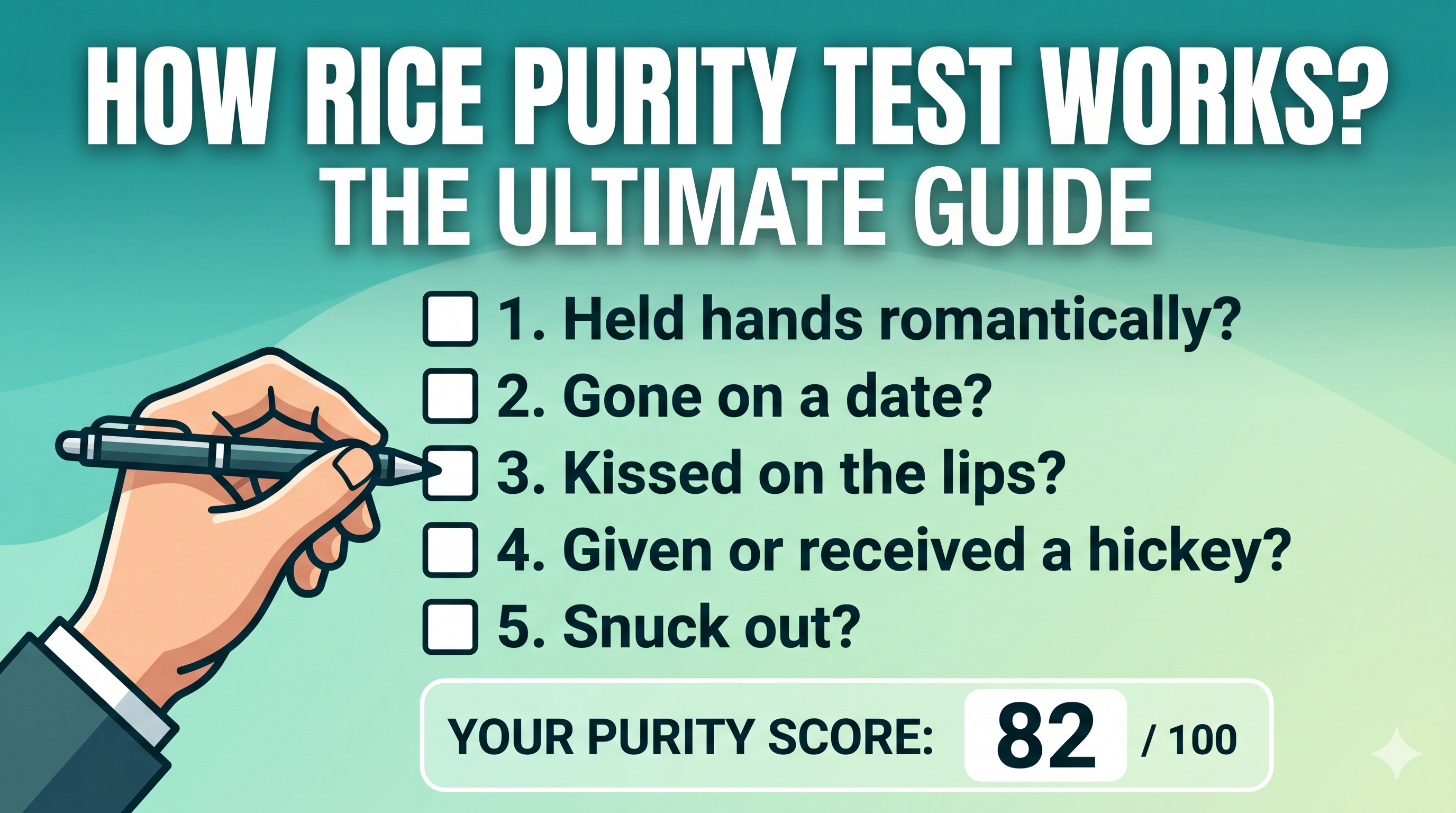
What is Rice Purity Test and how it works
The Rice Purity Test has become a legendary internet ritual, especially for high school and college students entering new chapters of their lives. If you have spent any time on social media, you have likely seen someone post a puzzling number with the simple caption, "My score is 82."
You know they are not talking about a recent history quiz—they are talking about their perceived "purity ratio."
But what exactly is this test, how did a simple 100-question checklist become a multi-generational phenomenon, and how do the mechanics actually work? Here is a refined breakdown of the internet’s favorite icebreaker.
The Origin Story: A Century of Testing Boundaries
The Rice Purity Test was not invented by a modern social media guru or a marketing firm. Its roots go all the way back to Rice University in Houston, Texas, in the early 1920s.
Originally, it was an informal survey published in a student publication, designed as a voluntary way for upperclassmen to gauge the lifestyle experiences of incoming freshman women. Over the decades, it evolved, was digitized, expanded to include all genders, and eventually escaped the boundaries of the campus to become a global internet viral sensation.
Summary of Historical Key Events
| Era | Event |
| 1920s | First informal "purity tests" appear in Rice student publications. |
| 1970s–1980s | The test resurfaces and expands from a few questions to a stylized 100-question format. |
| 1990s | The test finds a home on the early internet, digitizing the scoring system. |
| 2020s | A resurgence on platforms like TikTok makes it a viral trend for a new generation. |
How the Purity Test Works: The Mechanics of Experience
The setup of the Rice Purity Test is remarkably simple, which contributes to its enduring popularity. It is structured to be taken quickly and casually.
1. The 100-Question Format
The standard modern test consists of exactly 100 unique statements, presented as a yes-or-no checklist. These statements are designed to cover a broad spectrum of life experiences. They generally include categories like:
-
Social & Leisure Activities: Question examples might include "Played a drinking game?" or "Held hands romantically?"
-
Romantic Connections: Gauging the spectrum of dating and physical affection.
-
Risk-Taking Behaviors: Assessing experiences with rule-breaking or testing societal boundaries.
2. The Golden Rule of Checking
The test works on the honor system. The instructions are simple: Read through the list and check the box next to every single statement that applies to you. If you have never done the activity described, you leave the box blank.
3. The Reverse Scoring System
Unlike most tests you took in school, a lower score on the Rice Purity Test is considered "worse" (or less pure). The scoring works by deduction:
-
You start with a perfect score of 100.
-
For every box you check, one point is subtracted from your total.
-
If you check 15 boxes, your final score is 85.
-
If you check 60 boxes, your final score is 40.


