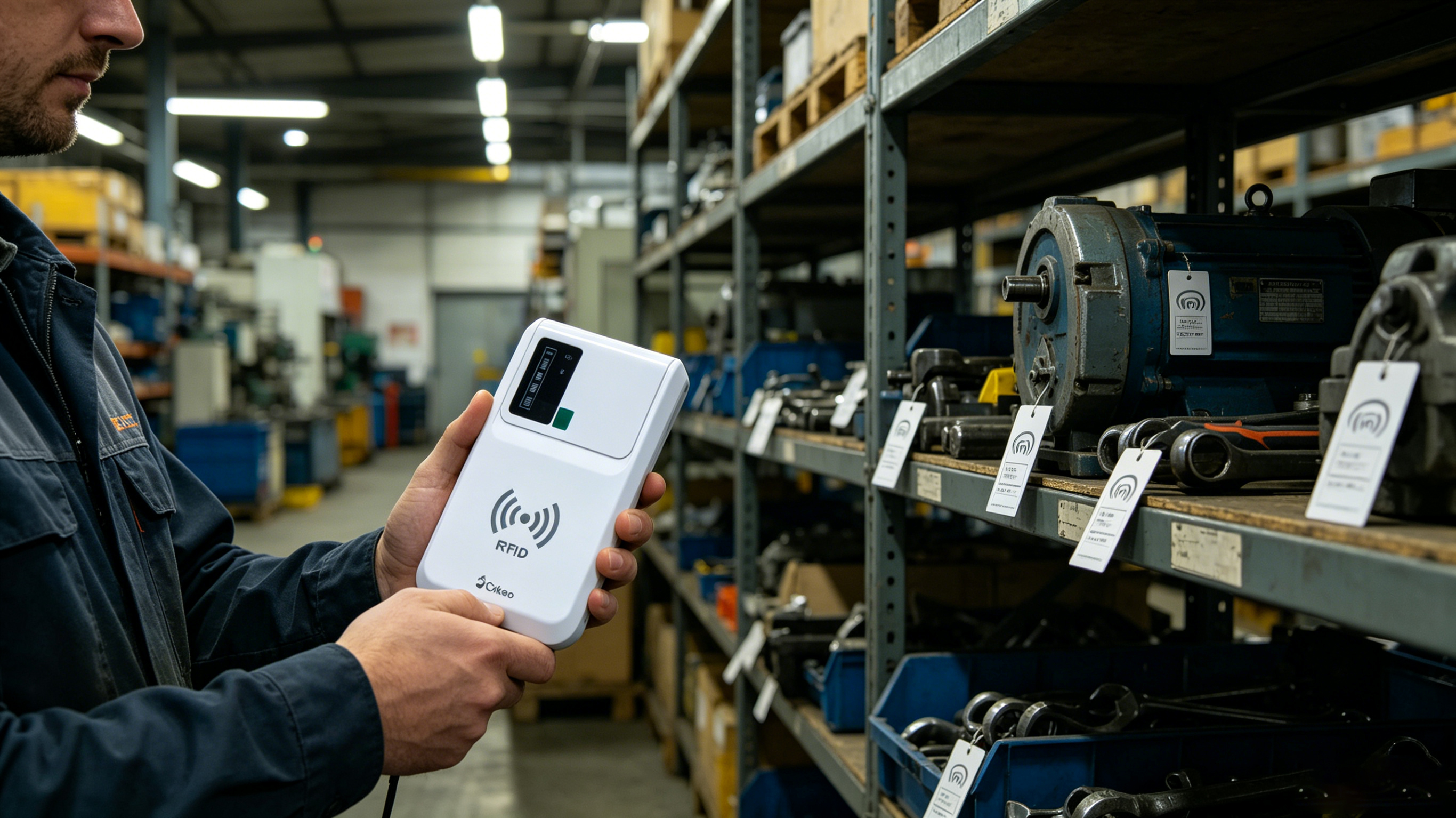
rfid stationary reader: Why Stable Hardware Still Lives in Unstable Environments
The first rfid stationary reader project I handled looked almost too clean during installation week.
Fresh warehouse paint. Newly installed conveyor lanes. Organized pallet flow. Every tagged carton passed through the RFID zone exactly as planned. Read accuracy stayed high enough that nobody questioned the system.
Three months later, the environment barely resembled the original layout.
Extra racks appeared beside outbound lanes. Operators stacked overflow inventory near dock doors during peak season. Forklift traffic started moving diagonally across the read area instead of straight through it.
Then the missed reads started.
Not catastrophic failures. Just enough uncertainty to slow people down again.
That’s something brochures rarely explain about a rfid stationary reader: the reader stays fixed, but the environment around it never does.
From a technical perspective, the hardware is extremely capable.
According to the RAIN RFID Alliance, modern UHF RFID systems can process hundreds of tag reads per second and achieve read distances exceeding 10 meters in optimized conditions.
But optimization is temporary.
Warehouses evolve continuously:
- Inventory density changes
- Temporary metal structures appear
- Workflow shortcuts emerge
- Vehicle traffic patterns shift
RF behavior reacts to all of it.
In one logistics center, read performance dropped noticeably after operators began staging metal carts beside the RFID tunnel during busy periods. The rfid stationary reader itself remained perfectly functional.
The RF environment changed instead.
Industrial RFID Stationary Reader: Why Power Creates Problems
An industrial rfid stationary reader is often evaluated based on maximum reading range. Buyers naturally assume stronger RF coverage improves reliability.
That assumption causes problems surprisingly often.
In one manufacturing deployment, the client requested higher reader power to eliminate occasional missed reads on fast-moving containers.
Initially, the system looked more responsive.
Then adjacent production zones started detecting the same tags simultaneously. Containers appeared in multiple workflow stages at once.
We reversed direction:
- Reduced RF output power
- Tightened antenna angles
- Lowered mounting height slightly
The read zone became smaller.
The operational data became far more reliable.
Research from Auburn University RFID Lab consistently shows that controlled read zones outperform excessive RF coverage in industrial environments.
UHF RFID Stationary Reader System: Real Warehouses Don’t Stay Predictable
A uhf rfid stationary reader system behaves differently once operators settle into real workflows.
In one warehouse deployment, forklift drivers gradually changed how they entered RFID-enabled dock lanes. Nobody instructed them to do it—it simply became faster operationally.
Pallets started entering read zones at sharper angles.
Read consistency slipped for certain products, especially liquids packed densely in shrink wrap.
We adjusted:
- Side-angle antenna positioning
- Reader timing sensitivity
- Antenna polarization orientation
Performance stabilized again.
The interesting part wasn’t the technology itself. It was how quickly human behavior reshaped RF conditions without anyone formally redesigning the workflow.
Author Background
Over the past 10+ years, I’ve worked on RFID deployments across warehousing, industrial manufacturing, logistics tracking, and asset visibility projects—specifically optimizing rfid stationary reader systems under live operational conditions. My deployment methods align with GS1 RFID implementation standards and performance validation practices referenced by Auburn University RFID Lab.
At Cykeo, the focus is not simply installing RFID hardware, but maintaining stable RFID performance after operational environments begin changing around the system.
The Quiet Sign That It’s Working
When a rfid stationary reader system is configured properly, operators stop paying attention to scanning entirely.
Inventory movement becomes passive. Visibility becomes continuous.
No repeated barcode checks. No manual confirmation loops.
Just operational awareness running quietly in the background.
Closing Thought
A rfid stationary reader proves its value long after installation day.
Not when the warehouse is clean and controlled, but months later—after layouts shift, traffic patterns change, and the environment becomes unpredictable again.
That’s where reliable RFID systems quietly separate themselves from temporary demonstrations.


