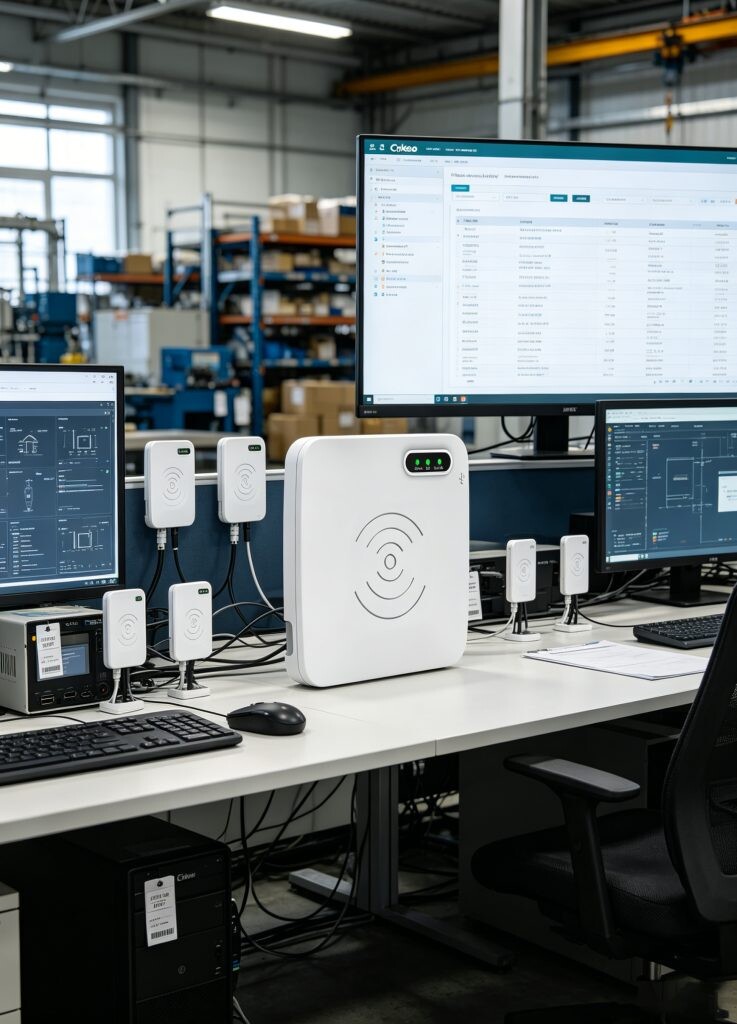
RFID Controller: How Does an RFID Controller Improve System Performance and Automation?
RFID Access Control System Management
Secure Entry and Authentication
Access control is one of the most common RFID controller applications.
Rather than simply reading a credential, the controller determines:
- Whether the credential is authorized
- Time-based access permissions
- Door unlocking commands
- Alarm activation
- Audit logging
In enterprise deployments, reliability often matters more than raw speed.
One office project I reviewed generated thousands of credential events each morning. Nearly 70% occurred within a short arrival window.
The RFID controller’s filtering and decision-making capabilities prevented duplicate records and unnecessary system load.
Common Access Control Components
| Component | Function |
| RFID Reader | Reads credentials |
| RFID Controller | Validates and processes events |
| Access Software | Stores permissions |
| Door Lock | Executes authorization |
| Alarm System | Handles violations |
FAQ
What does an RFID controller do?
An RFID controller manages RFID readers, processes tag data, filters duplicate reads, triggers actions, and communicates with software systems.
Can one RFID controller manage multiple readers?
Yes. Industrial RFID controllers commonly support multiple readers and antennas simultaneously.
Is an RFID controller required for access control?
For enterprise-grade access systems, yes. The controller validates credentials, manages permissions, and executes security rules.
What industries use RFID controllers?
Manufacturing, logistics, healthcare, libraries, archives, retail, transportation, government facilities, and enterprise security environments.
How does a Cykeo RFID controller improve system reliability?
Cykeo RFID controller solutions provide centralized device management, real-time event processing, stable communications, and scalable integration with business software platforms.
Author Expertise
This article was reviewed by the Cykeo RFID Engineering Team, which has participated in RFID deployments involving manufacturing automation, warehouse visibility, asset management, access control, and industrial IoT integration projects. The insights presented are based on practical deployment observations and industry standards rather than theoretical specifications alone.
The right RFID controller does more than connect hardware. It transforms RFID data into operational decisions, making the entire RFID ecosystem more reliable, scalable, and valuable. For modern automation projects, an RFID controller remains one of the most critical components in the infrastructure.


