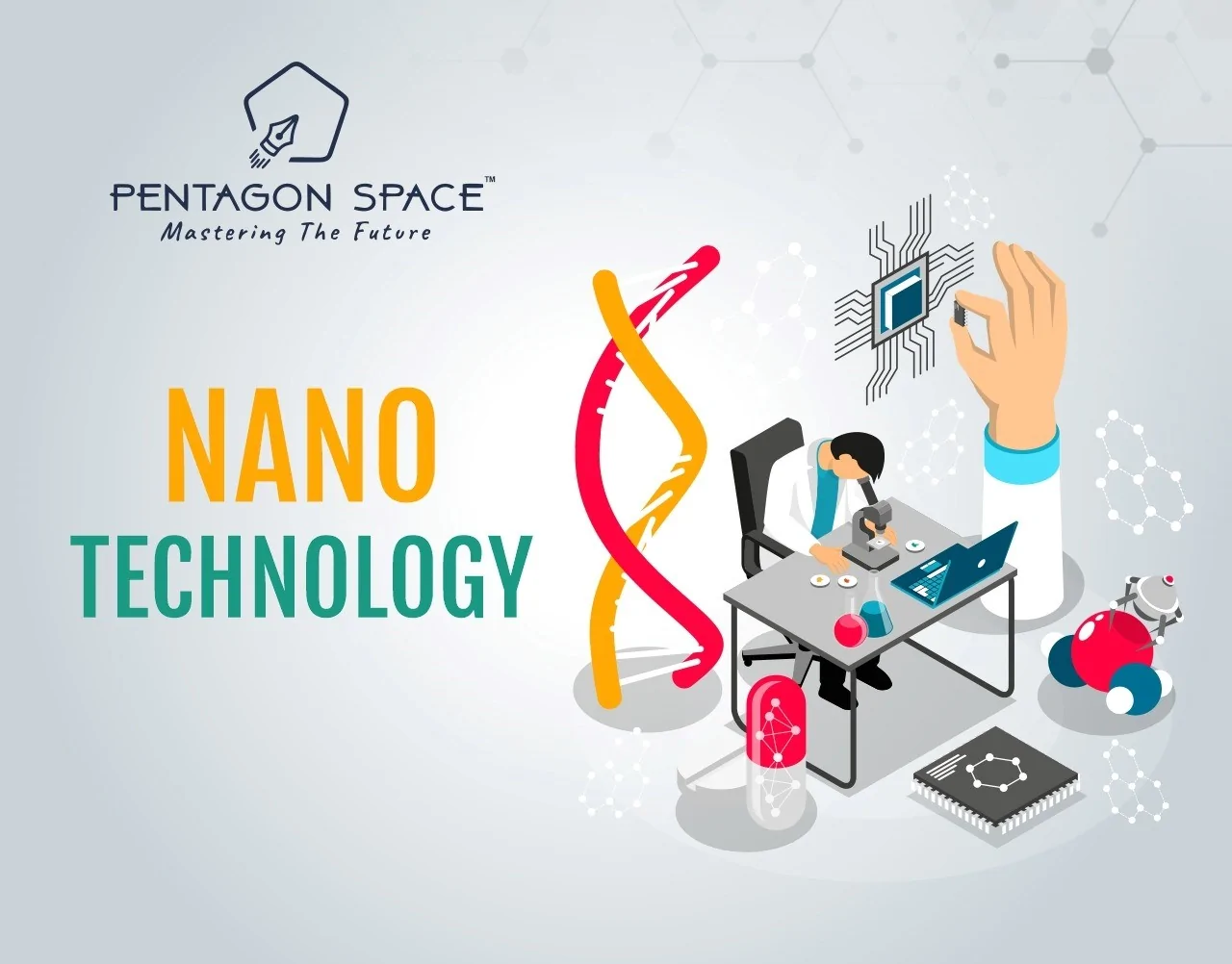
Nanotechnology – The high-tech revolution
Introduction
Nanotechnology refers to the field of innovation and research concerned with building materials and devices. The building process takes place on the scale of atoms and molecules. It is defined as an industrial process used in the atomic, molecular, and supramolecular scales. A Nano meter is a one-billionth of a meter, and it is 10 times the diameter of a hydrogen atom. Nanotechnology is referred to as manipulating atoms and molecules for the fabrication of macroscale products. This also is referred to as molecular nanotechnology.
History
Nanotechnology was first discussed in the year 1959 by a physicist named Richard Feynman. However, the word nanotechnology was first used by Norio Taniguchi in the year 1974.
The emergence of nanotechnology fully took over only in the 1980s when conceptual frameworks were developed, and experiments were conducted. The first breakthrough of nanotechnology was when a scanning tunneling microscope was invented for the high visualization of individual atoms and bonds, and it was also used to manipulate atoms and bonds successfully.
The second breakthrough was when fullerene was invented in 1985 by Harry Kroto and others. It was used to work with carbon nanotubes.
Nanotechnology flourished in the mid-2000s, successfully manipulating atoms and bonds. It and many projects regarding nanotech emerged. The government of the U.S. also provided funding for the National Nano technology Initiative.
Why does nanotechnology matter?
In the physical and chemical materials, unusual nanoscale materials are found. They differ in properties and can affect the material as a whole. The materials change significantly because of these nanoparticles. These Nano sized particles often bond together and become bulky products that are stronger for the whole original material to hold by itself. Nano technology understands these changes and provides solutions to deal with them.
The first dramatic and extraordinary demonstration of nano technology came in the 1990s when a team of IBM physicists spelled out the letters ‘IMB’ using 35 individual xenon atoms. They also developed an atomic switch, which was used for computing.
How can nanotechnology change the world?
Nanotechnology is widely used in engineering, modern science, and technology. Nano technology is growing immensely. Mainstream technology is one thing, but nanotechnology is a whole other thing. There are more engineers now working primarily on expanding the product at the nano level. Changing a product or modifying a product at the nano level can bring enormous, beautiful, and dangerous change to the whole creation.
Few ways that nanotechnology is changing the world:
- Through nanotechnology, people are getting access to more functional and accurate equipment.
- Now, all modern nanomaterial surfaces are used for producing modern implants in the medical field.
- Nanotechnology is producing more powerful computers that consume less power.
- Because of carbon nanotubes, modern computers have long-lasting batteries and circuits.
- Through nanotechnology, sensors have been invented, which has opened the possibility of using sensors in difficult and dangerous places and scenarios to measure the intensity of destruction like earthquakes.
- Through nano technology, computers, screens, phones have been made water-resistant and have the technology of self-cleaning.
- Using nanotechnology in bioengineering has aimed bioengineering in enzymes. It has enabled the conversion of cellulose from wood chips.
- These cellulosic nanomaterials have been proven for potential application in the industrial sector.
- Nanoengineering has evolved the tech world by providing long-lasting batteries, high power rechargeable batteries,
- Nanotechnology has enabled lubricants and engine oils to reduce wear and tear significantly.
- Through nanotechnology, transmitters and basic switches have become smaller.
- Computers are now using (MRAM) Magnetic Random Access Memory to boot instantly.
- Through nano technology, ultra-high-definition displays are available on screens.
- Nano technology has also made electronics items bendable, stretchable, foldable, and rollable.
- Through nanotechnology smartphone shave thumb drives now.

How to become a Nanotech?
- To become a nanotechnologist one has to first complete their 12th board’s Examination in the science stream focusing on Physical, Chemistry and Mathematics also pass the board examination with more than 50% of marks.
- The aspirant must join bachelor’s degree in nanotechnology, B.Tech with nanotech as specialization.
- The aspirant then should acquire a Master’s degree in M.Tech or M.Sc in nanotechnology.
Colleges that offer Nano Technology in India
- Bharathiar University in Coimbatore
- Madras University in Chennai
- R.M University in Kanchipuram
- Jawaharlal Nehru Centre for Advanced Scientific Research – Bangalore
What is the job of a nanotech?
The job of a nanotech is to design and build and manufacture microscopic nanomaterials and electronic circuits.
Career opportunities of a nanotech
A skilled nanotech can be hired by private companies or public sectors, but a fresher usually starts with the private sector then applies to public sector jobs.
Salary of a nanotech
A nanotechnologist’s salary ranges from 40000-700000 per month depending upon their experience and skills.
Conclusion
Nanotechnology is rapidly growing because of the quick expansion and evolution of the digital world. Everyone uses some sort of technology now, and technology has to be highly user-friendly and affordable; made possible by nanotechnology. Working as a not tech is challenging because it requires utmost amount of creativity and extra care as the work is on the micro-level but, in the macro level, the result is marvelous. Now phones are always listening to humans, and it captures voices; made possible by nano technology.
The most prominent example is Alexa by Amazon, a device that listens to the user’s voice and replies like a human, and even follows commands. Nanotechnology needs both back end and front end work, but it the high tech revolution that is changing the world immensely. And, within no time, nanotechnology is going to be the center of the technological world.


